Supply Chains and Pakistan Industrial Marginalisation

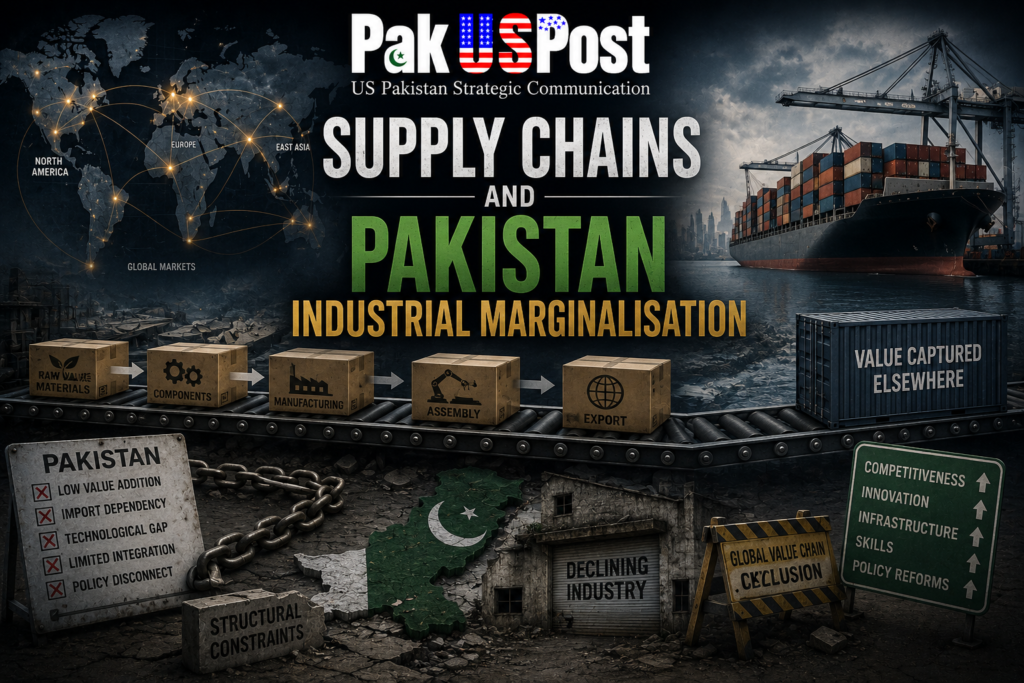
The reconfiguration of global supply chains in the aftermath of intensifying US China strategic rivalry has been widely interpreted as one of the most consequential structural shifts in the international political economy since the end of the Cold War. The discourse of de risked globalization, friend shoring, and nearshoring has gained traction in policy circles in Washington, Brussels, and select East Asian capitals, where resilience is increasingly privileged over efficiency as the organising principle of production networks. In theory, such a transformation should have opened significant industrial space for mid tier developing economies positioned outside the core geopolitical fault lines. Pakistan, given its geographical proximity to China, its historical ties with Western markets, and its strategic location along emerging connectivity corridors, appeared to possess a potentially advantageous structural position in this new cartography of global production. Yet the empirical reality reflects a striking absence of meaningful integration into redistributed supply chains, revealing deep seated structural constraints that extend far beyond episodic policy failures.
The contemporary global supply chain environment is no longer defined solely by cost arbitrage. Instead, it is increasingly shaped by a complex matrix of geopolitical alignment, regulatory compatibility, technological readiness, infrastructure reliability, and institutional predictability. Countries that have successfully captured relocated manufacturing capacity, such as Vietnam, Mexico, and to some extent India, have done so not merely by offering lower labour costs but by embedding themselves within stable policy regimes, export oriented industrial strategies, and credible investment environments. Pakistan’s marginal position within this evolving hierarchy reflects its inability to consistently meet these multidimensional criteria, despite episodic attempts at industrial revitalisation.
A central structural constraint lies in Pakistan’s narrow export base, which remains heavily concentrated in low value textile production. While textiles continue to provide critical foreign exchange earnings, their dominance has inhibited diversification into higher value segments such as electronics, precision manufacturing, automotive components, and intermediate industrial goods. In a global environment where supply chain relocation is driven by technological sophistication and value chain integration rather than simple labour cost minimisation, this structural limitation significantly reduces Pakistan’s attractiveness as a relocation destination. The absence of sustained investment in research and development, industrial upgrading, and technology transfer mechanisms further compounds this constraint.
Energy insecurity represents another critical bottleneck. Global manufacturing relocation decisions are increasingly sensitive to energy reliability, cost predictability, and grid stability. Frequent energy shortages, price volatility, and infrastructure inefficiencies in Pakistan introduce a level of operational uncertainty that significantly elevates production risk for potential investors. Even where labour costs are competitive, such systemic inefficiencies erode comparative advantage by increasing effective production costs and reducing supply chain reliability. Without structural reform in energy governance, Pakistan’s industrial landscape remains misaligned with the requirements of contemporary global manufacturing ecosystems.
Regulatory unpredictability further undermines investor confidence. Frequent policy shifts, complex taxation regimes, administrative fragmentation, and inconsistent enforcement of commercial regulations contribute to an environment characterised by uncertainty rather than stability. In contrast, successful supply chain recipients have invested heavily in regulatory streamlining, export facilitation, and institutional coherence, thereby reducing transaction costs for multinational corporations seeking relocation options. Pakistan’s failure to institutionalise similar reforms has limited its ability to position itself as a credible node within global production networks.
The geopolitical dimension adds another layer of complexity. While Pakistan’s close relationship with China through large scale infrastructure and connectivity initiatives has provided certain infrastructural foundations, it has not automatically translated into integration within Chinese or Western supply chain diversification strategies. Instead, global firms often assess supply chain relocation through the prism of geopolitical neutrality and market accessibility. Pakistan’s perceived entanglement in regional strategic rivalries may inadvertently constrain its attractiveness to firms seeking politically stable production environments. This illustrates how geopolitical perception, even when not grounded in direct policy restrictions, can influence investment geography.
At the same time, global supply chain fragmentation is creating unprecedented opportunities for economies capable of aligning domestic industrial policy with external demand shifts. The relocation of labour intensive manufacturing away from China, driven by rising wages and geopolitical recalibration, has created openings in sectors such as apparel, light engineering, and assembly based electronics. However, capturing these opportunities requires more than passive openness. It demands active industrial policy, targeted export incentives, infrastructure modernization, and strategic coordination between state and private sector actors. Pakistan’s policy environment has yet to fully operationalise such a coordinated industrial strategy.
The institutional architecture of industrial policy in Pakistan remains fragmented, with limited coherence between federal economic planning, provincial industrial development, and private sector engagement. This fragmentation reduces the state’s capacity to strategically position itself within global value chains. In contrast, countries that have successfully integrated into supply chain networks have demonstrated strong state capacity in coordinating export promotion agencies, industrial zones, skill development programmes, and foreign investment facilitation mechanisms. The absence of such integrated governance structures in Pakistan limits its ability to translate potential into actual industrial absorption.
Human capital constraints further exacerbate the problem. The transition from low value production to higher value manufacturing requires a skilled workforce capable of operating within technologically intensive environments. Pakistan’s education and vocational training systems have not yet achieved the level of alignment necessary to support such a transition at scale. Without significant investment in technical education, digital skills, and industrial training, the country risks remaining locked in low productivity segments of global production networks.
The broader global narrative of supply chain resilience also emphasises environmental sustainability and carbon efficiency. Increasingly, multinational corporations are integrating environmental criteria into their sourcing decisions. Pakistan’s industrial base, which is still heavily reliant on inefficient energy consumption patterns and limited environmental compliance mechanisms, faces additional barriers in meeting these emerging standards. This further reduces its competitiveness in an evolving global production landscape that is increasingly shaped by green transition imperatives.
Policy makers in Pakistan therefore face a critical strategic inflection point. The current trajectory, characterised by incremental reforms and fragmented industrial initiatives, is insufficient to reposition the country within restructured global supply chains. What is required is a comprehensive industrial transformation strategy that integrates export diversification, energy reform, regulatory simplification, and human capital development into a coherent national framework. Such a strategy must be forward looking, aligning domestic production capabilities with emerging global demand patterns rather than historical export structures.
Equally important is the need to redefine Pakistan’s engagement with global economic diplomacy. Supply chain integration is no longer purely an economic issue but a matter of strategic positioning within global production networks. Active participation in regional trade agreements, bilateral investment treaties, and multilateral economic platforms is essential to enhance visibility and credibility within global investor networks. Without such proactive engagement, Pakistan risks remaining on the periphery of a rapidly restructured global economy.
Ultimately, the failure to capitalise on supply chain fragmentation is not merely a missed economic opportunity but a structural signal of deeper institutional inertia. The global economy is undergoing a historic redistribution of production, yet the benefits of this transformation will accrue only to those economies capable of internalising flexibility, stability, and strategic coherence. For Pakistan, the challenge is not simply to attract investment, but to fundamentally reconfigure its industrial ecosystem in a manner that aligns with the logic of twenty first century global production.
In the absence of such transformation, Pakistan risks reinforcing a paradoxical position within global economic geography, simultaneously proximate to emerging supply chain corridors yet structurally excluded from their material benefits. The cost of this exclusion will not merely be measured in lost investment, but in the long term entrenchment of industrial stagnation within an increasingly dynamic global economy.
A Public Service Message