
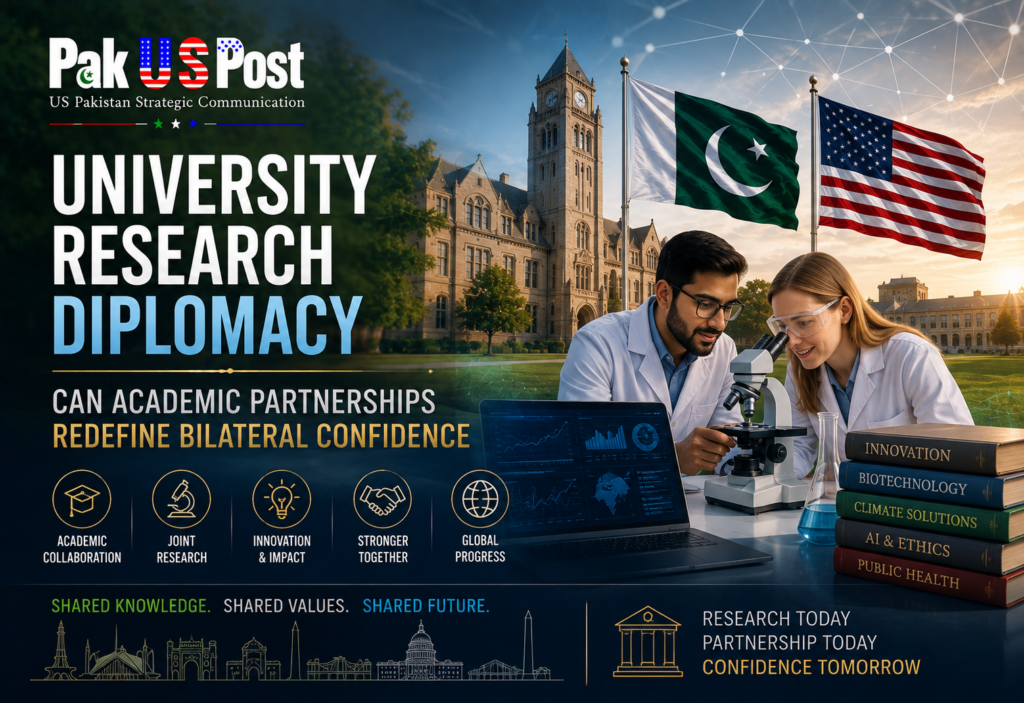
University Research Diplomacy Can Academic Partnerships Redefine Bilateral Confidence

For decades, Pakistan and the United States have measured their bilateral relationship through the fluctuating indicators of security cooperation, military assistance, counterterrorism coordination, crisis management and geopolitical necessity. Every strategic cycle has produced renewed engagement followed by institutional disappointment as changing regional priorities repeatedly altered diplomatic calculations. Such a pattern has generated an inherently transactional relationship in which strategic urgency often outweighed societal connectivity. Yet contemporary international relations increasingly demonstrate that enduring partnerships are rarely sustained through governmental dialogue alone. They are reinforced by intellectual networks, scientific cooperation, technological innovation and educational exchanges that gradually construct institutional confidence independent of political turbulence. Within this evolving landscape, university research diplomacy represents one of the least exploited yet potentially most transformative dimensions of Pakistan–United States engagement.
Knowledge has become an instrument of statecraft. Universities no longer function merely as educational institutions producing graduates for domestic economies. They increasingly operate as strategic platforms connecting governments, industries, laboratories, private capital and international organizations. Research partnerships influence technological competitiveness, innovation capacity, industrial modernization and regulatory development. Countries capable of integrating academic ecosystems into foreign policy frequently develop relationships that survive electoral transitions, diplomatic disagreements and temporary geopolitical realignments. Academic diplomacy therefore possesses a stabilizing influence unavailable to conventional diplomatic channels because it is sustained through institutional continuity rather than political immediacy.
The United States has long recognized universities as extensions of national influence. American higher education institutions attract international researchers, produce globally recognized scientific discoveries and establish collaborative networks spanning every continent. These networks contribute not only to scientific advancement but also to strategic relationships that shape international perceptions, policy thinking and technological partnerships. Nations engaging consistently with American academic institutions often experience wider integration into global innovation ecosystems, venture capital networks, advanced manufacturing supply chains and regulatory cooperation.
Pakistan possesses significant human capital capable of participating in these global research networks. Its universities produce thousands of graduates annually in engineering, medicine, agriculture, environmental sciences, computer science and public policy. Pakistani researchers increasingly publish within internationally indexed journals while several institutions have improved research output despite financial constraints. However, research productivity alone does not automatically translate into international influence. Institutional collaboration requires stable funding mechanisms, administrative flexibility, regulatory confidence, mutual recognition frameworks and sustained diplomatic commitment. Without these structural foundations, scientific capability remains isolated rather than internationally integrated.
The strategic rationale for expanding Pakistan–United States university cooperation extends beyond educational benefits. Scientific collaboration generates institutional familiarity. Researchers working together establish professional trust that often evolves into broader policy engagement. Joint laboratories produce shared intellectual property. Collaborative publications enhance international credibility. Faculty exchanges introduce comparative governance perspectives. Graduate mobility strengthens professional networks that continue influencing bilateral understanding decades after formal academic programs conclude. These cumulative interactions gradually construct intellectual infrastructure supporting diplomatic resilience.
Knowledge diplomacy has become increasingly important because emerging global challenges transcend traditional geopolitical boundaries. Climate adaptation, food security, pandemic preparedness, artificial intelligence governance, quantum computing, biotechnology regulation, cybersecurity, renewable energy and water management require multinational scientific cooperation. No single nation possesses sufficient expertise to address these complex challenges independently. Collaborative research therefore serves both developmental objectives and strategic interests simultaneously.
Pakistan faces substantial environmental vulnerabilities including glacier retreat, water stress, agricultural volatility and urban climate risks. American universities possess extensive expertise in environmental modelling, satellite observation, climate forecasting and resilience planning. Joint research initiatives could significantly enhance Pakistan’s institutional capacity for evidence based climate adaptation while simultaneously creating long term scientific partnerships extending across governmental administrations. Such collaboration transforms environmental cooperation into strategic confidence building.
Health innovation offers another equally promising avenue. The COVID-19 pandemic demonstrated the necessity of internationally connected research institutions capable of rapid scientific cooperation. Vaccine development, genomic surveillance, epidemiological modelling and public health management increasingly depend upon cross border scientific networks. Pakistani medical universities possess growing research capabilities while American institutions remain global leaders in biomedical innovation. Expanding collaborative health research would strengthen Pakistan’s healthcare resilience while deepening bilateral scientific engagement beyond conventional aid frameworks.
Technology cooperation represents perhaps the most strategically consequential domain. Artificial intelligence, semiconductor design, advanced materials, robotics, digital governance and cybersecurity increasingly define national competitiveness. Universities serve as primary incubators for these technologies before commercialization occurs through private industry. Pakistan’s youthful demographic profile offers considerable potential within digital innovation sectors, yet commercialization remains constrained by fragmented research funding, limited venture capital integration and insufficient university industry collaboration.
American research universities maintain extensive innovation ecosystems connecting academic laboratories with technology companies, investors and public agencies. Carefully structured research partnerships could provide Pakistani institutions with greater exposure to commercialization models, intellectual property management, technology transfer mechanisms and startup incubation practices. Such cooperation would contribute to Pakistan’s technological modernization while generating mutually beneficial research opportunities.
Agricultural research deserves equal strategic attention. Pakistan’s economy remains significantly dependent upon agriculture while climate variability increasingly threatens productivity. American universities have historically pioneered research concerning drought resistant crops, precision agriculture, biotechnology and water efficient cultivation systems. Collaborative agricultural science initiatives could improve Pakistan’s food security while strengthening broader scientific partnerships across rural development institutions.
Faculty mobility constitutes another indispensable pillar of research diplomacy. Academic exchanges facilitate more than temporary educational experiences. Visiting scholars establish professional relationships, initiate collaborative publications, supervise joint doctoral research and frequently develop institutional partnerships lasting decades. Faculty returning from international assignments often introduce improved teaching methodologies, research management practices and interdisciplinary collaboration models. These cumulative institutional improvements gradually elevate national research capacity.
Student mobility produces equally significant long term diplomatic effects. Alumni educated abroad frequently become policymakers, entrepreneurs, researchers and institutional leaders. Their professional familiarity with international academic environments enhances future cooperation while reducing institutional misunderstandings. Throughout history, educational exchange programs have consistently generated diplomatic goodwill exceeding their immediate academic objectives. Nations investing in international education frequently cultivate generations of decision makers possessing personal familiarity with partner countries.
Despite these opportunities, structural barriers continue restricting Pakistan–United States academic cooperation. Bureaucratic complexity remains one of the most persistent obstacles. Lengthy administrative procedures governing international research agreements, procurement regulations, financial transfers and institutional approvals discourage collaborative initiatives requiring operational flexibility. Scientific research frequently advances more rapidly than administrative systems designed decades earlier. Modern research diplomacy therefore requires governance structures capable of facilitating rather than delaying international cooperation.
Visa uncertainty represents another significant challenge. Faculty members, doctoral candidates and researchers often encounter unpredictable mobility constraints affecting conference participation, laboratory access and collaborative fieldwork. Scientific partnerships depend upon reliable physical interaction despite advances in digital communication. Research requiring laboratory experimentation, archival investigation or specialized equipment cannot always be conducted remotely. Improving academic mobility therefore directly influences research productivity.
Funding sustainability also limits collaboration. Numerous bilateral academic initiatives begin with considerable enthusiasm but gradually weaken because financial commitments remain project specific rather than institutionally embedded. Research diplomacy requires predictable multi year investment supporting laboratories, fellowships, doctoral scholarships, equipment modernization and collaborative publications. Sporadic funding rarely produces durable institutional relationships.
Institutional asymmetry presents additional complications. American universities generally possess larger research budgets, stronger commercialization infrastructure and greater access to international grant mechanisms. Pakistani institutions frequently operate under tighter financial constraints while managing larger teaching responsibilities. Effective collaboration therefore requires partnership models recognizing institutional differences without creating dependency. Mutual benefit should remain the organizing principle rather than donor recipient dynamics.
Research governance requires modernization as well. International collaboration increasingly involves intellectual property protection, cybersecurity protocols, ethical review mechanisms, data governance standards and technology export regulations. Universities unable to demonstrate internationally credible governance frameworks may encounter difficulties attracting advanced scientific partnerships involving sensitive technologies. Strengthening research integrity systems therefore constitutes both an academic necessity and a strategic imperative.
Political volatility periodically interrupts educational cooperation. Bilateral tensions arising from broader geopolitical developments often influence academic exchanges despite universities remaining largely independent of governmental disputes. Such interruptions undermine long term institutional planning and discourage sustained investment. Research diplomacy should therefore be insulated wherever possible from temporary political fluctuations through legally established frameworks ensuring continuity.
Pakistan must simultaneously address domestic challenges affecting university competitiveness. Research expenditure remains comparatively limited relative to national requirements. Laboratory infrastructure varies considerably across institutions. Doctoral supervision capacity requires expansion in several disciplines. Industry university collaboration remains insufficiently institutionalized. These domestic reforms are prerequisites for maximizing benefits derived from international partnerships because external collaboration cannot substitute for internal institutional development.
The private sector should become an active participant within research diplomacy. Innovation increasingly emerges through interaction among universities, technology firms, investors and government agencies rather than isolated academic departments. Pakistani technology companies, pharmaceutical industries, agricultural enterprises and engineering firms should participate alongside universities within collaborative initiatives involving American counterparts. Such triangular cooperation accelerates commercialization while enhancing practical policy relevance.
Diaspora engagement represents another underutilized strategic resource. Thousands of Pakistani origin academics, physicians, engineers and scientists occupy influential positions within American universities and research institutions. They possess deep understanding of both educational systems and frequently maintain professional interest in supporting Pakistani institutions. Structured diaspora research platforms could significantly expand collaborative opportunities while reducing institutional unfamiliarity.
Digital transformation further broadens possibilities. Advances in cloud computing, artificial intelligence assisted research, virtual laboratories and high performance computing increasingly enable distributed scientific collaboration. Pakistani universities investing strategically in digital research infrastructure could participate more effectively within international scientific networks despite geographical distance. Digital research diplomacy complements rather than replaces physical exchanges by expanding everyday collaboration.
Policy studies constitute another promising domain. Pakistan and the United States confront shared questions concerning digital governance, urbanization, disaster management, public finance, energy transition, institutional reform and demographic transformation. Joint policy research centres could produce evidence informing governmental decision making while simultaneously strengthening academic engagement. Such institutions would encourage comparative analysis grounded in empirical research rather than ideological assumptions.
Maritime studies, space policy, cyber governance and critical infrastructure resilience also deserve expanded academic attention. Strategic competition increasingly encompasses technological domains requiring interdisciplinary expertise extending beyond military institutions. Universities provide neutral environments where technical research, legal analysis and policy development intersect. Carefully designed cooperation within non sensitive areas strengthens mutual understanding while supporting national capability development.
The establishment in Pakistan should increasingly recognize universities as contributors to comprehensive national security rather than solely educational entities. Modern strategic competition depends upon technological superiority, innovation ecosystems, scientific literacy and institutional adaptability. Academic research contributes directly to defence industrial modernization, cyber resilience, public health preparedness, environmental security and economic competitiveness. Research diplomacy therefore complements rather than competes with traditional security priorities.
Likewise, American policymakers seeking sustainable engagement with Pakistan should appreciate that educational partnerships often generate longer lasting influence than episodic strategic initiatives. Military cooperation responds to immediate security requirements, whereas academic cooperation shapes future generations of researchers, administrators and policymakers. Investment in intellectual connectivity yields cumulative returns extending far beyond conventional diplomatic timelines.
A comprehensive Pakistan–United States Research Diplomacy Framework would therefore integrate multiple mutually reinforcing components. Bilateral research funds should support competitive collaborative projects addressing climate resilience, artificial intelligence, biotechnology, agriculture, cybersecurity and renewable energy. Joint doctoral fellowships should encourage long term scientific partnerships. University innovation centres should facilitate commercialization of collaborative research. Faculty exchange programs should emphasize institutional capacity building rather than symbolic visits. Digital research platforms should connect laboratories through secure collaborative infrastructure. Regular strategic science dialogues should involve universities alongside policymakers and industry representatives.
Quality assurance mechanisms require equal attention. Collaborative projects should prioritize measurable research outcomes including publications, patents, technology commercialization, policy implementation, graduate supervision and institutional partnerships. Transparent evaluation frameworks enhance accountability while encouraging continuous improvement. Research diplomacy should be assessed according to strategic impact rather than merely counting exchange participants.
Provincial universities should receive greater inclusion within international partnerships instead of concentrating opportunities exclusively among major metropolitan institutions. Broader institutional participation strengthens national research capacity while expanding regional innovation ecosystems. Inclusive academic diplomacy produces wider developmental dividends and reduces institutional concentration.
Public communication also matters. Successful collaborative research should be communicated through credible scientific outreach demonstrating tangible societal benefits. Citizens observing improvements in healthcare, agriculture, environmental management or technological innovation resulting from international research partnerships are more likely to support sustained academic engagement. Research diplomacy ultimately derives legitimacy from practical public outcomes.
The future trajectory of Pakistan–United States relations will increasingly depend upon sectors capable of generating enduring institutional trust independent of immediate geopolitical circumstances. Universities occupy precisely such a position because they cultivate knowledge rather than political expediency, innovation rather than temporary alignment and professional networks rather than transactional bargaining. Scientific cooperation gradually transforms perceptions through repeated collaboration grounded in measurable achievement.
History suggests that durable international partnerships emerge when societies become intellectually interconnected alongside diplomatic engagement. Laboratories, research centres, classrooms and innovation hubs quietly produce relationships often more resilient than formal agreements negotiated during periods of strategic urgency. Pakistan possesses sufficient intellectual capital to participate meaningfully within this evolving architecture provided institutional reforms accompany diplomatic ambition.
University research diplomacy should therefore be viewed neither as educational symbolism nor as peripheral foreign policy. It constitutes strategic infrastructure supporting technological advancement, economic modernization, national resilience and bilateral confidence simultaneously. If both Islamabad and Washington choose to invest consistently in shared scientific futures rather than episodic political necessities, academic collaboration may ultimately become the most enduring pillar of Pakistan–United States relations, strengthening not only bilateral understanding but also the broader capacity of both nations to navigate an increasingly knowledge driven international order.
A Public Service Message