
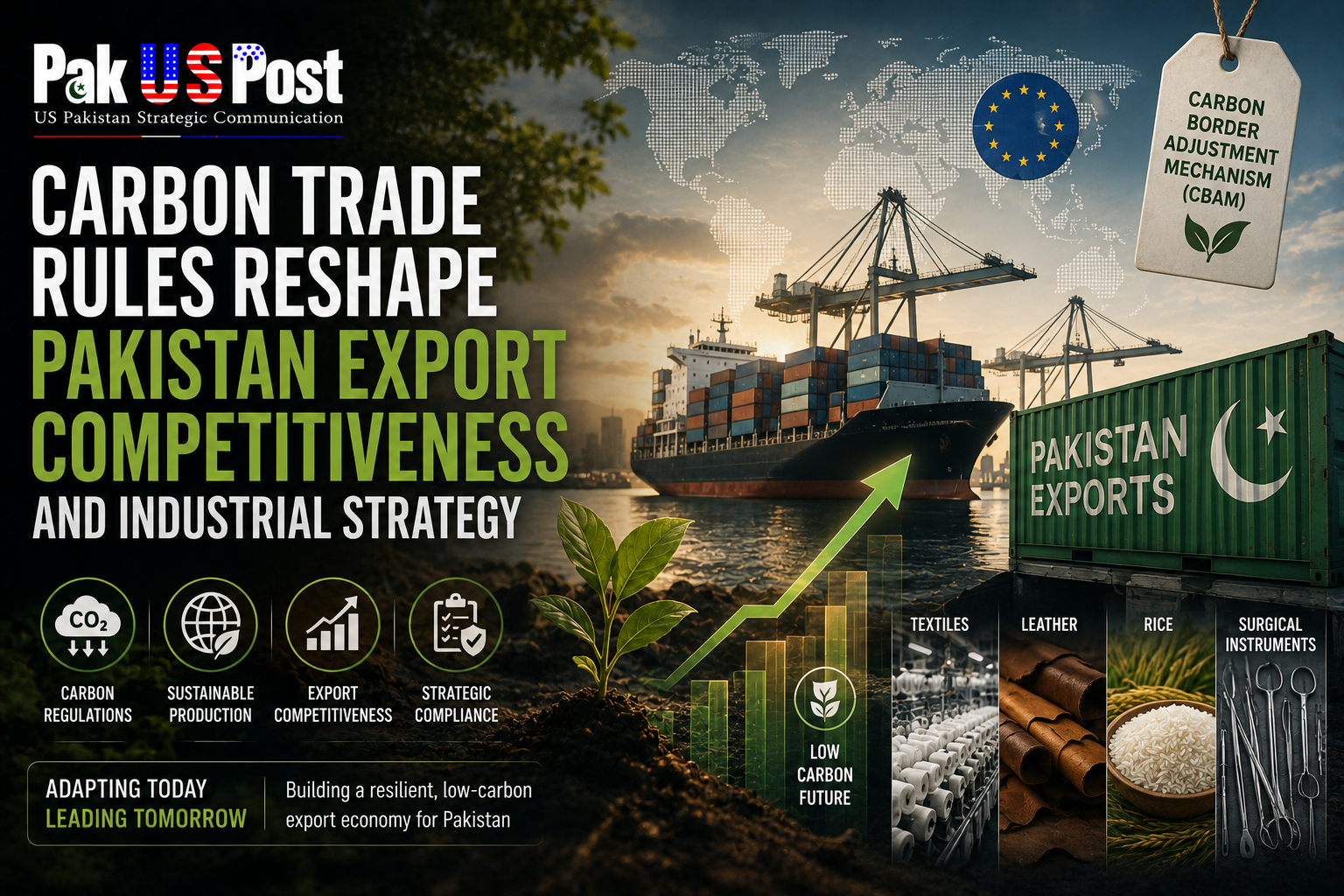
Carbon Trade Rules Reshape Pakistan Export Competitiveness and Industrial Strategy

Climate policy is no longer confined to environmental ministries, international conferences or sustainability declarations. It has entered customs administration, industrial regulation, financial disclosure and international trade policy with unprecedented force. The commercial geography of global exports is increasingly being determined not only by

American Semiconductor Controls And Pakistan’s Technological Future
The semiconductor has become the defining strategic commodity of the twenty first century. Earlier eras measured national influence through access to energy reserves, industrial production or military hardware. Contemporary competition increasingly revolves around computational capability, advanced chip fabrication, artificial intelligence accelerators and the

Pak US Digital Dollar Finance Reshapes Global Trade Settlement
Pak US financial engagement is entering a phase where the contest over trade, investment and strategic influence increasingly extends beyond tariffs, banking relationships and reserve currencies into programmable financial infrastructure. Washington is no longer approaching monetary innovation merely as a technological experiment. It

Friend Shoring And Industrial Relocation: Can Pakistan Capture Manufacturing Leaving East Asia?
The restructuring of global manufacturing is no longer driven solely by labour costs or production efficiency. It is increasingly shaped by strategic resilience, geopolitical alignment, technological security and supply chain reliability. The United States has gradually shifted from pursuing the lowest cost globalisation

Pakistan US Investment Needs a Disciplined Project Conversion Architecture
Pak US Post must treat the investment relationship with Washington as a problem of conversion rather than courtship. Pakistan has rarely suffered from a complete absence of American commercial interest. The United States remains one of Pakistan’s largest sources of foreign direct investment,

Pakistan’s Digital Export Gap Is Now a Strategic Liability
Pak US POST confronts a paradox that is increasingly consequential for Pakistan’s economic security: the country possesses a large and youthful technology workforce, yet remains marginal in the higher strata of the American digital services market where intellectual property, recurring contracts, regulatory assurance

Pakistan Must Convert Mineral Endowment Into Industrial Leverage
Pak US Post enters the critical minerals question at an unusually consequential juncture, when Washington is treating mineral security less as a conventional commodities issue than as an extension of national security, defence preparedness, advanced manufacturing and supply chain resilience. The United States

Pakistan Must Turn Tariff Relief Into Export Competitiveness
Pak US Post must treat the current tariff dialogue with Washington not as a narrow exercise in reducing an import duty, but as an opportunity to redesign Pakistan’s commercial position in the American market. The distinction is consequential. The United States is already

Artificial Intelligence Data Infrastructure Shapes Future Digital Economic Sovereignty
Artificial intelligence is steadily transforming from an enabling technology into the central infrastructure of economic power. The strategic contest is no longer defined only by access to advanced software or consumer applications. It increasingly revolves around who owns computational capacity, who governs digital

Financial Compliance Ecosystems Shape Strategic National Economic Credibility
Financial influence in the twenty first century is increasingly determined not only by economic production, fiscal discipline, industrial competitiveness, or trade performance, but also by the credibility of regulatory systems that govern financial behaviour. Capital today moves through a complex architecture of compliance