
Credibility In An Accelerated Post Truth Media Order


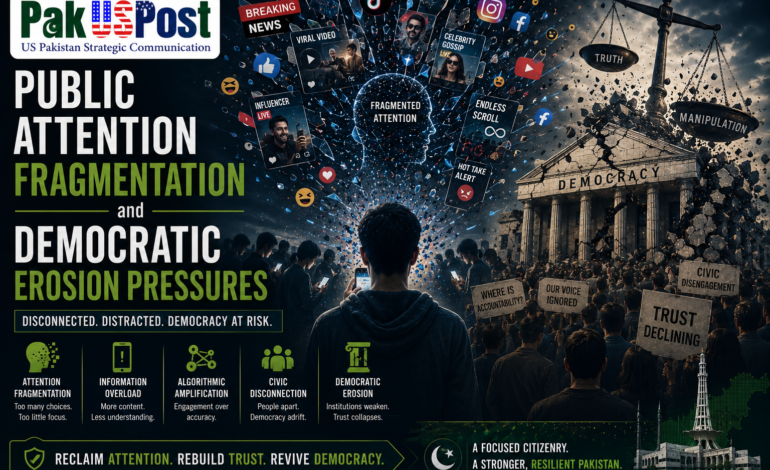
The question of whether traditional journalism can survive in an era where virality displaces verification has ceased to be speculative and now operates as a structural concern within global information systems. In Pakistan’s media ecology, this tension is not merely theoretical but operational, manifesting daily in newsroom decision making, editorial prioritisation, and the competitive pressures exerted by platform driven visibility economies. Journalism, once anchored in the authority of verification cycles and institutional reputation, now finds itself embedded within an environment where speed is not just an advantage but a determinant of relevance, and where delay is frequently interpreted as informational failure rather than methodological rigor.
This inversion of epistemic hierarchy has altered the foundational grammar of news production. In earlier configurations, credibility was accumulated through process transparency, editorial oversight, and the ability to withstand temporal scrutiny. In the contemporary environment, credibility is often externally assigned by algorithmic amplification systems that reward immediacy, emotional resonance, and network transmissibility. The consequence is a systemic disjunction between what is true and what is visible, between what is verified and what circulates, and between what is institutionally validated and what is socially amplified.
Within Pakistan, these dynamics intersect with a media economy shaped by advertising dependency, political sensitivity, and uneven regulatory enforcement. Traditional news organisations operate under dual pressures. On one side, they are expected to uphold standards of verification, balance, and procedural accuracy. On the other, they are compelled to participate in accelerated content cycles dictated by digital platforms that reward continuous output rather than analytical depth. This duality produces a form of institutional strain in which editorial judgment is increasingly subordinated to metrics of engagement.
The survival of journalism under such conditions cannot be understood as a binary outcome of success or failure. Instead, it is better conceptualised as a process of adaptive transformation in which journalistic institutions continuously renegotiate their epistemic authority within shifting technological infrastructures. The core challenge is not simply to produce accurate information, but to ensure that accuracy remains socially legible in environments saturated with competing narratives, synthetic interpretations, and emotionally optimised content streams.
The rise of virality as an epistemic force has redefined the parameters of public truth formation. Viral content does not necessarily derive its authority from evidentiary strength but from its capacity to propagate rapidly across networked audiences. This propagation is driven by affective intensity, ideological resonance, and algorithmic reinforcement rather than methodological validation. In such a system, verification becomes a secondary attribute, often applied retrospectively if at all, once narratives have already achieved widespread circulation.
The implications for editorial institutions are profound. Journalism is no longer competing solely with other journalism; it is competing with an entire ecosystem of non institutional content production that operates outside conventional standards of verification. Influencers, partisan commentators, automated content systems, and loosely structured digital communities all contribute to a fragmented epistemic field in which authority is decentralised and continuously contested.
In this environment, the concept of post truth does not imply the absence of truth but rather the proliferation of competing truth claims that are evaluated less on evidentiary grounds and more on narrative coherence and emotional plausibility. The result is a media landscape in which factual correction alone is insufficient to reassert credibility. Correction mechanisms are often slower than narrative diffusion, and by the time verification occurs, the informational environment has already moved toward new cycles of attention.
For Pakistan, this dynamic is particularly significant given the centrality of media in shaping public perceptions of governance, security, and economic stability. The erosion of trust in informational intermediaries has direct consequences for institutional legitimacy. When audiences are unable to distinguish between verified reporting and amplified conjecture, the credibility of all information sources becomes subject to generalized skepticism. This creates a condition in which even accurate reporting struggles to achieve authoritative recognition.
Editorial institutions therefore face a strategic imperative that extends beyond content production. They must reimagine their role as architects of epistemic infrastructure rather than mere distributors of information. This involves constructing systems of trust that are resilient to algorithmic distortion, designing formats that integrate verification with narrative accessibility, and developing temporal strategies that allow depth oriented reporting to coexist with accelerated consumption patterns.
One emerging approach involves the integration of layered reporting architectures. In such models, initial rapid reporting is accompanied by progressively deepening analytical layers that evolve as verification processes mature. This allows institutions to participate in real time information cycles without abandoning methodological rigor. However, this requires significant internal restructuring of newsroom workflows and a reallocation of resources toward investigative and analytical capacities.
Another critical dimension is the redefinition of editorial authority in relation to platform ecosystems. Traditional journalism assumed a relatively stable distribution hierarchy in which content flowed from institutions to audiences through predictable channels. This hierarchy has been replaced by decentralised dissemination systems in which platforms act as gatekeepers of visibility rather than distributors of content. Editorial institutions must therefore engage not only with audiences but also with the infrastructural logic of platforms themselves, including recommendation systems, engagement metrics, and algorithmic ranking criteria.
Policy intervention becomes essential at this juncture. Governments and regulatory bodies in Pakistan must recognise that credibility deficits in media systems are not solely the result of journalistic failure but also of structural incentives embedded within digital distribution architectures. Regulatory frameworks should therefore focus on transparency in algorithmic amplification, accountability in content prioritisation, and the establishment of independent oversight mechanisms that can audit platform behaviour without infringing upon expressive freedoms.
At the institutional level, media organisations must also confront internal vulnerabilities that exacerbate credibility erosion. The pressure to maintain continuous output has led in many cases to reduced editorial scrutiny, increased reliance on secondary sources, and a growing dependence on reactive reporting. This accelerates informational churn but weakens the epistemic foundation upon which journalistic authority is built. Reversing this trend requires a deliberate recalibration of newsroom incentives toward verification intensity rather than publication frequency.
Furthermore, the relationship between journalism and audiences must be reconceptualised. In fragmented media environments, audiences are no longer passive recipients but active participants in narrative construction. They interpret, redistribute, and reframe information within their own digital networks. This participatory dynamic does not necessarily undermine journalism, but it does require institutions to engage more directly with interpretive communities rather than assuming unilateral authority over meaning.
The long term sustainability of journalism will depend on its ability to reconstruct credibility as a multi layered construct rather than a singular attribute. Credibility will need to be distributed across verification processes, institutional transparency, methodological clarity, and consistent engagement with audience expectations. It will also require a renewed emphasis on explanatory journalism that prioritises understanding over immediacy, context over fragmentation, and synthesis over episodic reporting.
For policy makers and strategic planners in Pakistan, the implications extend beyond media regulation into the broader architecture of governance communication. In environments where public understanding is mediated through volatile informational systems, policy legitimacy becomes contingent upon communicative clarity and epistemic stability. This necessitates coordinated strategies between state institutions, media organisations, and technology platforms to ensure that governance narratives are not lost within the noise of accelerated information flows.
Ultimately, the survival of journalism in a post verification environment will not be determined by its ability to compete with virality on its own terms, but by its capacity to redefine the terms of credibility itself. This involves a shift from reactive validation to proactive epistemic construction, from isolated reporting to integrated interpretation, and from institutional isolation to infrastructural engagement.
If journalism succeeds in this transformation, it will not merely survive the post truth condition but may emerge as one of the few remaining institutions capable of stabilising meaning within increasingly volatile informational ecosystems. If it fails, the result will not be the disappearance of information, but the dissolution of authoritative interpretation, leaving public discourse permanently suspended in a state of high velocity ambiguity where truth exists but rarely consolidates into shared understanding.
A Public Service Message