Public Attention Fragmentation and Democratic Erosion Pressures


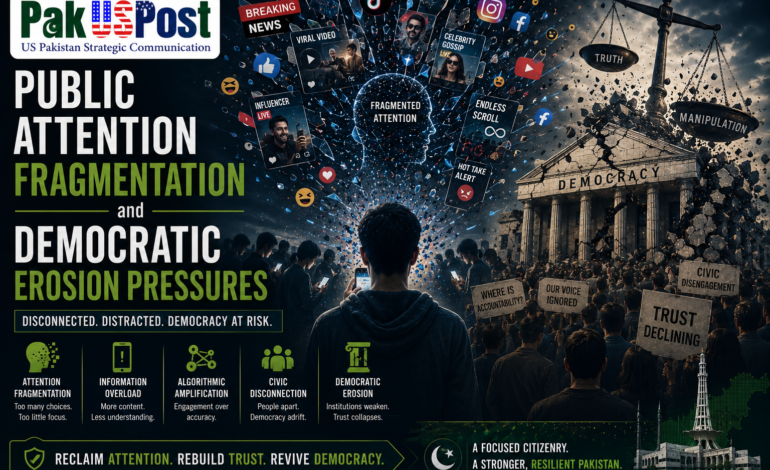
The contemporary information environment in Pakistan is undergoing a structural transformation that is neither linear nor reversible, but cumulative in its effects on democratic cognition, institutional legitimacy, and the coherence of public reasoning. What was once a mediated sphere anchored in editorial judgment, professional verification, and hierarchical gatekeeping has now become an open, continuously mutating attention market in which visibility is allocated not through institutional authority but through algorithmic prioritisation, emotional intensity, and behavioural prediction. The result is not merely a change in media consumption patterns but a deeper reconfiguration of how societies understand truth, relevance, and political significance.
In earlier media systems, journalism functioned as a stabilising intermediary between events and interpretation. It filtered information through professional norms that privileged corroboration, contextual depth, and editorial responsibility. In the current environment, however, this intermediary layer has been progressively weakened. Digital platforms do not merely distribute content; they actively restructure its perceived importance by amplifying material that maximises engagement rather than accuracy. This inversion has produced an attention economy in which informational value is increasingly subordinate to affective velocity.
Within Pakistan, this shift acquires additional complexity due to the coexistence of legacy broadcast structures, politically contested media ownership patterns, and rapidly expanding digital-native audiences. The result is a hybrid informational ecosystem in which contradictory epistemic regimes operate simultaneously. Television news retains institutional formality but increasingly competes with social media streams that privilege immediacy over verification. Meanwhile, audience behaviour reflects a growing preference for condensed narratives that are emotionally legible rather than analytically robust.
The fragmentation of attention has therefore become a structural condition rather than a behavioural anomaly. Public discourse is no longer organised around shared informational reference points but is dispersed across algorithmically curated micro-publics. These micro-publics are internally coherent but externally disconnected, producing parallel interpretive universes in which the same event acquires divergent meanings depending on platform exposure, ideological predisposition, and algorithmic reinforcement patterns.
This fragmentation carries direct implications for democratic accountability. In systems where accountability depends on shared factual baselines, the erosion of epistemic common ground weakens the capacity of citizens to evaluate institutional performance in a consistent manner. Policy literacy, similarly, is undermined when complex governance issues are reduced to episodic viral content that strips away procedural context and compresses structural processes into consumable fragments. The public thus engages with governance not as a continuum of policy trade-offs but as a sequence of isolated emotional triggers.
National cohesion, often presumed to be a function of cultural identity or constitutional structure, is increasingly contingent upon informational synchronisation. When citizens no longer consume overlapping narratives of national significance, the symbolic infrastructure that sustains collective belonging becomes attenuated. In such conditions, cohesion is replaced by episodic alignment, where temporary consensus forms around viral moments but dissolves rapidly once attention shifts elsewhere.
The deeper concern lies in the transformation of attention itself into a commodified resource governed by external optimisation systems. Algorithmic infrastructures are not neutral conduits but active participants in shaping cognitive priorities. They privilege content that maximises retention time and interaction density, often at the expense of nuance and analytical continuity. In doing so, they incentivise communicative styles that are performative, polarised, and structurally simplified.
Within Pakistan’s media environment, this dynamic intersects with pre-existing vulnerabilities. The institutional capacity of journalism has been constrained by economic pressures, advertising dependencies, and uneven regulatory frameworks. These constraints limit the ability of editorial institutions to resist platform-driven incentives. Consequently, even established news organisations increasingly adapt their output to match the temporal rhythms and stylistic demands of digital circulation.
This adaptation, however, comes at a cost. As editorial content becomes optimised for speed and engagement, the distinction between journalism and content production begins to blur. Investigative depth, long-form analysis, and contextual reporting are gradually displaced by reactive commentary cycles. The informational ecosystem thus shifts from structured explanation to perpetual reaction, where meaning is continuously deferred in favour of immediacy.
The implications for governance are significant. Policy processes require a stable informational environment in which complexity can be communicated without distortion. When public discourse becomes fragmented, policy communication loses coherence, and institutional messaging is forced to compete within a noisy, non-hierarchical attention field. This increases the probability of misinterpretation, reduces trust in official narratives, and complicates crisis communication during periods of political or economic volatility.
Moreover, the psychology of attention fragmentation alters citizen expectations of governance itself. When individuals are habituated to rapid content turnover, their tolerance for policy latency diminishes. Structural reforms that require time horizons extending beyond news cycles are often perceived as stagnation or inefficiency. This temporal mismatch between governance and attention economy creates a persistent legitimacy deficit, even in cases where institutional performance may be technically sound.
The emergence of synthetic narratives further intensifies this condition. Digital ecosystems now allow for the rapid circulation of partially accurate, emotionally charged interpretations that are difficult to counter through traditional fact-checking mechanisms. These narratives often achieve dominance not because of evidentiary strength but due to their alignment with pre-existing cognitive biases and platform amplification patterns. Once established, they acquire a self-reinforcing momentum that resists correction.
In such an environment, the role of journalism cannot remain confined to reactive correction. It must evolve into a form of cognitive infrastructure capable of stabilising interpretive frameworks across fragmented audiences. This requires a shift from event reporting to structural explanation, from isolated facts to integrated context, and from temporal immediacy to analytical continuity. However, such a transformation cannot occur solely at the level of editorial intent; it requires systemic support through policy, institutional redesign, and platform accountability mechanisms.
For policymakers, the first imperative is to recognise attention fragmentation as a governance issue rather than a purely cultural phenomenon. The distribution of information directly influences the distribution of political perception, which in turn shapes institutional legitimacy. Regulatory frameworks must therefore move beyond content moderation paradigms and engage with the structural incentives that govern visibility hierarchies on digital platforms.
Second, there is a need to strengthen independent verification infrastructures that operate outside commercial attention logics. These may include publicly supported fact verification bodies, academic-media partnerships, and cross-institutional research consortia capable of providing slow-time analysis insulated from engagement pressures. Such institutions would not replace journalism but would reinforce its epistemic foundations.
Third, media literacy must be redefined not as a peripheral educational objective but as a central component of civic competence. However, traditional literacy models focused on source evaluation are insufficient in algorithmically mediated environments. What is required is an understanding of how attention is engineered, how narratives are amplified, and how emotional triggers are structurally embedded within content distribution systems.
Fourth, editorial institutions themselves must reconsider their operational architectures. The pursuit of virality, while economically rational in the short term, undermines long-term credibility. Sustainable journalism in fragmented attention environments will depend on differentiated value propositions, where depth, verification, and contextual integrity become competitive advantages rather than liabilities.
Finally, there is a strategic requirement to re-establish temporal discipline within public discourse. Governance operates on policy cycles; digital attention operates on instantaneous cycles. Bridging this gap requires deliberate institutional mediation that can translate long-term policy objectives into communicative forms that remain intelligible within accelerated information environments without sacrificing analytical rigor.
The trajectory of Pakistan’s media ecology is therefore not predetermined but contingent upon whether institutions can adapt to the structural realities of attention fragmentation without surrendering epistemic authority. The challenge is not to restore a previous media order that no longer exists, but to construct a new informational equilibrium in which democratic accountability, policy literacy, and national cohesion can survive under conditions of continuous cognitive dispersion.
If unmanaged, the current trajectory points toward a sustained weakening of shared interpretive frameworks, increased volatility in public opinion formation, and a gradual decoupling of governance processes from informed citizen engagement. If strategically addressed, however, it may also catalyse the emergence of more resilient, adaptive, and institutionally sophisticated forms of journalism capable of operating within complex informational landscapes.
In either scenario, the central variable remains the same: the political economy of attention. It is within this domain that the future of democratic coherence in Pakistan will be negotiated, not through singular reforms or episodic interventions, but through sustained institutional recalibration across media, policy, and technological infrastructures.
A Public Service Message