
Synthetic Media and Algorithmic Truth Sovereignty Fractured

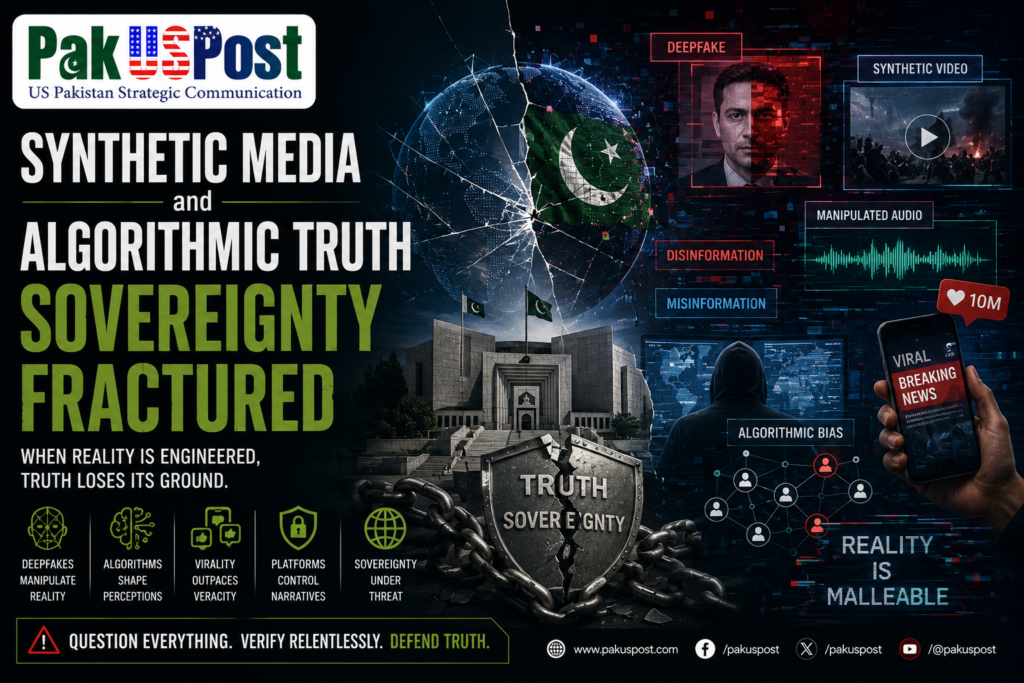
The contemporary information order is undergoing a structural mutation in which the production of truth, once anchored in editorial institutions and state-mediated broadcasting systems, is increasingly redistributed across synthetic media architectures, algorithmically curated platforms, and machine-generated content ecosystems. In this environment, the classical assumption that truth is discovered, verified, and disseminated through identifiable institutional hierarchies is no longer stable. Instead, truth has become an output of competing computational systems that continuously negotiate visibility, plausibility, and engagement at scale.
For Pakistan, and by extension its strategic interlocutors including the United States, this transformation introduces a more intricate governance challenge than conventional disinformation paradigms suggest. The issue is not simply the proliferation of false content, but the dissolution of a singular epistemic authority capable of arbitrating between authentic reporting, simulated content, and algorithmically amplified narratives. The consequence is a fragmented informational terrain in which credibility is no longer assigned by provenance alone but is increasingly inferred through engagement signals, network propagation velocity, and platform-specific ranking logic.
Synthetic media technologies, particularly those enabled by large-scale generative models, have accelerated this transition. Text, image, audio, and video content can now be produced with minimal marginal cost and near-realistic fidelity, often without detectable markers of artificial origin. These systems do not merely distort existing narratives; they generate entirely new informational events that may never have occurred but nevertheless circulate with persuasive authority within digital ecosystems. The epistemic boundary between documentation and fabrication has therefore become operationally ambiguous.
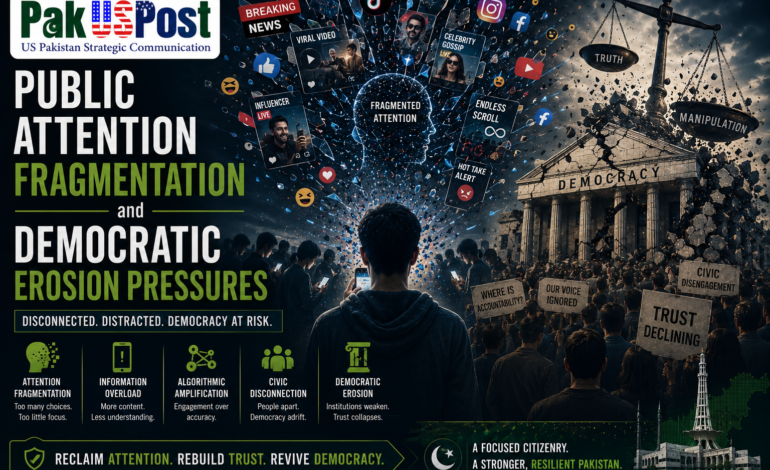
Algorithmic persuasion compounds this condition by restructuring how information is encountered rather than merely what information exists. Recommendation systems embedded within major platforms do not function as neutral conduits but as optimization engines designed to maximize attention retention, emotional engagement, and behavioral prediction accuracy. In doing so, they inadvertently privilege content that is cognitively sticky, emotionally charged, or narratively simplified, regardless of its factual robustness. Over time, this produces informational asymmetries in which certain narratives achieve disproportionate visibility while analytically rigorous but less engaging content is structurally marginalized.
The central question emerging from this transformation is no longer confined to whether states or platforms control information flows. Instead, authority over truth production is now distributed across a triadic structure consisting of state institutions, platform governance architectures, and user behavior loops mediated by machine learning systems. Each actor exercises partial and indirect influence, yet none possesses comprehensive control over the informational outcome. This distributed configuration complicates traditional notions of censorship, propaganda, and public diplomacy, all of which presuppose identifiable centers of narrative control.
In Pakistan’s case, this epistemic decentralization intersects with pre-existing vulnerabilities in media literacy, linguistic diversity, and platform dependency. The rapid expansion of digital connectivity has expanded public access to information, yet it has also increased exposure to algorithmically filtered content streams that are optimized for engagement rather than contextual accuracy. Urdu, regional languages, and code-mixed communication further complicate content moderation and verification processes, as many synthetic media detection systems are calibrated primarily for high-resource linguistic environments.
From a statecraft perspective, the most significant risk lies in the erosion of interpretive coherence during moments of political volatility or external crisis. In such scenarios, synthetic narratives can proliferate faster than institutional clarification mechanisms, generating parallel informational realities that persist even after official correction. This creates a temporal asymmetry between narrative emergence and narrative verification, in which the speed of machine-generated content outpaces the procedural velocity of institutional response.
For Pakistan–United States relations, the implications are particularly sensitive. Diplomatic signalling, security-related disclosures, and policy announcements now exist within an informational environment where machine-mediated amplification can distort intent, amplify misinterpretation, or artificially escalate perceived tensions. A single synthetic artifact, whether a fabricated statement, manipulated audiovisual clip, or algorithmically boosted narrative cluster, can rapidly acquire geopolitical significance if it intersects with existing cognitive biases or platform amplification thresholds.
This introduces a new dimension of strategic uncertainty in bilateral communication. Traditional diplomatic protocols assume that messages are transmitted through controlled channels and interpreted through established institutional frameworks. However, in algorithmically mediated environments, messages are reprocessed by platform systems that may prioritize virality over accuracy, thereby altering the perceived meaning of official communication before it reaches intended audiences. The result is a form of narrative instability in which diplomatic intent is continuously subjected to computational reinterpretation.
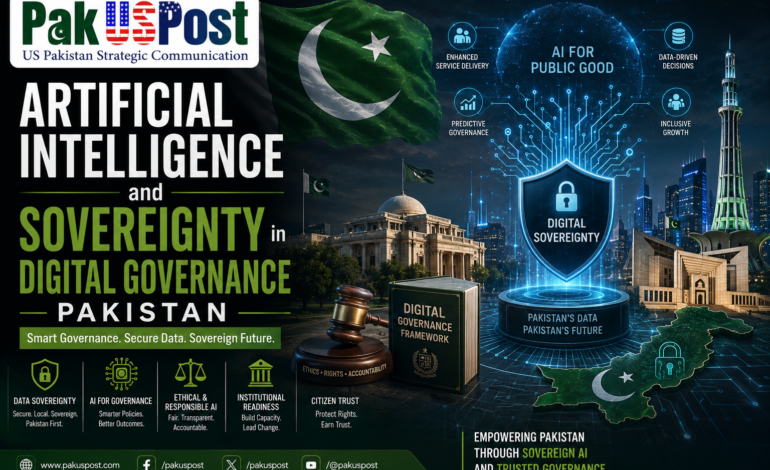
Information sovereignty, therefore, must be redefined beyond territorial data governance or content regulation. It now encompasses the capacity of a state to preserve interpretive integrity within algorithmically structured information flows. This includes the ability to ensure that official narratives are not structurally disadvantaged by platform ranking systems, that synthetic content can be reliably identified without suppressing legitimate expression, and that cross-border information ecosystems do not inadvertently amplify destabilizing misrepresentations.
The policy challenge is further complicated by the dual-use nature of synthetic media technologies. The same systems that generate misinformation risks also underpin legitimate applications in education, accessibility, entertainment, and public communication. Blanket restrictions are therefore neither feasible nor strategically optimal. Instead, governance must focus on provenance systems, authentication frameworks, and traceable content architectures that allow users and institutions to distinguish between human-originated, machine-assisted, and fully synthetic outputs.
Within establishment and policy circles, there is growing recognition that informational resilience must be treated as a component of national security architecture rather than a subsidiary media concern. This includes integrating synthetic media detection capabilities into cybersecurity frameworks, enhancing inter-agency coordination on narrative threat assessment, and developing rapid-response communication units capable of engaging both domestic and international information ecosystems in real time.
However, technological countermeasures alone are insufficient. The deeper challenge lies in structural dependency on platform ecosystems whose algorithmic governance is external to national jurisdiction. Major content distribution channels are controlled by transnational corporations whose ranking systems are optimized according to global engagement metrics rather than country-specific informational stability. As a result, national narratives are continuously subjected to external prioritization logics that may not align with domestic policy objectives.
Addressing this requires a shift toward what may be described as epistemic infrastructure strategy. Rather than focusing solely on content regulation, states must invest in the underlying systems that determine how content is surfaced, ranked, and contextualized. This includes advocating for transparency in recommendation algorithms, establishing audit rights over content amplification systems, and developing indigenous or regionally governed platforms that can serve as stabilizing alternatives in critical information domains.
At the diplomatic level, Pakistan–US engagement must incorporate algorithmic accountability as a formal agenda item within digital cooperation frameworks. This would involve establishing technical working groups focused on synthetic media governance, shared standards for content provenance, and crisis communication protocols designed for machine-mediated environments. Such mechanisms would not eliminate informational volatility but could reduce the risk of misinterpretation escalation during sensitive geopolitical events.
A further dimension involves the role of artificial intelligence in shaping public perception through generative content loops. As large language models become integrated into search engines, social platforms, and productivity tools, users increasingly receive synthesized summaries of reality rather than direct access to primary sources. This mediating layer introduces a subtle form of epistemic compression in which nuance is reduced, uncertainty is flattened, and complex events are rendered into simplified narrative constructs optimized for consumption.
The strategic implication is that informational ecosystems are no longer merely channels of communication but active participants in meaning construction. This shifts the locus of power from content producers to system designers, from journalists and institutions to engineers and platform architects. Governance in this context requires not only regulatory oversight but sustained engagement with the design principles of information systems themselves.
Policy recommendations must therefore operate across multiple registers. First, establish national frameworks for synthetic media authentication, including mandatory watermarking or cryptographic provenance tagging for AI-generated content used in public communication contexts. Second, develop bilateral agreements with major platform providers to ensure transparency in algorithmic ranking systems during politically sensitive periods. Third, create institutional capacity for real-time narrative analysis that integrates computational monitoring with traditional intelligence assessment.
Fourth, invest in public communication resilience by strengthening state capacity to issue rapid, verifiable, and multi-channel responses during information crises. Fifth, integrate media literacy and algorithmic awareness into educational curricula to build long-term societal resilience against synthetic narrative manipulation. Sixth, pursue multilateral engagement on global standards for synthetic media governance, particularly in forums where digital trade, cybersecurity, and information integrity intersect.
Ultimately, the emergence of synthetic media does not signify the end of truth, but the end of its passive stability. Truth is now continuously constructed, contested, and recalibrated within computational environments that operate at speeds and scales beyond human cognition. In such an environment, sovereignty is no longer defined solely by the ability to speak, but by the capacity to ensure that what is spoken remains intelligible, traceable, and resistant to algorithmic distortion.
A Public Service Message