
De Dollarization Pressures and Pakistan Financial Exposure

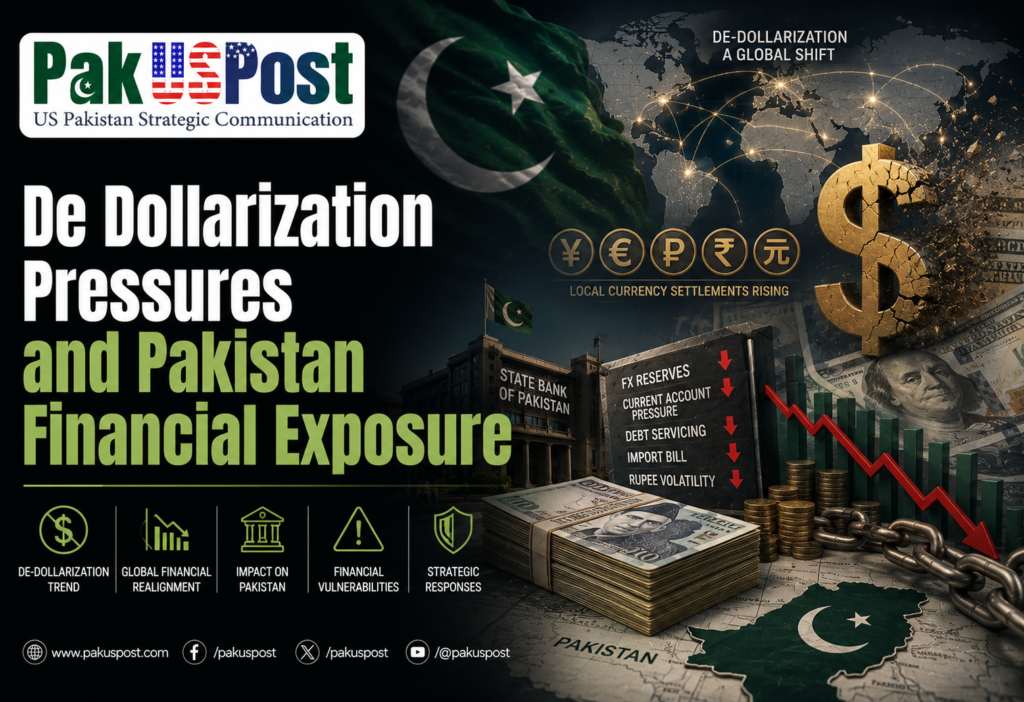
The gradual erosion of United States dominance in the global financial system, accelerated in a scenario where Washington becomes structurally constrained in the Middle East due to strategic vulnerabilities around the Strait of Hormuz, would have far-reaching implications for the international monetary order. Between 2026 and 2030, the intersection of energy geopolitics and monetary fragmentation could accelerate a partial shift away from dollar centrality, driven by coordinated efforts from China, Russia, Iran, and select Gulf economies seeking to reduce exposure to US financial leverage. For Pakistan, a structurally dollar-dependent economy, this transition would represent both an opportunity and a high-risk adjustment phase.
The foundational pillar of the global system, the petrodollar arrangement, relies on the pricing of oil in US dollars and the recycling of surplus revenues into dollar-denominated assets. If Gulf states begin to increasingly accept alternative currencies such as yuan or rial for a portion of energy transactions, the structural demand for US dollars in global trade settlement would gradually weaken. This would not collapse the dollar system but would introduce fragmentation at the margins, increasing volatility in exchange rates, reserves management, and international liquidity flows. For emerging economies like Pakistan, the key transmission channel would be reserve composition risk and external financing uncertainty.
Pakistan holds approximately 130 billion dollars in external debt, with nearly seventy percent denominated in US dollars. This currency concentration creates a structural vulnerability known as liability dollarization. In a scenario where global de-dollarization accelerates unevenly, Pakistan may paradoxically face higher short-term dollar scarcity rather than relief. As global liquidity fragments, access to dollar funding markets could become more expensive and politically conditional. This would increase rollover risk on external obligations and raise sovereign borrowing costs, particularly in Eurobond and commercial loan markets.
At the same time, institutions such as the IMF, which operate within a dollar-referenced framework, would remain central to Pakistan’s stabilization cycles. Even in a partially de-dollarized world, IMF programs would continue to anchor macroeconomic adjustment, but with potentially more complex conditionality structures if global reserve currencies diversify. Pakistan could face a situation where dollar inflows become more constrained, while adjustment requirements remain anchored in dollar-based accounting, creating a structural mismatch between financing reality and policy expectations.
In response to these shifts, alternative financial architectures are likely to expand. The China International Payment System, or CIPS, offers an alternative settlement layer for yuan-denominated trade, while emerging frameworks such as mBridge, a multi-central bank digital currency platform involving China, the UAE, Thailand, and others, could facilitate cross-border transactions outside traditional dollar clearing systems. Bilateral currency swap agreements between Pakistan and China already provide limited liquidity support, and similar arrangements with Russia or Iran could expand under conditions of heightened sanctions fragmentation.
However, these systems are not substitutes for the global depth and liquidity of dollar markets. Rather, they function as parallel channels that reduce marginal dependency. For Pakistan, the strategic challenge is to integrate into these systems without triggering financial isolation from Western capital markets. This requires a calibrated approach to de-dollarization that is gradual, segmented, and transaction-specific rather than systemic or ideological.
A three-phase strategic roadmap would therefore be necessary. In the first phase, Pakistan would focus on currency diversification in trade invoicing, particularly with China, Gulf partners, and neighboring states, while maintaining dollar dominance in external debt servicing. This phase prioritizes risk reduction without structural disruption. In the second phase, partial reserve diversification could be introduced, increasing holdings in yuan and potentially gold, while expanding swap-based liquidity buffers. This phase would require careful coordination with IMF frameworks to avoid signalling disorderly exit from dollar systems.
The third phase would involve selective integration into alternative payment corridors such as CIPS and CBDC-linked settlement systems for bilateral trade. At this stage, Pakistan would aim to create functional redundancy in its payment infrastructure, ensuring that trade continuity is not solely dependent on dollar clearing mechanisms. However, full decoupling from the dollar system would remain neither feasible nor strategically advisable given Pakistan’s exposure to Western financial institutions and multilateral lenders.
Policy implementation would require careful engagement with the State Bank of Pakistan’s reserve management strategy. Diversification must be gradual to avoid exchange rate instability or market perception of capital flight from dollar assets. Reserve allocation across currencies must balance liquidity, safety, and convertibility. Gold accumulation may also serve as a neutral hedge in an increasingly fragmented monetary environment, although it lacks yield and liquidity compared to sovereign currencies.
On the IMF front, Pakistan would need to pursue negotiation strategies that recognize emerging multipolar liquidity constraints. This includes advocating for flexible disbursement structures, enhanced shock facilities linked to commodity volatility, and greater tolerance for currency diversification in trade settlements. However, these negotiations must remain within the framework of institutional compliance to avoid program disruption.
From a broader strategic perspective, Pakistan’s financial doctrine must avoid abrupt alignment with any single de-dollarization bloc. Overexposure to yuan-based systems could create dependency asymmetry, while continued reliance on dollar systems alone increases vulnerability to external shocks and sanctions cycles. The optimal approach is financial multi-alignment, mirroring Pakistan’s broader foreign policy strategy, where exposure is distributed rather than concentrated.
Ultimately, the transition toward a more fragmented global financial order does not eliminate the dollar but reduces its exclusivity. For Pakistan, this creates a narrow corridor of opportunity within a structurally constrained environment. The key challenge is not choosing between dollar and non-dollar systems, but building the institutional capacity to operate across both without destabilizing macroeconomic fundamentals or triggering external financial retaliation. In such an environment, financial strategy becomes an extension of geopolitical navigation rather than a purely economic exercise.
A Public Service Message