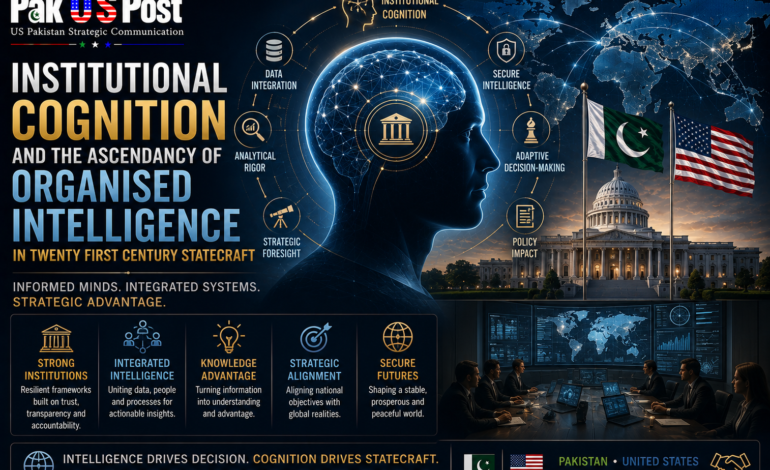
Institutional Cognition and the Ascendancy of Organised Intelligence in Twenty First Century Statecraft


The genealogy of national power is undergoing a profound epistemological reconstruction. The international system is no longer governed exclusively by the arithmetic of military inventories, demographic abundance, territorial magnitude or aggregate economic production. These variables continue to possess undeniable strategic consequence, yet they no longer constitute the principal determinants of durable influence. Their effectiveness has become increasingly contingent upon an antecedent capability that conventional strategic literature frequently understates, namely the institutional capacity to generate trustworthy knowledge, absorb complexity, refine administrative judgement and transform scientific discovery into coherent public action. The centre of gravity within international competition is therefore migrating from material accumulation towards organised intelligence. States are progressively differentiated not by what they possess but by how effectively their institutions perceive uncertainty, evaluate evidence, correct policy failures and continuously reconstruct collective competence.
This transformation reflects a deeper philosophical evolution within international affairs. Earlier centuries rewarded territorial conquest because land represented agricultural wealth. Industrial modernity privileged manufacturing capacity because production determined prosperity. The nuclear age elevated deterrence because destructive capability became synonymous with survival. The emerging epoch, however, increasingly rewards institutional cognition because information has become both the primary strategic resource and the principal arena of geopolitical competition. Information alone, nevertheless, possesses limited intrinsic value. Its strategic significance depends upon institutional mechanisms capable of distinguishing evidence from speculation, expertise from ideological affirmation, innovation from technological imitation and constitutional legitimacy from administrative improvisation. Consequently, the decisive struggle among nations increasingly concerns not physical resources but epistemic architecture.
The vocabulary of international relations has consequently begun to evolve beyond conventional conceptions of hard power and soft power. A more consequential dimension may now be described as cognitive power, representing the collective institutional ability to anticipate emerging risks, synthesise multidisciplinary knowledge and formulate adaptive governance before crises become irreversible. Unlike traditional power resources, cognitive power cannot be imported through procurement contracts, diplomatic declarations or episodic strategic partnerships. It emerges through decades of educational excellence, constitutional continuity, scientific originality, administrative professionalism and intellectual pluralism. It represents accumulated institutional memory rather than temporary political momentum.
From this perspective the relationship between Pakistan and the United States acquires a significance extending beyond bilateral diplomacy. Rather than interpreting their engagement exclusively through security cooperation, economic assistance or regional strategic calculations, it becomes possible to understand both societies as representing distinct cultures of institutional reasoning. Every state develops characteristic methods through which knowledge enters governance. These methods determine how evidence is collected, how expertise influences legislation, how universities interact with government, how technological innovation informs industrial transformation and how constitutional institutions preserve administrative continuity despite political change.
The comparative distinction therefore concerns not merely governmental structures but institutional cognition itself. The United States has historically invested enormous intellectual resources into constructing interconnected ecosystems linking universities, research laboratories, private enterprise, constitutional institutions, philanthropic foundations and technological entrepreneurship. Scientific originality is seldom isolated from public administration because institutional mechanisms encourage reciprocal circulation between academia, innovation and policymaking. Knowledge consequently acquires strategic utility through organisational integration rather than remaining confined within disciplinary boundaries.
Pakistan possesses intellectual traditions of remarkable historical depth and substantial human potential, yet the institutional mechanisms responsible for transforming dispersed intellectual capacity into coordinated national competence remain unevenly developed. Considerable scientific talent frequently exists without corresponding administrative continuity. Academic research occasionally remains detached from executive decision making. Public institutions periodically experience discontinuities that interrupt long term learning. Consequently, policy innovation sometimes depends excessively upon personalities rather than institutional memory. The challenge therefore concerns not intellectual deficiency but organisational translation.
Institutional intelligence should never be confused with bureaucratic expansion. Large administrative systems frequently exhibit remarkable informational rigidity despite considerable organisational size. Genuine institutional intelligence refers instead to the capacity of public organisations to learn continuously from evidence, revise obsolete assumptions, encourage constructive criticism and incorporate interdisciplinary expertise into executive judgement. Such institutions recognise error not as political embarrassment but as indispensable knowledge for subsequent improvement. Administrative humility thereby becomes an instrument of strategic resilience rather than institutional weakness.
This distinction possesses profound implications for Pakistan’s future engagement with the United States. Bilateral cooperation frequently concentrates upon defence dialogue, investment promotion, counterterrorism coordination or commercial exchanges. While these remain indispensable dimensions of diplomacy, they seldom address the deeper determinants of national resilience. The more enduring opportunity resides in collaborative cultivation of institutional learning itself. Joint scientific research, university partnerships, technological ethics, regulatory innovation, public health collaboration, climate adaptation and evidence based governance possess the potential to generate cumulative confidence extending beyond transient geopolitical circumstances. Institutions capable of learning together frequently sustain cooperation long after governments change.
The accelerating emergence of artificial intelligence further intensifies this philosophical transformation. Machine learning systems increasingly participate in financial regulation, healthcare diagnostics, judicial administration, educational assessment, military planning and public service delivery. Yet algorithms themselves do not constitute institutional intelligence. They merely amplify the intellectual quality already embedded within governing institutions. Artificial intelligence deployed by organisations lacking epistemic integrity may accelerate administrative dysfunction rather than improve decision quality. Conversely, institutions grounded in constitutional accountability, scientific transparency and professional competence may employ identical technologies to enhance democratic responsiveness and administrative precision.
The decisive question therefore concerns not technological adoption but institutional discernment. Artificial intelligence requires governance architectures capable of evaluating algorithmic bias, protecting civil liberties, ensuring procedural accountability and preserving human judgement within increasingly automated administrative environments. Technological sophistication without ethical oversight merely transfers existing institutional deficiencies into computational form. Consequently the future of governance depends less upon algorithmic capability than upon philosophical clarity regarding the legitimate relationship between technology, citizenship and public authority.
This reality has simultaneously elevated cognitive security into one of the defining responsibilities of contemporary governments. National security can no longer be confined to territorial defence because societies increasingly confront informational manipulation, synthetic media, algorithmic polarisation, epistemic fragmentation and digitally amplified distrust. These phenomena threaten constitutional legitimacy not through military invasion but through systematic corrosion of public reasoning itself. Democratic resilience consequently depends upon institutions capable of preserving informational credibility while respecting intellectual freedom. The defence of truth becomes inseparable from the defence of constitutional order.
Scientific diplomacy similarly acquires unprecedented strategic significance. Earlier diplomatic traditions frequently emphasised military alliances, trade agreements or ideological partnerships. Contemporary diplomacy increasingly incorporates collaborative research, technological standardisation, biomedical innovation, environmental science and educational mobility. Scientific cooperation generates reciprocal confidence because empirical inquiry possesses universal methodological standards transcending immediate political disagreements. Laboratories frequently sustain dialogue where conventional diplomacy encounters stagnation. Universities often preserve intellectual engagement despite deteriorating geopolitical relations. Knowledge therefore becomes both an instrument and an objective of international cooperation.
The philosophical implications extend beyond interstate relations towards the nature of civilisation itself. Historically, societies achieved endurance through military fortification or economic abundance. Contemporary resilience increasingly depends upon institutional adaptability. Adaptability emerges when educational systems cultivate critical inquiry rather than memorisation, when constitutional frameworks encourage accountability rather than arbitrary discretion, when administrative organisations reward competence rather than conformity and when political cultures regard evidence as an indispensable foundation of legitimate governance. Institutional intelligence therefore represents the cumulative outcome of countless educational, legal, scientific and civic practices operating across generations.
The distinction between episodic success and enduring national relevance consequently becomes increasingly apparent. Temporary geopolitical advantages may emerge through favourable alliances, resource discoveries or transient economic expansion. Enduring strategic relevance, however, requires societies capable of continuously reconstructing themselves through organised learning. Such reconstruction depends upon institutions sufficiently confident to question inherited assumptions without abandoning constitutional stability. Intellectual flexibility thereby becomes compatible with institutional continuity rather than antagonistic to it.
Perhaps the most underestimated dimension of contemporary power therefore concerns administrative imagination. Institutions possessing sophisticated foresight mechanisms identify emerging technological transformations before they become strategic crises. They invest in future capabilities while immediate political incentives encourage short term expediency. They cultivate interdisciplinary dialogue because complex problems rarely respect disciplinary boundaries. Most importantly, they recognise that governance constitutes an evolving process of organised learning rather than an immutable collection of administrative procedures.
Within such an intellectual landscape the Pakistan United States relationship acquires extraordinary philosophical potential. Its future significance may depend less upon conventional diplomatic negotiations than upon the extent to which both societies participate in constructing shared epistemic communities committed to scientific excellence, constitutional credibility, technological responsibility and reciprocal institutional learning. Strategic partnerships ultimately endure not because governments temporarily converge but because institutions progressively internalise common standards of evidence, accountability and innovation.
The international order consequently approaches a decisive historical inflection. Material capabilities remain indispensable, yet their strategic effectiveness increasingly derives from institutional ecosystems capable of transforming knowledge into adaptive governance. The states most likely to exercise enduring influence will not necessarily possess the largest territories, the greatest populations or the highest military expenditures. They will instead cultivate the most credible institutions, the most resilient constitutional cultures and the most sophisticated architectures of organised intelligence. Their greatest strategic asset will not be accumulated power but continuously renewable institutional cognition, capable of converting uncertainty into foresight and complexity into national endurance.
The transition from material predominance towards institutional cognition also necessitates a reconsideration of sovereignty itself. Classical political thought frequently conceived sovereignty as the supreme authority to command territory, regulate populations and monopolise legitimate coercion. Contemporary statecraft increasingly reveals a more intricate reality. Sovereignty now depends not merely upon juridical recognition but upon the institutional competence to preserve social trust, regulate technological transformation, protect informational integrity and sustain constitutional legitimacy amidst accelerating complexity. A state incapable of interpreting its own strategic environment eventually becomes vulnerable irrespective of military capability or economic scale. Ignorance has consequently become a strategic liability, while organised learning has emerged as an indispensable instrument of national preservation.
This philosophical evolution has transformed governance from an essentially administrative enterprise into an epistemic vocation. Ministries, legislatures, regulatory authorities and judicial institutions are no longer evaluated exclusively according to procedural compliance or statutory authority. Their legitimacy increasingly derives from their ability to incorporate empirical evidence, interdisciplinary expertise and anticipatory analysis into public decision making. Governments that repeatedly formulate policies detached from verifiable knowledge gradually exhaust institutional credibility, whereas those capable of integrating scientific reasoning with democratic accountability accumulate strategic confidence both domestically and internationally. Institutional authority therefore originates less from coercive capacity than from demonstrated intellectual reliability.
Such developments illuminate an important distinction between information abundance and knowledge sophistication. Contemporary societies possess unprecedented access to digital information, yet informational proliferation does not necessarily generate collective wisdom. Indeed, excessive informational fragmentation frequently produces epistemic instability, encouraging ideological polarisation, cognitive overload and declining public confidence in authoritative institutions. The central challenge confronting modern governance therefore concerns not the acquisition of additional information but the institutional cultivation of discernment. Strategic advantage belongs to societies capable of distinguishing evidence from manipulation, expertise from popularity, methodological rigour from algorithmically amplified spectacle and long term national interest from transient political gratification.
The implications for Pakistan possess exceptional significance. Public discourse frequently attributes developmental constraints to financial limitations, geopolitical uncertainty or external dependencies. While each factor retains explanatory relevance, an equally consequential variable concerns institutional learning itself. Sustainable national transformation cannot emerge solely through additional expenditure if organisational cultures remain resistant to evaluation, adaptation and administrative refinement. Fiscal resources undoubtedly facilitate reform, yet institutional intelligence determines whether those resources generate enduring public value or merely reproduce existing inefficiencies. Consequently, the decisive investment of the twenty first century may not be financial capital alone but cognitive capital institutionalised through governance.
The Pakistan United States relationship offers an instructive laboratory through which this proposition may be examined. Diplomatic engagement has historically oscillated according to security imperatives, regional contingencies and shifting geopolitical calculations. Such fluctuations, although understandable within international politics, often obscure more durable opportunities rooted in institutional collaboration. Educational exchanges, scientific partnerships, judicial dialogue, regulatory innovation, technological ethics, climate research and biomedical cooperation generate cumulative reservoirs of confidence because they strengthen organisational competence rather than merely negotiating immediate strategic transactions. Institutions educated together frequently acquire comparable standards of reasoning, thereby reducing future diplomatic misunderstanding through shared intellectual methodology.
The future trajectory of bilateral engagement may therefore depend increasingly upon reciprocal investments in epistemic infrastructure rather than exclusively upon conventional diplomacy. Universities constitute strategic institutions because they cultivate future policymakers before they assume governmental responsibility. Independent research organisations strengthen governance by producing evidence unconstrained by immediate political expediency. Professional civil services preserve institutional continuity across electoral transitions. Constitutional courts reinforce predictability through principled jurisprudence. Scientific academies expand technological capability while simultaneously encouraging ethical deliberation regarding innovation. Each institution contributes incrementally towards a national architecture of organised intelligence whose cumulative strategic significance exceeds the contribution of any individual organisation.
Artificial intelligence intensifies these imperatives by introducing unprecedented philosophical questions regarding authority, responsibility and democratic legitimacy. Algorithms increasingly influence employment decisions, financial regulation, healthcare diagnostics, criminal justice, educational assessment and national security analysis. Yet algorithmic sophistication cannot substitute for institutional wisdom. Every computational system embodies assumptions regarding fairness, efficiency, acceptable risk and legitimate authority. These assumptions inevitably reflect human judgement, political philosophy and constitutional values. Consequently, the governance of artificial intelligence ultimately concerns the governance of human institutions rather than autonomous technology. The quality of algorithms invariably mirrors the intellectual integrity of the societies that design, regulate and supervise them.
This observation introduces the emerging concept of technological ethics as an essential dimension of strategic competitiveness. Earlier industrial revolutions rewarded production capacity irrespective of ethical reflection. Contemporary technological leadership increasingly requires societies capable of integrating innovation with accountability, scientific ambition with constitutional restraint and computational efficiency with human dignity. Nations neglecting ethical governance may initially accelerate technological development, yet they frequently encounter declining public confidence, regulatory instability and international scepticism. Ethical credibility therefore becomes a strategic resource rather than merely a moral aspiration.
An analogous transformation characterises scientific diplomacy. Scientific collaboration possesses unique diplomatic properties because empirical inquiry depends upon methodological transparency, reproducibility and intellectual reciprocity. Researchers collaborating across national boundaries gradually construct communities of professional trust transcending temporary political disagreement. Such networks generate cumulative resilience within international relations because they institutionalise communication independently of fluctuating governmental priorities. Scientific diplomacy consequently expands the vocabulary of statecraft beyond negotiation towards collaborative discovery. Knowledge ceases to function exclusively as an instrument of national competition and simultaneously becomes a medium of international confidence building.
The philosophical significance of educational excellence similarly extends beyond labour market productivity. Universities constitute repositories of civilisational memory, intellectual experimentation and normative reflection. They cultivate the cognitive dispositions through which future administrators, judges, scientists, entrepreneurs and legislators interpret public responsibility. Educational systems encouraging analytical independence produce institutions capable of constructive self correction. Those rewarding memorisation without critical inquiry frequently reproduce administrative conformity, thereby limiting adaptive governance despite considerable individual intelligence. Educational philosophy therefore exerts profound strategic influence upon national resilience decades before its consequences become politically visible.
Administrative competence likewise requires constitutional credibility. Constitutions acquire strategic significance not merely because they distribute governmental authority but because they establish predictable frameworks through which institutional learning may accumulate across generations. Frequent constitutional uncertainty interrupts organisational memory, encourages policy discontinuity and diminishes investor confidence. Conversely, constitutional stability permits gradual refinement rather than perpetual reconstruction. Institutions become progressively wiser because accumulated experience is preserved instead of repeatedly discarded. Constitutional credibility therefore functions as an indispensable repository of national intelligence.
Equally essential is the preservation of epistemic integrity within public life. Epistemic integrity denotes the collective commitment to intellectual honesty, methodological transparency and evidentiary accountability across governmental, academic and civic institutions. Societies characterised by robust epistemic integrity possess remarkable adaptive capacity because errors are identified before becoming systemic crises. Institutional criticism strengthens rather than weakens governance because constructive evaluation becomes integral to administrative learning. Public trust consequently emerges from demonstrated openness to evidence rather than rhetorical assertions of infallibility.
Democratic accountability reinforces this process by ensuring that institutional intelligence remains compatible with public legitimacy. Sophisticated expertise divorced from democratic oversight risks technocratic insulation, whereas electoral responsiveness detached from empirical evidence frequently encourages short term populism. Successful governance therefore requires a delicate constitutional equilibrium wherein specialised knowledge informs political decision making without displacing democratic sovereignty. Such equilibrium represents one of the defining institutional achievements of mature constitutional systems. Neither expertise nor representation alone suffices. Their productive interaction generates resilient public authority.
These considerations collectively suggest that the future hierarchy of international influence will increasingly reflect qualitative rather than quantitative distinctions. Gross domestic product, military expenditure and demographic scale remain important indicators, yet they inadequately capture institutional adaptability, constitutional reliability, scientific originality and administrative imagination. A comparatively smaller state possessing sophisticated institutional cognition may frequently outperform materially stronger competitors whose governance structures remain intellectually inflexible. Organised intelligence thereby introduces an alternative metric of national capability more consistent with the complexities of the contemporary international environment.
An integrated framework for cultivating institutional intelligence should therefore rest upon mutually reinforcing foundations. Educational systems must privilege analytical reasoning, scientific literacy and interdisciplinary inquiry. Universities should function as strategic partners of government rather than isolated academic enclaves. Civil services require continuous professional development grounded in empirical evaluation rather than procedural routine. Constitutional institutions must preserve administrative continuity while encouraging transparent accountability. Regulatory agencies should incorporate technological expertise without compromising democratic legitimacy. Scientific research deserves sustained investment because innovation constitutes the renewable infrastructure of national competitiveness. Artificial intelligence must operate within ethical governance frameworks protecting individual liberty, procedural fairness and constitutional oversight. Public communication should strengthen epistemic resilience by rewarding factual integrity over algorithmically amplified sensationalism. International partnerships ought to prioritise collaborative knowledge production capable of generating reciprocal institutional learning rather than episodic diplomatic symbolism.
Within this comprehensive architecture the Pakistan United States relationship assumes renewed philosophical significance. Its greatest strategic potential lies not merely in transactional cooperation but in the coevolution of institutional capacities dedicated to scientific excellence, constitutional responsibility, technological ethics and evidence based governance. Such collaboration would gradually construct a shared epistemic community whose resilience exceeds the volatility of immediate geopolitical circumstances. Strategic relevance would consequently derive from mutually reinforcing institutional competence rather than temporary convergence of external interests.
The twenty first century is therefore unlikely to be remembered as the era in which nations accumulated the greatest quantity of material resources. It may instead be recognised as the historical period during which the architecture of organised intelligence superseded conventional metrics of national power. The societies that endure will not necessarily be those possessing the largest economies, the most expansive territories or the most formidable arsenals. They will be those capable of institutionalising curiosity, preserving constitutional credibility, cultivating scientific originality, governing technological transformation with ethical wisdom and continuously refining public reasoning through disciplined engagement with evidence. Their influence will arise because they have mastered the most sophisticated capability available to any civilisation, namely the capacity to learn more rapidly than the challenges confronting them. In that emerging international order, institutional intelligence will no longer constitute a desirable administrative attribute. It will become the definitive foundation of national endurance, international credibility and strategic relevance, establishing organised knowledge as the supreme currency of enduring state power.
A Public Service Message