
Neural Networks of Nations: The Organic Architecture of Power and Cohesion

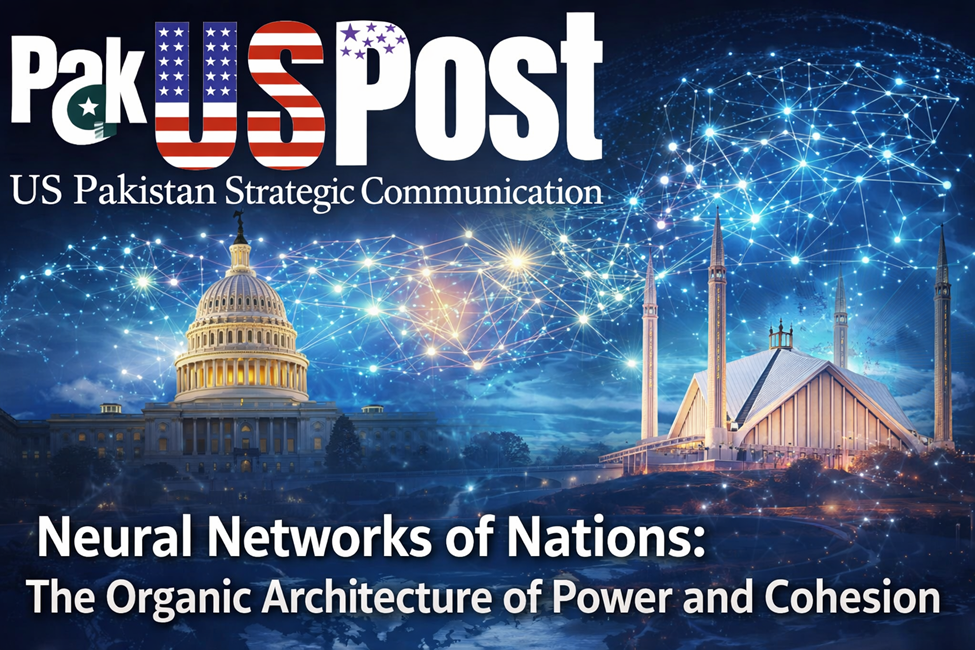
In the contemporary geopolitical landscape, nations operate less as static entities and more as complex, dynamic organisms, whose vitality and resilience depend on the interplay of interdependent institutions, normative structures, and strategic communication pathways. Conceptualizing the state as a living system allows for a nuanced understanding of the mechanisms that sustain governance, social cohesion, and international influence. In this metaphorical framework, the United States and Pakistan function as distinct national organisms, each comprising intricate networks of policy, societal norms, and institutional architectures that collectively maintain equilibrium, respond to external perturbations, and adapt to evolving challenges. The nation’s organs—legislatures, bureaucracies, media ecosystems, and civic institutions—perform specialized roles analogous to the physiological functions of a body, while the interconnections between these organs constitute the neural pathways through which information, perception, and influence circulate.
The United States has operationalized this conception through a deliberate integration of defense doctrine, legislative oversight, and technological infrastructure. Pentagon-endorsed frameworks conceptualize strategic communication as an extension of cognitive-domain operations, wherein the shaping of public perception, narrative alignment, and information flows are treated as integral components of national resilience and power projection. Congressional policy structures, oversight mechanisms, and regulatory frameworks serve as the synaptic connectors that ensure coordination between military strategy, technological capacity, and private sector platform governance. In this organic metaphor, social media platforms act as both arteries and neural pathways, facilitating the rapid transmission of narratives, norms, and signals across domestic and global populations. Algorithmic curation, real-time analytics, and cognitive targeting enable the orchestration of narratives with precision, creating an adaptive and responsive informational circulatory system capable of responding to both internal fluctuations and external adversarial pressures.
The strategic interdependence within the national organism is mirrored by the interaction of organs at multiple levels. Legislative frameworks codify the normative and operational boundaries within which information flows, ensuring that the dissemination of narratives aligns with both legal imperatives and strategic objectives. Executive agencies operationalize these mandates, coordinating rapid-response communication mechanisms, intelligence-driven messaging, and engagement campaigns designed to reinforce desired perceptions while mitigating disruptive content. Meanwhile, the technological architecture of platforms functions as the medium through which these directives are translated into perceptible influence on audiences, effectively integrating structural design, functional purpose, and operational execution. These networks exemplify a sophisticated model of cybernetic governance, in which feedback loops, adaptive modulation, and iterative optimization collectively sustain the cognitive and perceptual health of the national organism.
Pakistan, as a regional actor navigating asymmetrical informational and strategic landscapes, demonstrates both the challenges and the adaptive capacities inherent in sustaining a national organism under external pressures. The country’s institutions, social norms, and policy architectures operate within structural constraints that include historical legacies, socio-cultural hierarchies, and geopolitical vulnerabilities, each of which shapes the operational capacity and resilience of the state. Functional imperatives such as bureaucratic efficiency, media management, and societal cohesion act as regulatory mechanisms, maintaining systemic integrity while enabling adaptive response to dynamic geopolitical developments. Strategic communication cells embedded within governmental and military institutions serve as neural hubs, coordinating messaging, monitoring discourse, and responding to real-time information perturbations to ensure the coherence of national narratives. These mechanisms are complemented by civil society initiatives that promote digital literacy, critical engagement, and fact-checking, collectively reinforcing the resilience of the social organism against external incursions and internal distortions.
The metaphor of the nation as a living organism also illuminates the dynamics of inter-national interactions, particularly in the context of Pakistan–United States relations. Nations, like biological entities, exist within a shared ecological system characterized by competition, cooperation, and adaptive co-evolution. Strategic engagements, bilateral initiatives, and global policy frameworks function as inter-organismic connections, analogous to synapses transmitting signals between distinct yet interdependent entities. The United States’ global narrative campaigns, informed by Pentagon doctrine and legislative frameworks, act as external stimuli, shaping perceptions, norms, and policy responses within regional organisms such as Pakistan. In response, Pakistan’s adaptive mechanisms—including regulatory oversight, media strategies, and civil society resilience—modulate the internal impact of these stimuli, preserving informational sovereignty and sustaining the integrity of the national organism within an environment of complex interdependence.
The philosophical grounding of this analysis draws upon functionalist and structuralist principles without explicitly naming them, embedding their logic within the metaphor of organic systems. Functionalist reasoning highlights the specialized roles of institutions and social norms as mechanisms that sustain systemic equilibrium and collective functionality. Structuralist reasoning, by contrast, illuminates the underlying frameworks that constrain behavior, organize relationships, and shape the distribution of power and influence within the organism. These complementary perspectives enable a holistic understanding of how nations maintain internal cohesion, mediate external influence, and adapt to evolving challenges in the global system. Metaphorically, the interplay of organs, neural pathways, and circulatory networks captures the dynamic tension between functional purpose and structural constraint, demonstrating how philosophical concepts translate into practical mechanisms of governance, social regulation, and strategic communication.
The interaction of narrative, perception, and policy within these national organisms also carries profound implications for civil society, media ethics, and the dynamics of public opinion. The orchestration of information flows, whether through algorithmic amplification, strategic messaging, or normative framing, has the capacity to reinforce cohesion, guide collective behavior, and stabilize societal equilibrium. Yet, these processes also raise ethical questions regarding transparency, accountability, and the legitimacy of influence operations. In both the United States and Pakistan, the regulation of discourse, the curation of narratives, and the management of informational ecosystems must balance the imperatives of strategic efficacy with the preservation of civic trust, freedom of expression, and democratic norms. The neural networks of nations, while highly functional and adaptive, operate within ethical parameters that determine the societal legitimacy and long-term resilience of the organism.
Moreover, the metaphor of the living nation provides a lens for understanding emergent phenomena such as polarization, institutional fragility, and media-driven social disruption. Just as physiological systems experience stress when organs or neural pathways are impaired, national organisms are vulnerable when key institutions fail, communication channels are compromised, or normative coherence is eroded. The asymmetric capabilities of states, the proliferation of digital information, and the transnational flow of narratives create conditions in which adaptive mechanisms must be both robust and responsive. Pakistan’s regulatory interventions, media strategies, and civil society programs function as protective mechanisms, analogous to homeostatic processes that maintain equilibrium in the face of external shocks and internal turbulence. Similarly, the United States’ integration of defense doctrine, policy oversight, and platform governance represents a sophisticated form of systemic resilience, ensuring that the cognitive and perceptual health of the national organism is maintained across multiple operational dimensions.
The ecological metaphor extends further to the interaction of nations within the global system. Like organisms in an ecosystem, states engage in both competition and symbiosis, responding to one another’s signals while maintaining internal coherence. International alliances, strategic partnerships, and multilateral engagements serve as inter-organismic connections that facilitate adaptation, cooperation, and mutual resilience. The United States’ influence operations, shaped by Pentagon strategies and congressional policy instruments, function as external environmental pressures that other national organisms must negotiate. Pakistan’s adaptive responses—through institutional coordination, strategic communication, and societal resilience—reflect the operationalization of functional imperatives within structural constraints, ensuring that the organism retains autonomy while engaging constructively with the broader geopolitical ecosystem.
The metaphor of neural networks also illuminates the role of feedback loops, information flow, and adaptive modulation in national governance. Signals transmitted through media channels, policy directives, and institutional communication are constantly interpreted, integrated, and acted upon, creating dynamic cycles of perception, decision-making, and strategic adjustment. This cybernetic understanding of the nation underscores the interdependence of institutions, norms, and strategic communication in sustaining systemic coherence and enabling responsive adaptation. Both Pakistan and the United States exhibit these cybernetic characteristics, albeit at differing scales and with varying degrees of technological and institutional sophistication, demonstrating the universality of the organic metaphor while highlighting context-specific operational dynamics.
In conclusion, conceptualizing nations as living organisms with neural networks of interdependent institutions, social norms, and strategic communication pathways provides a rich framework for understanding the architecture of power, cohesion, and resilience. The United States operationalizes these principles through the integration of Pentagon doctrine, legislative oversight, and technological governance, ensuring that narrative, perception, and influence are systematically aligned with strategic objectives. Pakistan navigates a complex and asymmetrical landscape, employing regulatory frameworks, institutional coordination, and societal resilience mechanisms to preserve internal equilibrium, maintain informational sovereignty, and adapt to global pressures. The interplay of functional imperatives and structural constraints, embedded within the metaphor of organic systems, illuminates the philosophical, practical, and strategic dimensions of national governance, offering insights that are relevant to policymakers, social psychologists, philosophers, and international scholars alike. By interpreting the nation as an organism with cognitive, circulatory, and regulatory networks, this analysis bridges theoretical abstraction with practical implications, demonstrating how philosophical frameworks inform contemporary governance, societal cohesion, and strategic interaction in an interconnected, media-mediated, and dynamic international system.
A Public Service Message