
Negotiated Wars and the American Shift From Victory to Containment

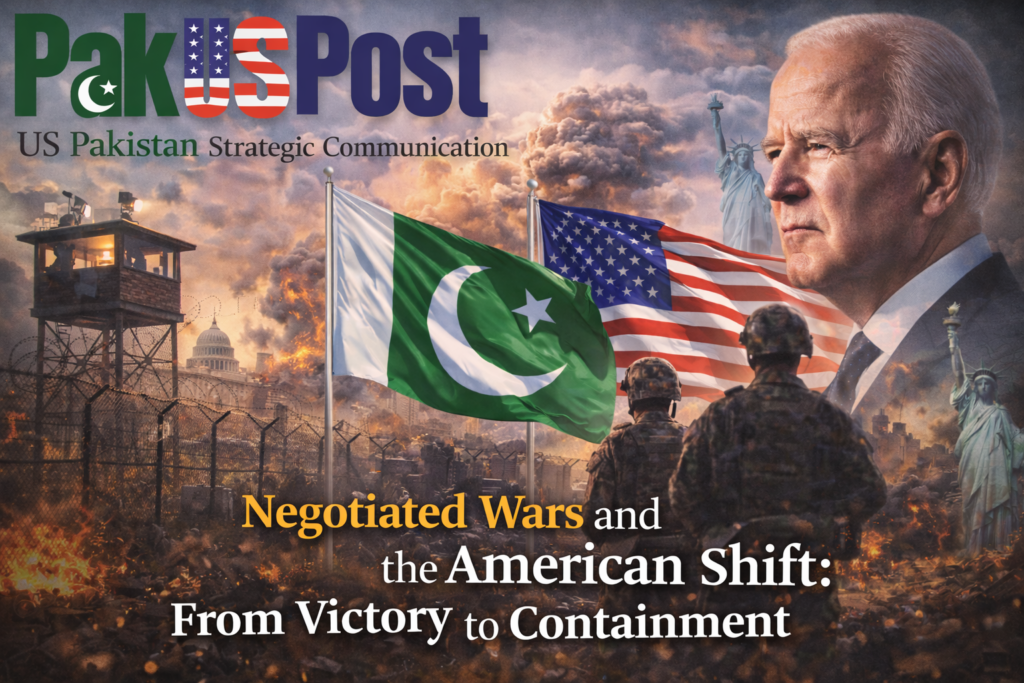
The evolution of warfare in the twenty first century is marked by a fundamental departure from the classical assumption that conflicts culminate in decisive military outcomes. Instead, the emerging reality suggests that many modern conflicts are increasingly structured around containment, regulation, and managed escalation rather than outright victory. This transformation is particularly evident in the strategic behavior of the United States, which appears to be transitioning from a doctrine of decisive intervention to a framework of negotiated conflict management. Within this paradigm, wars are not necessarily meant to be won in the traditional sense but are instead designed to be controlled, stabilized, and prevented from escalating beyond defined thresholds.
This shift is not a sudden rupture but the result of accumulated strategic experience across multiple theaters of engagement. From prolonged military operations in the Middle East to complex deterrence environments in Eastern Europe and Asia, the United States has encountered the limits of conventional military dominance in achieving sustainable political outcomes. These experiences have reinforced a strategic recalibration in which the costs of total victory are often judged to outweigh its benefits. As a result, Washington’s approach increasingly emphasizes calibrated involvement, selective escalation, and reliance on partners to manage localized dimensions of broader conflicts.
Within this evolving strategic framework Pakistan occupies a functionally significant position due to its historical engagement in regional security dynamics and its proximity to multiple overlapping conflict environments. Its relevance is not defined by formal alignment but by situational utility within crisis management ecosystems. In scenarios where direct engagement by major powers is constrained or undesirable, intermediary actors capable of facilitating communication and stabilizing escalation become strategically important. Pakistan’s institutional experience in navigating complex security environments places it within this category of functional intermediaries.
The concept of negotiated wars refers to a condition in which military conflict and diplomatic engagement operate simultaneously rather than sequentially. In this model, warfare does not conclude before negotiations begin but instead evolves alongside continuous diplomatic interaction. This creates a dynamic environment where escalation and de escalation are managed through ongoing communication channels rather than definitive battlefield outcomes. The objective is not to eliminate conflict entirely but to regulate its intensity and prevent systemic spillover into wider regional or global instability.
For the United States this model represents a pragmatic adaptation to the constraints of contemporary global order. The increasing interdependence of economies, the proliferation of advanced military technologies, and the rise of multipolar power centers have collectively reduced the feasibility of unilateral conflict resolution. In this environment, absolute victory is often replaced by strategic sufficiency, where the primary objective is to maintain acceptable levels of stability rather than achieve total dominance. This recalibration reflects a broader transformation in American grand strategy from hegemonic enforcement to distributed management of global risks.
One of the defining features of negotiated wars is the integration of multiple actors into conflict management processes. Unlike traditional warfare, which is primarily bilateral in structure, modern conflicts often involve a network of stakeholders including regional powers, non state actors, and intermediary states. This networked structure creates a complex diplomatic environment in which outcomes are shaped by continuous interaction rather than discrete decision points. Pakistan’s role in such environments is shaped by its ability to engage with multiple sides of a conflict without being fully embedded in any single strategic bloc.
However the transition toward managed conflict systems introduces inherent structural contradictions. The most significant of these is the normalization of instability. When conflicts are continuously managed rather than resolved they risk becoming permanent features of the international system. This can lead to prolonged uncertainty in affected regions where populations experience sustained insecurity without clear pathways to resolution. In such scenarios war becomes less an exceptional event and more a persistent condition regulated by diplomatic and military calibration.
Another contradiction lies in the diffusion of responsibility. In negotiated war systems accountability for outcomes becomes fragmented across multiple actors. It becomes increasingly difficult to attribute success or failure to any single participant. This diffusion can weaken institutional accountability and complicate long term strategic planning. For intermediary states such as Pakistan this creates both opportunity and risk. While it enhances relevance within crisis management networks it also exposes them to criticism when outcomes are unfavorable or incomplete.
The American shift toward managed conflict systems is also closely linked to domestic political and economic constraints. Sustained large scale military interventions have become increasingly difficult to justify in terms of financial cost, political consensus, and strategic return. As a result there is a growing preference for limited engagements that avoid long term occupation or direct governance responsibilities. Instead, the United States increasingly relies on indirect influence mechanisms including partnerships, coalitions, and intermediary actors to achieve strategic objectives.
Within this distributed model Pakistan’s functional value is primarily derived from its ability to operate in complex security environments where direct engagement by major powers is constrained. This includes facilitating communication channels, contributing to de-escalation processes, and acting as a stabilizing interface in regions where trust deficits prevent direct dialogue between adversarial actors. However, this role is inherently contingent and does not translate into permanent strategic status. It is activated by crisis conditions and diminished during periods of relative stability.
The broader implication of negotiated wars is the gradual erosion of the distinction between war and peace. As conflict and diplomacy become increasingly intertwined the international system moves toward a continuous state of managed tension. This condition challenges traditional legal and institutional frameworks that are designed around clear separations between peace time governance and war time conduct. In a negotiated war environment these distinctions become blurred, creating new challenges for international law, humanitarian norms, and strategic accountability.
The United States position within this evolving system reflects both adaptation and constraint. While still the most powerful military actor globally it increasingly operates within a network of constraints that limit its ability to impose unilateral outcomes. This has led to a greater emphasis on coalition building, burden sharing, and indirect engagement. Negotiated wars thus represent not a decline in American influence but a transformation in the modalities through which influence is exercised.
For Pakistan the strategic implications of this shift are significant but complex. Participation in managed conflict systems can enhance diplomatic relevance and provide access to high level strategic dialogues. However, it also increases exposure to volatile environments where outcomes are uncertain and responsibilities are shared. The challenge lies in maintaining strategic balance while navigating the demands of continuous engagement in multiple overlapping crisis systems.
Technological evolution further intensifies the dynamics of negotiated wars. Modern conflicts are increasingly shaped by real time information flows, cyber operations, and rapid escalation mechanisms that compress decision making timelines. This creates a need for constant communication and adaptive response strategies. Intermediary actors must therefore possess not only diplomatic capacity but also informational agility to remain effective within fast moving crisis environments.
Ultimately the shift from victory oriented warfare to managed conflict systems represents a fundamental transformation in the nature of international security. It reflects a world in which absolute outcomes are increasingly rare and stability is achieved through continuous regulation rather than decisive resolution. Pakistan’s role within this system is defined not by dominance but by connectivity and functional relevance within broader networks of crisis management.
The future of warfare under this paradigm will depend on the ability of states to manage complexity without allowing it to devolve into uncontrolled fragmentation. Negotiated wars may offer a temporary solution to the problem of escalation in a multipolar world, but they also introduce new forms of uncertainty that challenge traditional conceptions of peace, victory, and strategic order.
A Public Service Message