
Beyond the Wall: How the Southern Border Challenges the United States


The southern border of the United States, stretching over 1,900 miles from the Pacific coast of California to the Gulf of Mexico in Texas, represents one of the most strategically consequential zones for U.S. national security, economic policy, humanitarian management, and international relations. This border is not merely a line on a map but a complex environment where geography, governance, economics, human mobility, organized crime, and climate dynamics converge, producing a set of interdependent challenges that have persisted across multiple administrations and demand nuanced, multidimensional policy responses. The historical evolution of the border reflects both shifts in domestic politics and transformations in global migration patterns. During the twentieth century, migration flows were primarily seasonal and labor-driven, with temporary movements of agricultural workers between Mexico and the United States underpinning regional economies. The Bracero Program, operational from the 1940s through the 1960s, formalized temporary labor migration while reinforcing bilateral economic interdependence. Even as programs like Bracero ended, migration continued, increasingly influenced by a combination of push and pull factors including economic disparity, political instability, social violence, and environmental degradation across Latin America. These historical precedents have shaped the contemporary strategic calculus for U.S. policymakers, revealing the limitations of purely enforcement-based approaches and the necessity of integrating socio-economic and diplomatic dimensions into border management strategy.
In contemporary analysis, the southern border is most prominently associated with the challenges of irregular migration and transnational organized crime. Migrants fleeing economic deprivation, violence, and environmental shocks increasingly travel through dangerous routes controlled or exploited by sophisticated criminal networks. Drug cartels operating along the U.S.–Mexico border maintain extensive logistical and financial capabilities, coordinating smuggling of narcotics, firearms, and human beings, and their operations often intersect with broader regional security dynamics, including gang activity in Central America and trafficking networks extending into other hemispheric regions. These criminal enterprises leverage weak governance, corruption, and limited institutional capacity to maintain operational freedom, challenging U.S. enforcement agencies to develop intelligence-driven approaches that anticipate rather than merely react to threats. The complexity of these networks, combined with migratory flows that often include unaccompanied minors and vulnerable populations, presents policymakers with a dilemma: how to enforce the rule of law and secure the border without generating humanitarian crises that undermine both domestic legitimacy and international credibility.
Political polarization within the United States has further intensified the discourse surrounding the southern border. The issue has been framed alternately as a national security imperative, a humanitarian crisis, and a symbol of governance failure, with each framing carrying implications for policy implementation. Hardline measures, including the construction of physical barriers and the deployment of additional border patrol agents, reflect an emphasis on deterrence and territorial control, yet evidence suggests that physical infrastructure alone cannot fully stem the flow of irregular migration. Migrants often adapt to enforcement measures by seeking alternative routes, relying on human smugglers, or attempting to cross at less-monitored segments of the border. Consequently, policy analysts increasingly recognize that an effective border strategy must integrate enforcement with intelligence gathering, cross-border cooperation, socio-economic engagement in source countries, and mechanisms for humanitarian protection. This multi-layered approach acknowledges that the southern border is simultaneously a site of operational necessity and political symbolism, where domestic narratives and electoral politics shape the allocation of resources and the prioritization of policy initiatives.
The economic dimension of the border further complicates strategic considerations. The U.S. and Mexican economies are deeply intertwined, particularly in states adjacent to the border. Cross-border trade, labor mobility, and integrated supply chains form the foundation of regional economic stability, and any disruption in these flows can produce significant consequences for both nations. According to data from the U.S. Department of Commerce, billions of dollars in goods transit daily across the border, including automotive components, agricultural products, and manufactured goods, making secure and efficient border operations a prerequisite for sustaining economic growth. Policies that emphasize enforcement at the expense of facilitation risk creating bottlenecks, slowing commerce, and producing diplomatic friction with Mexico and other regional partners. The strategic challenge, therefore, lies in balancing security imperatives with economic facilitation, ensuring that the border functions both as a protective measure against criminal and security threats and as an engine of economic interdependence that benefits the region and supports broader U.S. interests in hemispheric stability.
Humanitarian considerations are increasingly central to strategic planning. Migrants, asylum seekers, and refugees who attempt to cross the border face perilous conditions, including exposure to extreme temperatures, inadequate shelter, exploitation by smugglers, and limited access to medical care. Detention facilities, while necessary for operational management, have faced sustained criticism for overcrowding, poor sanitation, and insufficient oversight, raising questions about compliance with domestic law and international human rights standards. These humanitarian issues have a direct bearing on U.S. international credibility. Allies and multilateral institutions monitor how the United States treats vulnerable populations at the border, and failures in this regard provide material for adversaries and critics to challenge American leadership and moral authority. From a policy perspective, this underscores the necessity of integrating humanitarian protections, monitoring mechanisms, and accountability systems into border management, not as a concession but as an integral component of strategic governance that strengthens rather than weakens operational legitimacy.
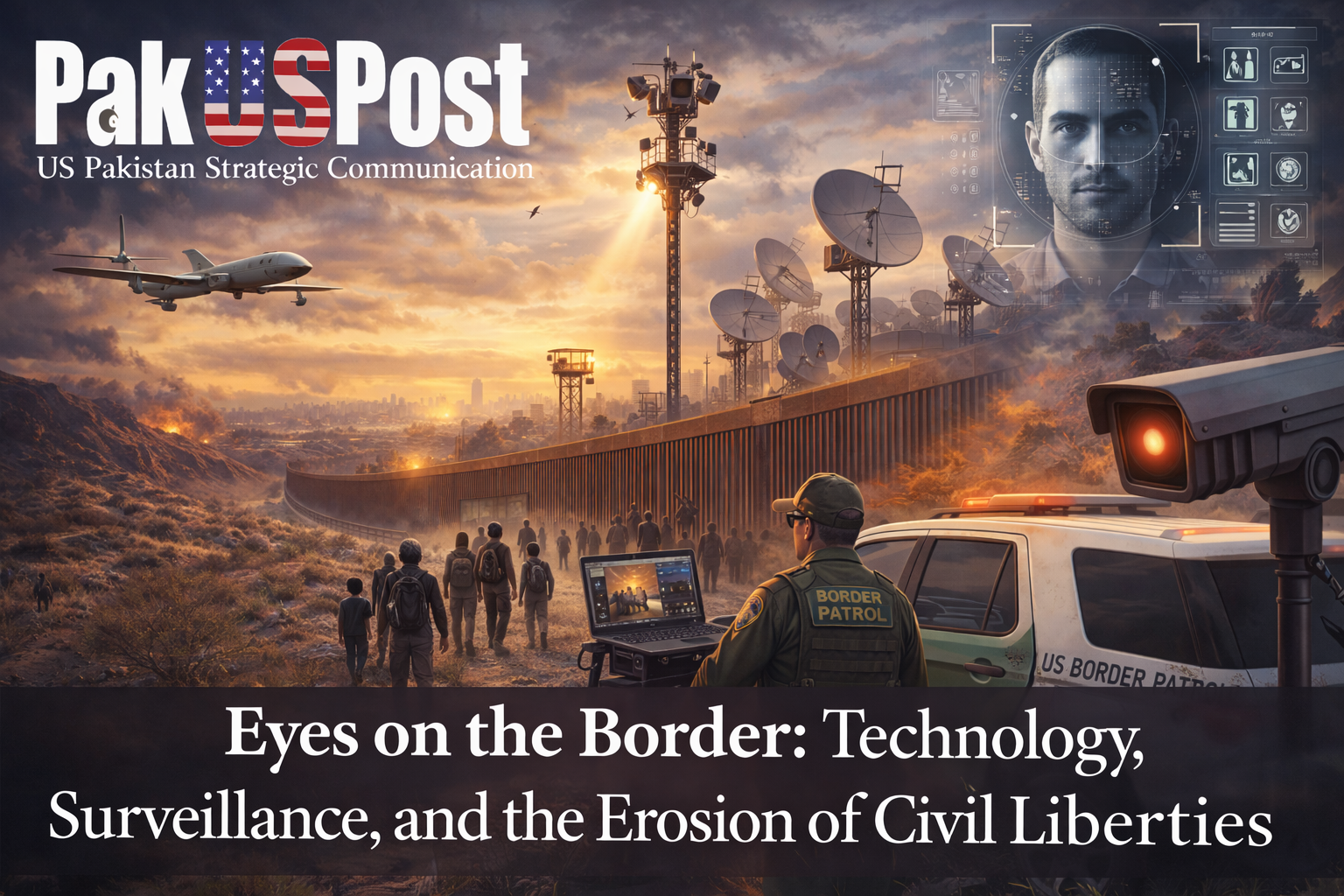
The technological dimension of border management represents both an opportunity and a challenge. Advanced surveillance systems, including aerial drones, sensors, integrated biometric databases, and predictive analytics, have enhanced situational awareness and operational effectiveness. These technologies enable authorities to monitor large swathes of terrain, detect irregular movements, and coordinate rapid responses with unprecedented precision. However, reliance on technology introduces its own risks, including potential vulnerabilities to cyber intrusion, ethical dilemmas regarding privacy, and the possibility of over-reliance at the expense of human intelligence and engagement with local communities. Effective policy requires not only investment in technological tools but also rigorous oversight, interagency coordination, and continuous evaluation of operational effectiveness relative to human rights and civil liberties considerations. In strategic terms, technology serves as a force multiplier but cannot substitute for comprehensive policies that address the root causes of migration, transnational criminal activity, and border instability.
Diplomatic engagement with Mexico and other regional partners is an indispensable component of a coherent border strategy. The United States cannot unilaterally address the complex dynamics of migration and organized crime. Cross-border cooperation, including intelligence sharing, joint operations against trafficking networks, and collaboration on economic development initiatives in source countries, strengthens the capacity of the U.S. to manage risks effectively while building trust and maintaining regional stability. Diplomatic engagement also allows for the alignment of policies with international norms, ensuring that U.S. actions are defensible in global forums and contribute to the broader objectives of hemispheric security and prosperity. Failures in diplomacy, conversely, risk isolating the United States, weakening operational effectiveness, and providing narratives for critics to challenge U.S. legitimacy and commitment to shared regional interests.
Climate and environmental factors are increasingly relevant to strategic planning at the southern border. Extreme heat, flooding, and drought in northern Mexico and Central America drive migration patterns, exacerbate humanitarian risks, and place additional stress on infrastructure and operational capacity along the border. The intersection of environmental degradation with economic vulnerability creates conditions in which irregular migration becomes both necessary for survival and highly dangerous, and U.S. policy must incorporate climate resilience and disaster response into the broader border management framework. Strategic planners are beginning to recognize that climate change is not a peripheral concern but a core driver of security and humanitarian outcomes, linking environmental policy with border strategy, regional development, and international cooperation.
The political dimension within the United States cannot be understated. Immigration and border policy have become central to electoral politics, shaping partisan divides and influencing the allocation of resources to border enforcement, humanitarian programs, and technological investment. Policy decisions are therefore influenced not only by operational necessity but also by public perception, media framing, and the political imperative to demonstrate decisiveness and control. While this politicization can produce rapid policy shifts, it may also undermine continuity, disrupt interagency coordination, and reduce the effectiveness of long-term strategic initiatives. Maintaining policy coherence in the face of political volatility is therefore a critical requirement for effective border governance.
In synthesizing these various dimensions—security, economy, diplomacy, humanitarian, technology, climate, and politics—the southern border emerges as a dynamic strategic theater where success is contingent upon integrated, multidimensional policy design. National security cannot be pursued in isolation from economic facilitation or humanitarian responsibility, nor can technological innovation substitute for robust interagency coordination, regional cooperation, or ethical governance. The border serves as a microcosm of U.S. governance capacity, reflecting how effectively the nation can reconcile competing imperatives, project strength while maintaining legitimacy, and respond adaptively to complex challenges that operate at the intersection of domestic policy and international scrutiny.
Policy recommendations therefore emphasize a comprehensive, forward-looking approach. First, enforcement must be intelligence-driven, adaptive, and coordinated across federal, state, and local agencies. Second, humanitarian protections must be institutionalized to ensure safe, lawful, and ethical treatment of migrants and asylum seekers, mitigating the risk of international censure and preserving credibility. Third, economic interdependence must be preserved through streamlined trade facilitation, bilateral agreements, and infrastructure investment that sustain regional prosperity. Fourth, technological capabilities should be integrated with human intelligence, oversight mechanisms, and privacy safeguards to maximize effectiveness while mitigating ethical and operational risks. Fifth, diplomatic engagement with Mexico and regional partners must be continuous, deepening cooperation on security, development, and climate resilience initiatives. Finally, strategic communication and policy continuity should be prioritized to ensure that operational gains are not undermined by political polarization or short-term electoral pressures.
In conclusion, the southern border of the United States is far more than a physical demarcation; it is a strategic arena where security, economic vitality, humanitarian obligations, environmental pressures, and international perception intersect. The challenges it presents require sophisticated, multidimensional policies that recognize the interdependence of enforcement, diplomacy, technology, and ethics. Success in managing the border reinforces not only national security but also international credibility, economic stability, and moral authority, while failure to do so can produce cascading consequences that compromise operational effectiveness, erode domestic legitimacy, and weaken America’s position in global strategic affairs. For policymakers, the southern border offers both a test of governance capacity and an opportunity to demonstrate how a nation can integrate complex imperatives into a coherent, effective, and ethical strategic framework, ensuring that the United States remains secure, credible, and influential in a rapidly evolving regional and global landscape.
A Public Service Message