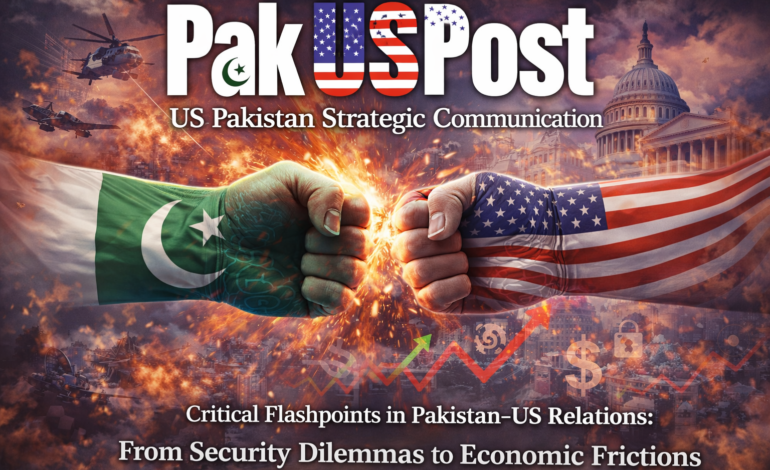
Critical Flashpoints in Pakistan–US Relations: From Security Dilemmas to Economic Frictions


The current arc of Pakistan–United States relations reflects a complex interplay of security dilemmas, economic frictions, geopolitical recalibrations, and emerging diplomatic roles that defy easy classification. Far from the post‑Cold War era dominated by expansive military and counterterrorism cooperation, today’s bilateral trajectory is shaped by a mosaic of unresolved issues. These flashpoints not only expose deep strategic trust deficits but also underscore how shifting global priorities and domestic pressures in both Islamabad and Washington complicate cooperation. From counterterrorism and defence cooperation to trade negotiations and regional mediation, the relationship is both challenged and renewed in different dimensions.
Security cooperation remains an enduring yet fraught pillar of this bilateral engagement. Over decades, the United States and Pakistan built their ties largely around counterterrorism objectives, most prominently during the post‑9/11 era when Islamabad was a frontline partner against extremist groups. That period saw extensive military aid, intelligence sharing, and strategic alignment in Afghanistan and South Asia. However, this collaboration always carried underlying mistrust, with Washington frequently accusing Islamabad of insufficient action against specific militant networks while Pakistan chafed at external pressure on its sovereignty and strategic priorities vis‑à‑vis neighboring states. Such mistrust lingered long after the U.S. troop withdrawal from Afghanistan, with analysts observing that the United States’ strategic interest in Pakistan diminished significantly once its primary military objective was deemed complete. As a result, the partnership settled into a lower‑intensity equilibrium marked by limited engagement and periodic diplomatic outreach rather than the robust strategic alliance of earlier years.
In the current context, security collaboration exists alongside persistent doubts over reliability and mutual expectations. While the U.S. continues to engage with Pakistan’s military leadership on regional security, particularly in the backdrop of spill‑over concerns from crises in neighboring Afghanistan and broader Middle Eastern volatility, Islamabad also seeks to recalibrate its security partnerships. These recalibrations include diversifying alliances beyond Washington, deepening ties with other powers, and asserting a strategic autonomy that reflects Pakistan’s complex security calculus. The tension between cooperation and assertive autonomy creates structural friction in the relationship, reproducing a cyclical dynamic of cooperation under duress followed by periods of diplomatic coolness.
One of the most pressing unresolved issues remains the question of counterterrorism cooperation and intelligence sharing. Although formal mechanisms exist for coordination, trust deficits continue to constrain the depth and transparency of collaboration. The U.S. often expects more decisive action against militant actors it considers threats to regional stability and U.S. interests, while Pakistan’s strategic environment includes balancing internal security needs, territorial sovereignty concerns, and complex relations with regional neighbours. The result is a strategic stalemate where both sides acknowledge shared threats but differ in operational preferences and political framing.
Alongside these security dilemmas, economic frictions also feature prominently as a source of unresolved tension. Trade talks and negotiations over market access have been ongoing, but substantive breakthroughs remain elusive. There have been reports of continued dialogue between officials from both sides focused on trade, investment, and tariff issues, reflecting a mutual recognition that economic cooperation could strengthen broader bilateral ties. However, the specifics, including elimination of steep tariffs on Pakistani exports and improved access to U.S. markets, have yet to translate into a comprehensive trade agreement with clear timelines or commitments. These negotiations are further complicated by competing domestic pressures in both countries. Pakistan seeks relief for its export sectors and foreign exchange earnings, while U.S. policymakers are balancing domestic political considerations on trade policy and labor interests alongside geopolitical strategy.
The geopolitical context within which these security and economic issues unfold further complicates the bilateral agenda. A particularly salient development is Pakistan’s emerging role as a diplomatic interlocutor in regional crises. Recently, Islamabad has positioned itself as a potential mediator in the ongoing U.S.–Iran tensions, leveraging its relatively strong ties with both Tehran and Washington to facilitate dialogue. Through back‑channel communication efforts, Pakistan has been relaying proposals between the United States and Iran, attempting to act as a broker in a conflict that deeply affects regional stability and global energy markets. Islamabad’s diplomatic posture in this regard signals a strategic reorientation where it seeks to exercise independent agency and contribute to conflict resolution rather than simply aligning with a single power. This thrust into mediation reflects both Pakistan’s geopolitical relevance and its desire to diversify its diplomatic portfolio in an increasingly multipolar environment.
While potentially elevating Pakistan’s global diplomatic standing, this role also highlights unresolved strategic dilemmas in the bilateral relationship. For Washington, Pakistan’s mediation could provide a valuable conduit for engagement with a regional adversary, but it also raises questions about Islamabad’s long‑term strategic priorities and how closely those align with U.S. objectives. For Islamabad, the balancing act underscores the difficulty of reconciling relations with major powers that have divergent interests in the region. The pursuit of mediation therefore sits at the intersection of opportunity and risk, exposing underlying uncertainties about strategic coherence in both capitals.
Unresolved political and institutional frictions also colour the broader bilateral landscape. The United States often frames its engagement with Pakistan through the prism of democratic governance, human rights, and accountability, normative themes that resonate within sections of U.S. political discourse and foreign policy circles. However, these priorities can be contested in Islamabad’s domestic political environment, leading to periodic rhetorical tension. Washington’s focus on transparency and governance is sometimes perceived in Pakistan as external pressure that interferes with sovereign political processes, while Islamabad emphasises its own approaches to democratic consolidation and institutional reform. The result is a subtle but persistent normative friction, where global expectations of democratic norms intersect with divergent domestic political realities.
In addition to political disagreements, economic vulnerabilities and development challenges also shape the unresolved issues in the bilateral relationship. Pakistan’s economic fragility, characterised by trade deficits, balance‑of‑payments pressures, and structural reform needs, highlights areas where U.S. engagement could be transformational but has yet to achieve lasting impact. While Washington has historically provided aid and development assistance, the mutual benefits of such engagements are debated within both countries. Pakistan’s need for sustainable economic growth and job creation, particularly for its youth population, remains acute, and how U.S. economic policies and investment frameworks align with these needs is a continuing question. The lack of a comprehensive, mutually supportive economic strategy contributes to frustration on both sides, as potential opportunities for growth remain under‑exploited.
The unintended consequences of these unresolved flashpoints are significant. Continued ambiguity in the security partnership can erode strategic trust, encouraging Pakistan to hedge more decisively with rival powers or pivot towards alternative alliances. This hedging behavior, in turn, complicates Washington’s calculations, particularly as U.S. strategy increasingly emphasizes competition with other major powers, including China and Russia. Economic negotiations that languish without tangible progress can fuel domestic skepticism, leading to narratives that the United States prioritizes its own interests over genuine partnership and exacerbating public distrust. Meanwhile, normative disagreements over governance and political conditionality can inflame nationalist sentiments in Pakistan, further distancing public opinion from cooperation with external actors.
Yet there are also intended outcomes embedded in the ongoing engagements. Both countries have demonstrated an interest in stabilizing and enhancing cooperative frameworks. Continued dialogue on trade and investment signals a mutual understanding that economic interdependence can complement strategic interests. Security cooperation, albeit uneven, continues to function as a channel for shared intelligence and tentative coordination on mutual threats. Diplomacy around regional conflicts illustrate that despite mistrust; there remain openings for constructive engagement on issues of global significance.
At its core, the bilateral relationship is grappling with the realities of a rapidly evolving global order. The United States is recalibrating its foreign policy priorities in an era of great‑power competition, where resources and attention are divided among multiple theatres. Pakistan is negotiating its own strategic autonomy, seeking to maximize its agency amid competing pressures from regional and global powers. In these dynamic, unresolved flashpoints are not merely bilateral problems but symptoms of deeper transformations in international relations.
The pathway toward resolution requires a recalibrated framework that acknowledges these multifaceted challenges. For the United States, articulating a coherent strategy that balances security cooperation with genuine economic partnership and respectful diplomatic engagement can bridge some of the trust deficits. For Pakistan, clarifying strategic priorities in a way that harmonizes domestic imperatives with international partnerships can enhance predictability and mutual confidence. Both sides must also invest in transparent, sustained dialogue that transcends episodic diplomatic overtures, ensuring that cooperation is institutionally anchored rather than transactional.
Ultimately, the future trajectory of Pakistan–US relations will be shaped by how effectively these unresolved flashpoints are managed within a context of interdependence, competition, and geopolitical realignment. The bilateral relationship still holds potential for constructive collaboration, but realizing that potential demands deliberate policy choices, principled engagement, and a shared commitment to addressing the complex challenges that define the contemporary global landscape.
A Public Service Message