
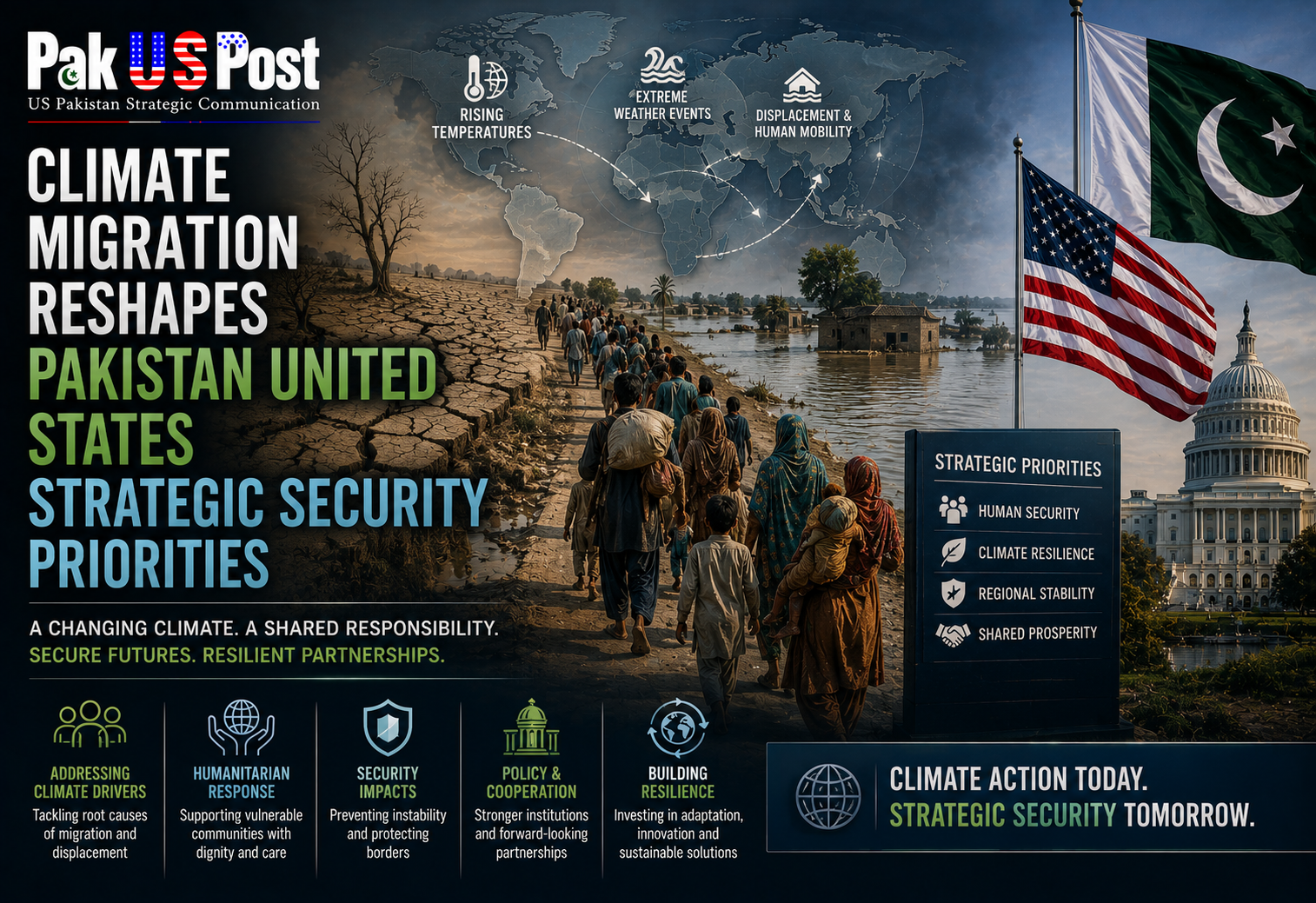
Climate Migration Reshapes Pakistan United States Strategic Security Priorities

Climate change has progressively moved beyond the traditional boundaries of environmental governance into the core architecture of national security, strategic planning and geopolitical stability. The distinction once separating humanitarian emergencies from defence calculations has narrowed considerably as prolonged droughts, catastrophic floods, glacial instability,
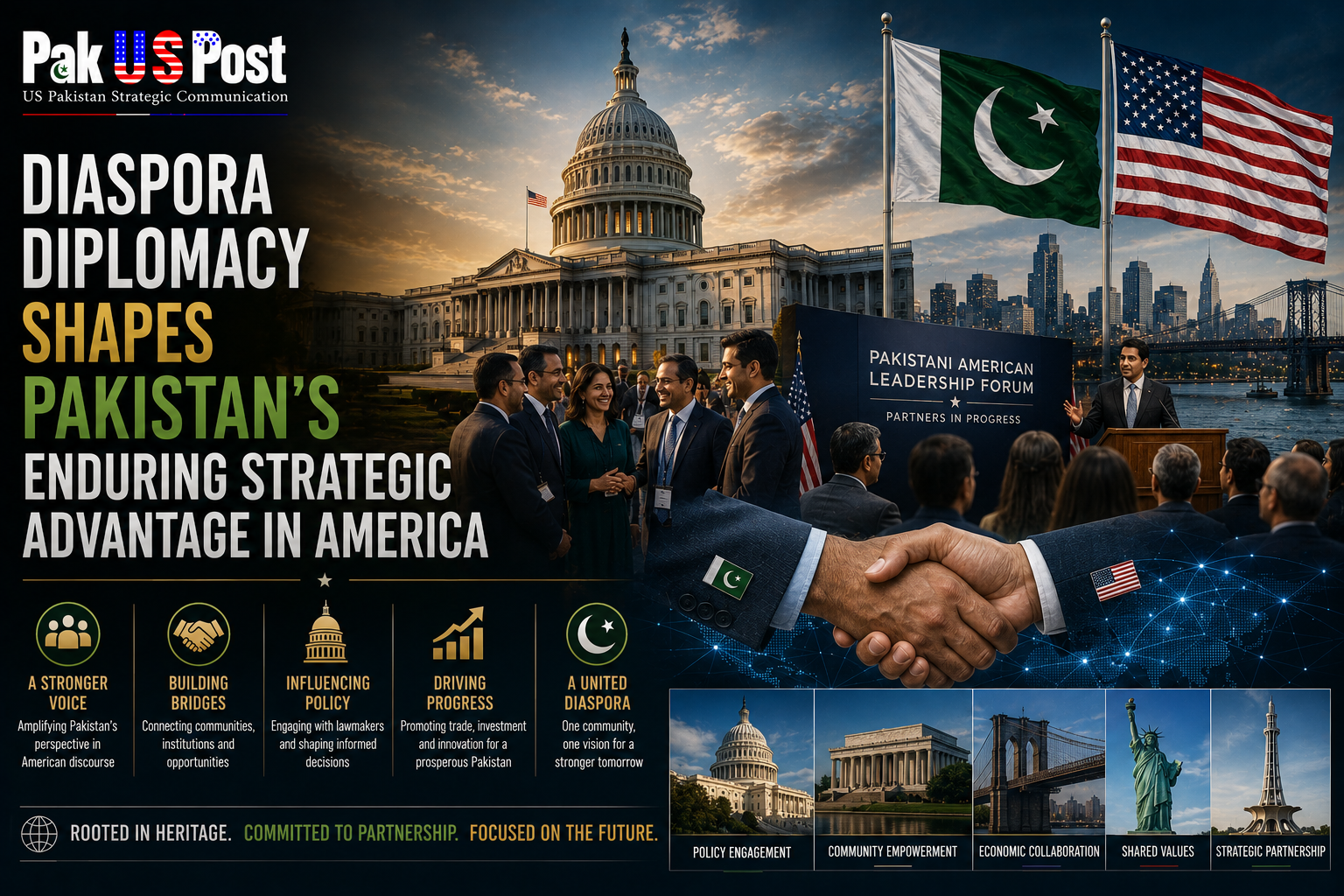
Diaspora Diplomacy Shapes Pakistan’s Enduring Strategic Advantage in America
Few countries possess an untapped strategic asset as extensive, professionally accomplished and geographically dispersed as Pakistan’s community in the United States. Yet despite decades of migration, educational advancement and entrepreneurial success, Pakistan has never transformed its American diaspora into a coordinated instrument of

Making Pakistan US Agreements Publicly Legible
Pak US Post, The durability of the bilateral relationship is increasingly constrained not by the absence of diplomatic engagement, but by the opacity surrounding what engagement is supposed to produce. Washington and Islamabad routinely announce understandings, memoranda, frameworks, investment intentions, security arrangements, development

Strategic Autonomy Is Becoming Costlier for Pakistan
Pak US Post confronts a question that Islamabad has often preferred to frame as diplomatic dexterity rather than strategic accounting: can Pakistan continue cultivating simultaneous relationships with Washington, Beijing, Riyadh, Abu Dhabi, Tehran and other influential capitals without allowing the accumulated expectations of

Urban Heat Governance Shapes National Productivity and Strategic Climate Resilience
Urban heat is no longer a seasonal inconvenience. It has become a structural economic variable, a public health emergency, an infrastructure challenge, and an increasingly important determinant of national competitiveness. Across the world, prolonged periods of extreme heat are reshaping labour markets, industrial

Water Stress and Climate Conditionality in Pakistan’s Security
Pakistan’s water system is no longer a matter of hydrological engineering or agricultural planning in isolation. It has become an accumulating pressure point where climate volatility, fiscal dependency, provincial contestation, and external conditionality converge into a single strategic equation. The country’s exposure is

Institutional Fatigue and Policy Credibility in United States Governance
The United States enters the middle of the decade with an increasingly visible strain between its external expectations and internal administrative capacity. The tension is not episodic, nor can it be reduced to electoral cycles or temporary partisan deadlock. It reflects a deeper

Manufactured Consensus Shapes Pakistan’s Foreign Policy Beyond Public Democratic Accountability
Pakistan’s foreign policy establishment increasingly operates within a carefully managed ecosystem of narrative construction where strategic communication, media securitization, elite consensus manufacturing, and institutional gatekeeping collectively shape the national understanding of external affairs. The deeper concern emerging within sophisticated policy circles is not

COUNTERTERRORISM AND THE STRUCTURAL WEIGHT OF STRATEGIC DISTRUST IN US PAKISTAN RELATIONS
The architecture of US Pakistan relations has been persistently shaped by the long shadow of counterterrorism cooperation, a domain that has simultaneously produced tactical convergence and strategic estrangement. What appears, at first glance, as a record of sustained collaboration against transnational militancy is

Elections Turn Fragile States into Predictable Violence Cycles
Electoral democracy is often described as the institutional heartbeat of modern governance, a periodic mechanism through which legitimacy is renewed and political contestation is peacefully resolved. Yet across a widening arc of fragile and transitional states, elections are increasingly functioning in the opposite