Balancing Great Power Interests: Pakistan’s Foreign Policy in the Age of US–China Rivalry

In the current era of intensifying geopolitical contestation, Pakistan finds itself navigating unprecedented strategic complexity arising from the deepening rivalry between the United States and the People’s Republic of China. This rivalry is not merely a contest for global influence; it is a systemic reordering of international relations that permeates economic, technological, military, diplomatic, and normative domains. For Pakistan, whose foreign policy has historically been shaped by security exigencies, regional dynamics, and superpower interests, the contemporary environment demands a recalibration of strategic posture one that simultaneously safeguards national sovereignty, advances economic modernization, and exploits opportunities for strategic agency without drifting into the orbit of any single hegemonic actor.
Pakistan’s historical engagement with global powers has been characterized by periods of alignment and realignment in response to shifting strategic imperatives. During the Cold War, Pakistan entered into formal alliances with the United States as part of collective security frameworks aimed at countering Soviet expansionism. This relationship, grounded in security cooperation, military assistance, and political alignment, delivered material benefits but also entrenched strategic dependencies that constrained autonomous policy options. The aftermath of the Soviet withdrawal from Afghanistan in 1989 and the subsequent recalibration of US priorities exposed the asymmetries inherent in this alignment, as Washington disengaged and Pakistan faced economic stagnation and international isolation by successive waves of sanctions.
The post‑9/11 era temporarily revitalized US–Pakistan ties as Islamabad became a frontline partner in the global campaign against violent extremism. While this partnership restored channels of cooperation, it also underscored persistent mistrust, divergent threat perceptions, and transactional dynamics. Concurrently, Pakistan deepened its strategic partnership with China, grounded in mutual geopolitical interests, economic cooperation, and shared skepticism toward external pressures on sovereign domestic policies. This Sino‑Pakistan axis, epitomized by the China‑Pakistan Economic Corridor (CPEC), has evolved into a cornerstone of Islamabad’s long‑term economic strategy, promising infrastructure investment, industrial development, and enhanced connectivity.
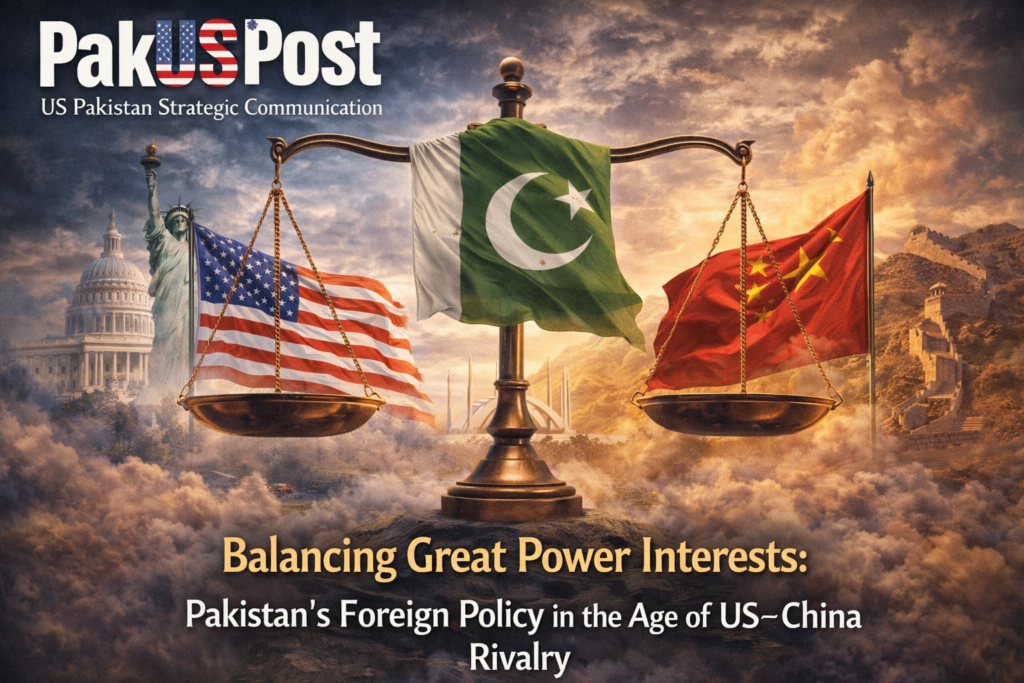
It is against this backdrop that the emergent US–China rivalry exerts multifaceted pressures and opportunities for Pakistan. The intensification of this rivalry has manifested in trade confrontations, technological competition, military posturing, alliance formations, and normative contestation over global governance norms. For Islamabad, navigating this rivalry entails avoiding binary alignment while extracting maximum strategic benefit from both partners. This delicate balancing act is inherently complex, requiring nuanced diplomacy, strategic foresight, and institutional coherence.
Pakistan’s recent engagement in diplomatic mediation during the US–Iran conflict, alongside participation in US‑led economic initiatives such as the Critical Minerals Supply Initiative, reflects an attempt to broaden its foreign policy horizons beyond conventional security prisms. At the same time, Islamabad’s collaboration with Beijing on a jointly proposed peace framework underscores the enduring importance of the Sino–Pakistan relationship and reflects a willingness to engage major powers in concert rather than in competition. These developments illuminate Islamabad’s strategic intent to position itself as an interlocutor capable of bridging divergent interests, thereby elevating its profile while preserving autonomy.
The strategic imperative for Pakistan is to interpret its relations with the United States and China through lenses that transcend transactional cooperation. With the United States, Pakistan must seek substantive engagement that integrates economic modernization with security collaboration, fostering partnerships that support technology transfer, investment, and institutional capacity building. Simultaneously, Pakistan must acknowledge that US strategic objectives in South Asia are influenced by broader priorities, including India’s emergence as a partner in balancing China, and that Islamabad’s value in Washington’s calculus is conditional and bounded.
Engagement with China, on the other hand, offers Pakistan opportunities for long‑term economic transformation through infrastructure investment, industrial diversification, and connectivity projects. The deepening of the Sino–Pakistan economic partnership has yielded tangible gains, particularly through energy projects, transport corridors, and special economic zones. However, this partnership is not without challenges. Beijing’s strategic interests are not always congruent with Islamabad’s domestic development priorities, and the asymmetry of economic power raises questions about dependency and leverage. Therefore, Pakistan must approach this relationship with both gratitude for strategic support and critical assessment of long‑term risks.
The US–China rivalry also introduces geopolitical fault lines that Pakistan cannot ignore. The competition for influence in the Indian Ocean, Central Asia, and the Middle East situates Pakistan in a region of strategic consequence. As the United States strengthens partnerships with India and other regional actors, Islamabad must carefully manage its security relationships to avoid strategic encirclement. At the same time, Pakistan’s geographic position, demographic potential, and economic aspirations make it a significant actor in regional connectivity initiatives that both Washington and Beijing seek to influence.
The technological dimension of the rivalry adds another layer of complexity. The contest over semiconductor supply chains, digital infrastructure, artificial intelligence, and cybersecurity has global ramifications. Pakistan’s engagement in technology partnerships that extend beyond military cooperation to civilian technological adoption and innovation will determine its future competitiveness. Aligning with global standards, attracting investment in technology sectors, and developing indigenous capacity should be central to Islamabad’s strategic agenda. Failing to do so may tether Pakistan to outdated paradigms that reinforce dependence and limit sovereign agency.
Economically, Pakistan’s strategic challenge is to diversify trade and investment sources while avoiding polarizing dependencies that could constrain policy autonomy. Engagement in global value chains, participation in regional trade arrangements, and adoption of transparent regulatory frameworks will increase Pakistan’s attractiveness to a wide range of partners. This approach aligns with the objective of mitigating the risks associated with overreliance on any single partner, whether in infrastructure financing, defense procurement, or critical resources.
Pakistan’s diplomatic strategy must be underpinned by institutional strengthening. Foreign policy cannot be the domain of the Ministry of Foreign Affairs alone; it must integrate inputs from economic planners, defense strategists, industry stakeholders, and civil society. The establishment of strategic think tanks, foresight units, and interagency coordination mechanisms will enhance policy coherence and enable Pakistan to anticipate global shifts rather than react to them. Decision‑making frameworks that incorporate risk assessment, scenario planning, and competitive intelligence will position Islamabad to make informed strategic choices.
The narrative Pakistan projects internationally is equally consequential. Islamabad must articulate a coherent vision of its strategic priorities that resonates with both Western and Eastern partners without compromising core principles of sovereignty, non‑alignment, and equitable cooperation. This narrative should emphasize Pakistan’s commitment to peace, economic modernization, and constructive engagement while resisting external pressures that undermine domestic policy prerogatives. Such articulation not only enhances diplomatic credibility but also reinforces Pakistan’s normative stance in global forums.
Security cooperation, while necessary, must be repositioned within a broader framework that prioritizes human security, economic resilience, and institutional stability. Engagement in counterterrorism, border management, and regional security dialogues remains important, yet it should be complemented by concerted efforts to address socioeconomic drivers of instability. Pakistan’s foreign policy must therefore integrate domestic development goals with external engagements, recognizing that sustainable security is inseparable from economic opportunity and social inclusion.
The fluidity of global alliances also provides Pakistan with opportunities to deepen cooperation with emerging partners. Engagement with the European Union, ASEAN, Gulf Cooperation Council states, and African economies can diversify Pakistan’s diplomatic and economic portfolio. These partnerships, grounded in mutual interest rather than strategic contestation, offer avenues for trade expansion, technology transfer, and cooperative development. Pakistan’s outreach to these regions must be strategic, sustained, and based on clear value propositions that align mutual priorities.
Critically, Pakistan must avoid zero‑sum interpretations of the US–China rivalry that compel forced alignment. The essence of Pakistan’s strategic challenge is to maintain sovereign autonomy while maximizing benefits from multiple partnerships. This requires clarity of purpose, strategic patience, and a willingness to assert national interests even when they diverge from the agendas of powerful partners. Pakistan’s diplomatic agency is measured not by alignment with hegemonic blocs but by its capacity to shape outcomes that reflect national priorities.
In operational terms, Pakistan should invest in diplomatic infrastructure that enhances its capacity to engage in high‑level multilateral forums, contribute to conflict resolution, and influence global governance norms. Active participation in institutions such as the United Nations, World Trade Organization, and emerging forums for digital governance and climate action will amplify Pakistan’s voice. Equally important is Pakistan’s engagement in regional architectures such as the Shanghai Cooperation Organization and South Asian strategic dialogues that provide platforms for collaborative problem‑solving.
The interplay between domestic politics and foreign policy also merits attention. Political stability, institutional integrity, and transparent governance strengthen Pakistan’s bargaining position in international engagements. Conversely, political polarization, policy discontinuity, and governance deficits weaken strategic coherence and expose vulnerabilities that external actors can exploit. Strengthening democratic processes, reinforcing rule of law, and promoting accountable governance are therefore strategic imperatives that bolster foreign policy effectiveness.
From a policy‑maker perspective, Pakistan must articulate a long‑term strategic framework that sequences priorities, allocates resources, and delineates benchmarks for evaluating progress. This framework should integrate economic modernization goals, defense planning, technological adaptation, and diplomatic outreach into a unified vision that transcends short‑term exigencies. Strategic clarity will enable Pakistan to engage with the United States and China from positions of informed choice rather than reactive necessity.
In conclusion, Pakistan’s navigation of the US–China rivalry is a defining challenge of the current geopolitical epoch. Success in this endeavor requires a sophisticated understanding of global power dynamics, disciplined strategic execution, and unwavering commitment to sovereign interests. Pakistan has the potential to emerge as a constructive, autonomous, and influential actor in a world defined by competition and cooperation in equal measure. Achieving these potential demands strategic foresight, institutional resilience, and an unwavering focus on national development objectives that harmonize domestic priorities with global engagement. The balance Pakistan strikes today will determine not only its role in the international system but also the quality of life and prosperity for generations to come.
A Public Service Message