Strategic Economic Diplomacy: Pakistan’s Engagement with the US‑Led Critical Minerals Supply Initiative and its Geopolitical Implications

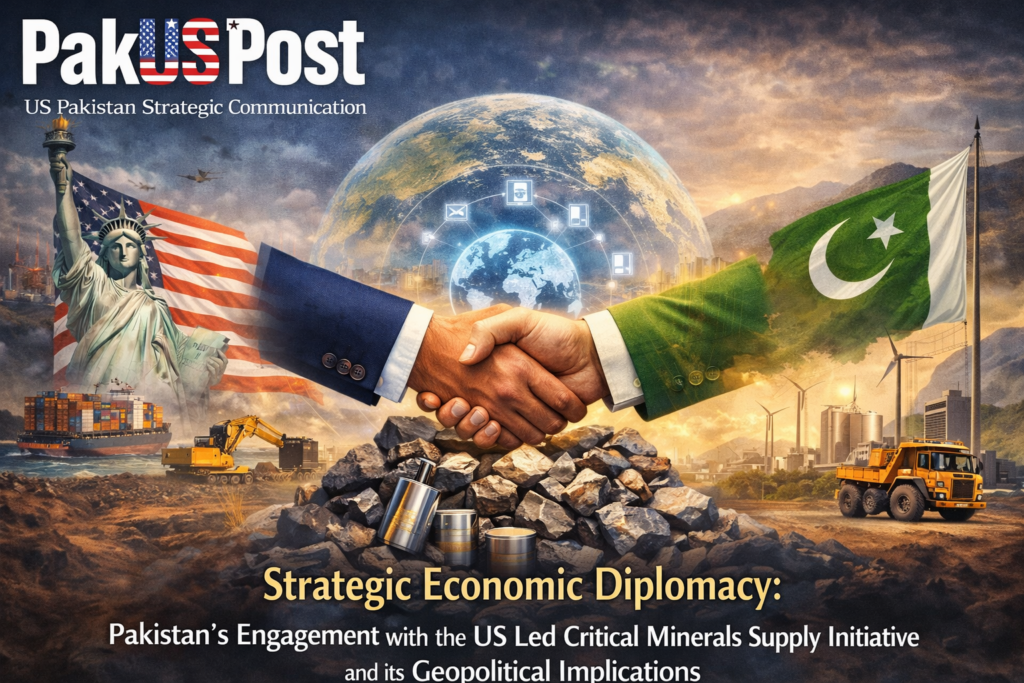
In the context of an increasingly multipolar global order, Pakistan’s recent participation in the United States‑led Critical Minerals Supply Initiative represents a strategic evolution in its foreign policy, signaling a deliberate shift from a security‑centric paradigm toward proactive economic diplomacy. The initiative, which seeks to secure resilient supply chains for minerals integral to advanced technologies, energy transition, and defense applications, provides Islamabad with a platform to integrate economic engagement into its broader geopolitical strategy. This engagement reflects recognition that economic leverage, technological collaboration, and resource diplomacy are critical instruments for asserting sovereign influence in an era defined by complex interdependencies and competitive global economics.
Pakistan’s involvement in the initiative is both timely and consequential. Global disruptions in the supply of critical minerals exacerbated by geopolitical crises in the Middle East, sanctions regimes targeting Russia and Iran, and the US–China strategic competition have heightened the strategic value of securing reliable mineral sources. By aligning with the United States in this domain, Pakistan positions itself as a cooperative actor capable of contributing to the stability and resilience of essential global supply chains, thereby enhancing its diplomatic capital and credibility among advanced economies. This move also signals Islamabad’s intent to diversify its economic partnerships and reduce overreliance on traditional trade corridors and bilateral agreements that may be susceptible to geopolitical volatility.
The initiative’s potential implications extend beyond immediate economic gains. Critical minerals, including lithium, cobalt, rare earth elements, and graphite, underpin emerging sectors such as renewable energy, electric vehicles, semiconductors, and military hardware. Pakistan’s participation enables it to integrate domestic industrial planning with global demand patterns, thus promoting technological development, infrastructure modernization, and industrial competitiveness. Moreover, this engagement creates a framework for knowledge transfer, investment inflows, and capacity building that can enhance Pakistan’s long‑term economic resilience and strategic autonomy. The intersection of economic, technological, and security imperatives underscores the multidimensional nature of this engagement and its capacity to recalibrate Pakistan’s position within global governance frameworks.
The geopolitical dimension of this initiative is equally salient. By joining a US‑led multilateral effort, Pakistan signals alignment with Western strategic priorities while simultaneously maintaining strategic partnerships with China, with whom it has coordinated in regional peace initiatives and trade corridors under the Belt and Road framework. This dual engagement reflects Islamabad’s calibrated approach to balancing major power interests, leveraging economic cooperation to strengthen diplomatic agency without compromising sovereignty or strategic flexibility. In this light, economic diplomacy is not merely transactional but constitutes a deliberate instrument for reinforcing Pakistan’s global posture and enhancing leverage in both bilateral and multilateral negotiations.
The strategic calculus for Pakistan also involves internal policy coherence and institutional capacity. Effective engagement in critical mineral diplomacy requires interministerial coordination across foreign affairs, commerce, industry, and energy portfolios, as well as alignment with domestic investment policies, regulatory frameworks, and infrastructure development plans. Failure to integrate these domains risks diminishing the benefits of participation and undermining credibility in international partnerships. Consequently, Pakistan must adopt a comprehensive policy architecture that aligns diplomatic intent with industrial strategy, technological capability, and regulatory robustness, thereby ensuring sustainable and credible engagement in the global critical minerals landscape.
Furthermore, Pakistan’s engagement in this initiative has implications for regional trade dynamics and economic influence. By participating in a US‑led framework, Islamabad can potentially facilitate transnational partnerships, attract foreign investment into mineral extraction and processing, and integrate domestic supply chains with global production networks. This positioning enhances Pakistan’s capacity to project economic influence in South and Central Asia while offering the potential for synergistic cooperation with neighboring states in areas of shared interest, such as energy security, infrastructure development, and technological collaboration. By embedding economic diplomacy within regional frameworks, Pakistan can advance both domestic prosperity and geopolitical relevance concurrently.
The domestic policy dimension of this strategic engagement cannot be overstated. Investment in critical mineral capacity and allied sectors necessitates a coherent industrial policy, supportive infrastructure, skilled human capital, and regulatory clarity. Pakistan must therefore leverage its participation to catalyze domestic industrial transformation, emphasizing resource efficiency, technological adoption, and environmental sustainability. Integration of domestic objectives with global economic opportunities ensures that participation in the initiative yields tangible benefits for national development while reinforcing the strategic narrative of proactive engagement in international affairs.
From a policy‑maker perspective, the following imperatives emerge. Pakistan should institutionalize its engagement in global mineral diplomacy through dedicated task forces, strategic foresight units, and coordination mechanisms that align foreign, economic, and industrial policies. Diplomatic efforts must be complemented by domestic reforms to streamline investment procedures, enhance technological readiness, and secure environmental and social governance standards. Moreover, Pakistan must adopt a strategic communication framework to project its contributions and capabilities in international forums, thereby amplifying soft power and reinforcing its narrative as a responsible and forward-looking actor in global economic governance.
The broader strategic benefits of engagement in the Critical Minerals Supply Initiative extend to Pakistan’s capacity to hedge against geopolitical uncertainty. By embedding itself in a network of multilateral economic partnerships, Pakistan can mitigate exposure to regional disruptions, reduce vulnerability to unilateral sanctions, and establish alternative channels for trade, investment, and technological collaboration. These structural advantages enhance both national resilience and strategic autonomy, providing Islamabad with the means to navigate a complex and often adversarial international system with greater confidence and leverage.
In conclusion, Pakistan’s participation in the US‑led Critical Minerals Supply Initiative exemplifies a sophisticated exercise in strategic economic diplomacy. It reflects an awareness that in the contemporary geopolitical environment, economic engagement, technological collaboration, and resource diplomacy are inextricable from security and foreign policy objectives. By integrating domestic industrial strategy with international economic partnerships, calibrating relations between major powers, and institutionalizing engagement mechanisms, Pakistan can leverage this initiative to enhance both economic prosperity and diplomatic capital. This approach offers a template for reconceptualizing foreign policy as a multidimensional instrument of national strategy, capable of advancing sovereign interests while contributing constructively to global stability and governance. The success of this engagement will ultimately depend on Pakistan’s ability to operationalize strategic intent, align domestic capacity with international expectations, and sustain coherent, credible, and principled diplomacy in pursuit of long-term national and regional objectives.
A Public Service Message