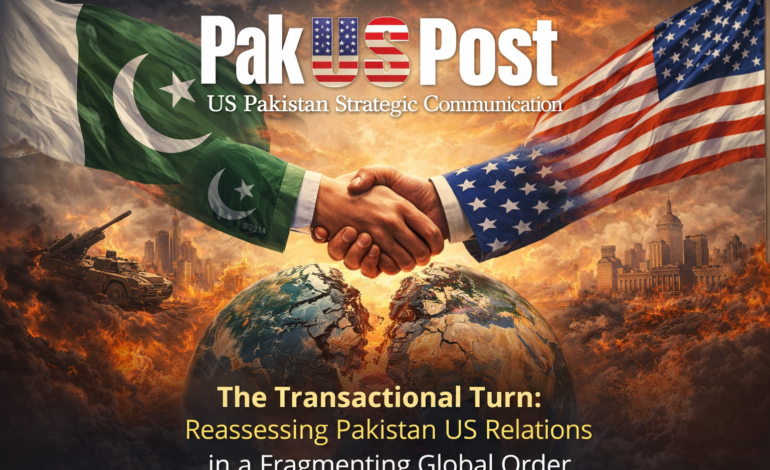
The Transactional Turn: Reassessing Pakistan‑US Relations in a Fragmenting Global Order


For decades, the critique of Pakistan‑United States relations has revolved around the idea of its transactional character, often described as an alliance of convenience marked by strategic highs and diplomatic lows. This critique has frequently carried a moral undertone, suggesting that transactional diplomacy is inherently inferior to alliances grounded in shared values and principles. Yet in the contemporary global context, where American foreign policy has undergone profound changes under the influence of populist nationalism and unilateralism, the very notion of transactional diplomacy deserves reconsideration. The assertion that Pakistan’s engagement with Washington is purely opportunistic must be understood not as a failure of policy but as a deliberate adaptation to a global environment in which transactional statecraft has become the norm rather than the exception. In a world where great powers increasingly prioritize short-term gains over long-standing ideological commitments, the pragmatism that Pakistan has cultivated for decades may in fact reflect strategic foresight rather than opportunism.
The concept of transactional diplomacy has evolved in tandem with transformations in global power dynamics. The era of value-based alliances, in which cooperation was anchored in shared democratic norms and multilateral agreements, is giving way to a system characterized by pragmatic bargaining, zero-sum calculations, and flexible alignments. The American approach exemplifies this shift, particularly under political movements that have normalized the view that traditional allies and international institutions often advance their interests at the expense of the United States. In this context, transactional diplomacy is no longer a moral failing but a practical necessity for middle powers navigating an increasingly uncertain and fragmented global order. Pakistan’s foreign policy, long criticized for its perceived opportunism, aligns with this reality. By engaging simultaneously with Washington, Beijing, and Riyadh, Pakistan is pursuing a strategy of diversification that mitigates risk, preserves strategic autonomy, and maximizes national interest.
Stephan Klingebiel’s concept of a global order minus one offers a compelling lens through which to understand this evolution. According to this framework, the United States, by selectively undermining multilateral norms and emphasizing unilateral action, creates a system in which remaining states must rely less on institutional guarantees and more on their own bargaining power. In such an environment, the ability to navigate strategic partnerships flexibly, to negotiate discreetly, and to maintain leverage across multiple actors becomes essential for national survival. Pakistan’s historically pragmatic approach is therefore not a weakness but a sophisticated response to a world in which rules-based cooperation is increasingly unstable and strategic calculus predominates over normative alignment. What critics often perceive as opportunism is, in fact, an adaptive strategy designed to maintain agency in a fluid international landscape.
The recent meeting between Prime Minister Shehbaz Sharif and former President Donald Trump illustrates this transactional approach in practice. The meeting, notable for its absence of a joint communique, emphasized private negotiation rather than public signaling. This departure from the ceremonial declarations and grand pronouncements of previous decades underscores a broader trend in global diplomacy: substance increasingly takes precedence over rhetoric, and the public performativity of alliances is subordinated to the pursuit of tangible benefits. Pakistan’s willingness to engage in this mode of diplomacy reflects an acute understanding of the changing norms of international negotiation. Rather than seeking validation through public statements, the leadership prioritizes discreet, behind-the-scenes engagement that safeguards national interests while navigating the unpredictability of American policy-making.
Critics of transactional diplomacy often contend that prioritizing pragmatism over principles risks moral compromise or strategic vulnerability. They argue that Pakistan may be too willing to accommodate the demands of external powers or to subordinate domestic priorities in pursuit of temporary gains. However, this critique fails to account for the reality of global politics in the twenty-first century, where even the United States itself selectively emphasizes values-based diplomacy only when it aligns with strategic objectives. The inconsistency in Washington’s foreign policy—oscillating between advocating democratic norms and engaging with authoritarian regimes when convenient—demonstrates that transactional diplomacy is not unique to Pakistan. Rather, it reflects a global trend in which strategic interests frequently supersede normative commitments.
Pakistan’s approach is thus best understood as a hedging strategy, balancing multiple partnerships to maximize flexibility and preserve sovereignty. Engagement with China, through initiatives such as the Belt and Road Project, provides economic investment and infrastructure development. Cooperation with Saudi Arabia ensures regional security support, particularly in defense and energy. Maintaining ties with the United States, despite its unpredictability, allows Pakistan to leverage strategic assistance, access markets, and shape global narratives that impact regional stability. This multidirectional engagement is not a departure from principle but an exercise in maintaining strategic autonomy while operating within a system increasingly defined by competition rather than consensus. It demonstrates that middle powers can exercise agency and influence even when great powers act in unilateral or transactional ways.
At the same time, transactional diplomacy carries inherent risks. Pragmatism can become indistinguishable from capitulation if a state consistently prioritizes external demands over national interest. Pakistan must navigate a delicate balance, ensuring that its engagements, while flexible, do not compromise sovereignty or erode the capacity for independent decision-making. The challenge lies in maintaining credibility with all partners, particularly when American policy fluctuates between engagement and withdrawal. Misreading signals or overcommitting to any one actor could weaken Pakistan’s strategic position and reduce its leverage across multiple relationships. Therefore, transactional diplomacy must be exercised with clarity, foresight, and an unwavering commitment to core national interests.
This balance between pragmatism and sovereignty is particularly relevant in light of domestic political pressures. Pakistani policymakers must ensure that external engagement does not become a tool for internal political contestation, which could undermine both domestic legitimacy and international credibility. Domestic actors often frame relations with Washington as either evidence of moral alignment or betrayal, thereby transforming foreign policy into a domestic political instrument. This creates additional challenges for leadership, which must navigate public perception while engaging in the discreet, calculated negotiations that characterize contemporary diplomacy. In this sense, transactional diplomacy is both a necessity and a skill, requiring not only strategic foresight but also the political acumen to manage narratives and expectations.
The evolution of Pak-US relations within this transactional framework also has implications for regional dynamics. Pakistan’s balanced engagement with the United States, China, and Saudi Arabia positions it as a pivotal actor in South Asia and the Middle East. By diversifying its partnerships, Pakistan reduces dependence on any single power and strengthens its capacity to influence outcomes in regional conflicts, economic development projects, and security initiatives. This multifaceted strategy allows Pakistan to maintain relevance in global affairs even as traditional alliance structures become less predictable. In a world where multilateral institutions are weakening and unilateralism is increasingly common, the ability to navigate multiple partnerships simultaneously is a key attribute of resilience and strategic acumen.
Moreover, the transactional model enables Pakistan to prioritize practical outcomes over symbolic gestures. In an era where global rhetoric often emphasizes values while actual policies are dictated by interest, Pakistan’s willingness to focus on tangible benefits—whether in trade agreements, military cooperation, or investment projects—enhances its credibility as a reliable partner. This approach is particularly valuable when dealing with an American administration that alternates between ideological signaling and hard-nosed negotiation. By emphasizing results and adaptability, Pakistan demonstrates that it can operate effectively in a world where power, rather than principle, often dictates outcomes. In doing so, it sets an example for other middle powers seeking to preserve agency in a fragmented global order.
The transactional turn also reshapes expectations regarding diplomatic communication. Grand statements, joint communiques, and ceremonial alliances are increasingly less important than private negotiations, strategic leverage, and careful alignment of mutual interests. Pakistan’s foreign policy reflects this understanding, with leadership focused on maximizing outcomes while minimizing exposure to reputational or strategic risk. The emphasis on pragmatism over performative diplomacy allows Pakistan to maintain flexibility and preserve options even when global conditions shift rapidly. In essence, transactional diplomacy in this context is not merely a tactical choice but a strategic adaptation to the evolving rules of international engagement.
In conclusion, the long-standing critique of Pakistan-US relations as transactional requires reassessment in the context of contemporary global politics. Transactional diplomacy is no longer an aberration; it is a reflection of the realities of a world in which strategic interests frequently outweigh normative alignment, where multilateral norms are eroded, and where middle powers must hedge across multiple partnerships to preserve sovereignty and influence. Pakistan’s historically pragmatic approach, balancing relations with Washington, Beijing, and Riyadh, demonstrates a sophisticated understanding of these dynamics. While risks remain, particularly regarding the potential for overdependence or domestic politicization, the transactional model allows Pakistan to navigate uncertainty, maximize agency, and secure tangible outcomes in a fragmented global order. In a world where strategic calculation increasingly supplants moral or ideological alignment, Pakistan’s experience offers a valuable case study in the evolution of statecraft, illustrating how pragmatism, when anchored in clear national interest and exercised with foresight, can serve as a powerful tool for survival, influence, and resilience.
A Public Service Message