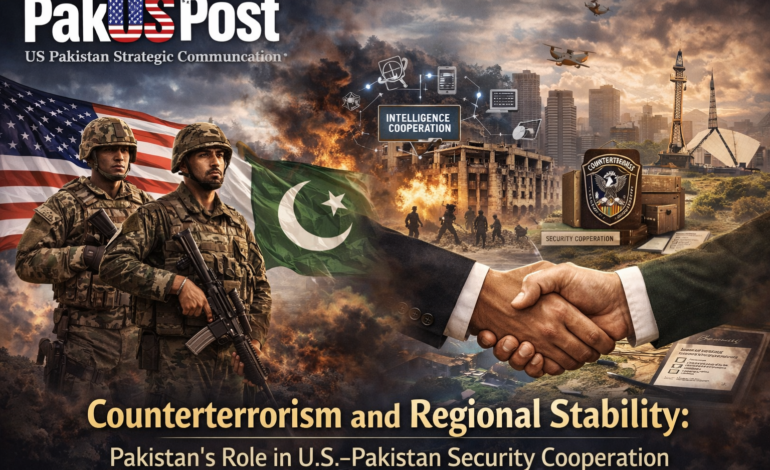
Counterterrorism and Regional Stability: Pakistan’s Role in U.S.-Pakistan Security Cooperation


Pakistan occupies a strategic vantage point in South Asia and the wider Middle East, where emerging conflicts, fragile states, and transnational extremist networks continuously redefine the security landscape. Islamabad’s historical experience in counterterrorism, combined with its geographic proximity to Afghanistan, Iran, and key regional hotspots, positions it as an indispensable partner for the United States. Yet, for decades, Pakistan’s contributions have been perceived as reactive rather than proactive, limiting its strategic influence. Today, a unique opportunity exists for Pakistan to recalibrate its engagement, integrate operational capacity with diplomatic foresight, and establish itself as a credible architect of regional stability. For policymakers and diplomats, a structured, forward-looking approach is essential to ensure that Pakistan derives measurable strategic, economic, and political benefits from its cooperation with the United States.
The contemporary environment is defined by multiple challenges. Afghanistan’s instability, the persistent threat of transnational militant networks, and cross-border insurgency complicate regional security, while U.S. counterterrorism priorities have evolved to emphasize intelligence-led operations, hybrid threat mitigation, and multilateral cooperation. Pakistan’s response must be both systematic and multidimensional. This requires integrating military operations, intelligence coordination, legal reform, diplomatic engagement, and development-oriented security initiatives into a coherent national strategy that aligns with U.S. priorities while safeguarding sovereignty and strategic autonomy.
To operationalize these objectives, Pakistan must establish a U.S.–Pakistan Strategic Security Forum, a permanent platform that includes senior officials from military intelligence, civilian security agencies, and foreign affairs departments. This forum would coordinate joint operational planning, share threat intelligence, and provide a structured channel to communicate Pakistan’s policy priorities to Washington. By formalizing engagement mechanisms, Islamabad can transition from reactive diplomacy to proactive strategic management, allowing it to negotiate tangible security cooperation benefits rather than responding to ad hoc U.S. initiatives.
Equally important is the integration of counterterrorism operations with regional stabilization efforts. Pakistan must develop comprehensive regional stabilization blueprints that combine intelligence-sharing, cross-border monitoring, counter-financing of terrorism, and deradicalization programs. By linking operational capability with diplomatic engagement, Islamabad can demonstrate measurable impact, position itself as a reliable partner, and secure U.S. support for broader security and development initiatives.
Institutional capacity-building must accompany operational reforms. Pakistan should invest in cyber-intelligence, hybrid threat response, and early-warning systems, ensuring preparedness for rapidly evolving threats. Training, technology transfer, and integration of AI-based monitoring systems will strengthen both domestic security and Pakistan’s credibility as a sophisticated partner for the United States. Policymakers will benefit from an enhanced negotiating position in bilateral security agreements, military assistance, and intelligence collaboration.
Diplomacy and strategic communications are critical to reinforcing Pakistan’s role. Islamabad should articulate its counterterrorism successes through think tanks, policy forums, and international media engagement. Highlighting achievements in border stabilization, insurgent neutralization, and intelligence-led operations will bolster Pakistan’s credibility, support negotiations for U.S. assistance, and ensure that contributions are acknowledged in global security discourse.
Operational cooperation should extend to capacity-building for regional partners. Pakistan can train Afghan border forces, regional law enforcement, and counterterrorism units, converting its operational expertise into soft power. This approach enhances Pakistan’s regional leadership role, strengthens U.S.-Pakistan trust, and reinforces its position as a proactive security actor.
Multilateral engagement amplifies impact. Pakistan should leverage its participation in forums such as the Shanghai Cooperation Organization and the Organization of Islamic Cooperation to integrate bilateral U.S.-Pakistan initiatives into broader regional frameworks. Policy-makers can use these platforms to lead initiatives on counterterrorism financing, cross-border intelligence-sharing, and extremist ideology mitigation, ensuring that Pakistan’s contributions are institutionalized and recognized internationally.
Development-linked security programs further enhance outcomes. Infrastructure, education, and employment projects in border regions mitigate conditions that give rise to militancy. By aligning development and security agendas, Pakistan can secure U.S. investment while strengthening domestic resilience and improving its image as a responsible regional actor.
Timeline of Recent Developments (Operational Context for Pakistan Policy-Makers):
- August 2021: Taliban takeover of Afghanistan increases cross-border security concerns; Pakistan becomes key mediator between Kabul and U.S. interests.
- October 2021: Pakistan and U.S. conduct joint intelligence-sharing initiative focusing on border monitoring and counterterrorism financing.
- March 2022: Islamabad hosts regional counterterrorism workshop with U.S. participation, strengthening Pakistan’s role as a facilitator of regional stability.
- July 2023: U.S. announces targeted security assistance package to Pakistan contingent on institutional reforms in intelligence coordination and border management.
- January 2024: Pakistan implements early-warning systems along western borders, enhancing operational readiness and signaling reliability to Washington.
- September 2025: Pakistan launches integrated deradicalization programs in border provinces, attracting U.S. technical and advisory support.
- February 2026: Strategic dialogue framework between Pakistan and U.S. finalized, enabling structured cooperation on intelligence, cyber-security, and regional stabilization.
Risk-Opportunity Matrix for Pakistan’s U.S.-Pakistan Security Cooperation:
| Dimension | Risks | Opportunities / Policy Levers | Operational Recommendations |
| Operational Security | Overexposure to U.S. operational priorities may constrain autonomy; intelligence leakage risks. | Demonstrate expertise in counterterrorism; lead regional initiatives. | Establish secure intelligence-sharing protocols and cross-agency oversight mechanisms. |
| Regional Diplomacy | Misalignment with Afghan, Iranian, or regional actors could create tension; risk of being perceived as U.S. proxy. | Mediation role enhances credibility; leverage regional forums. | Launch structured regional stabilization frameworks and diplomatic engagement programs. |
| Institutional Capacity | Limited cyber and hybrid threat capabilities; fragmented coordination among agencies. | Modernization strengthens operational readiness and negotiation power. | Invest in AI-based monitoring, joint training programs, and early-warning systems. |
| Economic Integration | Security-centric approach without economic alignment may limit U.S. assistance and regional development support. | Development-linked counterterrorism improves domestic stability and attracts investment. | Integrate security initiatives with U.S.-supported development projects in border provinces. |
| Strategic Narrative | Perceptions of Pakistani duplicity or inconsistency can erode U.S. trust. | Effective communication enhances leverage, recognition, and policy influence. | Use think tanks, media, and multilateral platforms to publicize successful initiatives and operational impact. |
| Contingency & Crisis Planning | Sudden escalations in Afghanistan or border infiltration could overwhelm capacity. | Preparedness strengthens resilience and credibility. | Establish contingency frameworks, rapid-response units, and scenario-based operational drills in coordination with U.S. |
| Multilateral Leverage | Misalignment with regional institutions may reduce legitimacy; internal bureaucratic resistance. | Pakistan can position itself as bridge between U.S. and regional actors. | Lead initiatives in OIC, SCO, and SAARC for counterterrorism and intelligence-sharing frameworks. |
By leveraging this integrated approach, Pakistan can transition from a reactive role to a proactive security partner. The combination of operational reform, institutional modernization, strategic diplomacy, multilateral engagement, and development-linked initiatives ensures that Pakistan’s contributions are tangible, recognized, and rewarded. Policymakers who adopt this framework will not only safeguard national security but also enhance Pakistan’s standing in U.S. strategic calculus, securing material, diplomatic, and reputational dividends.
A Public Service Message