
The Algorithmic Soul and the Collapse of Moral Gravity

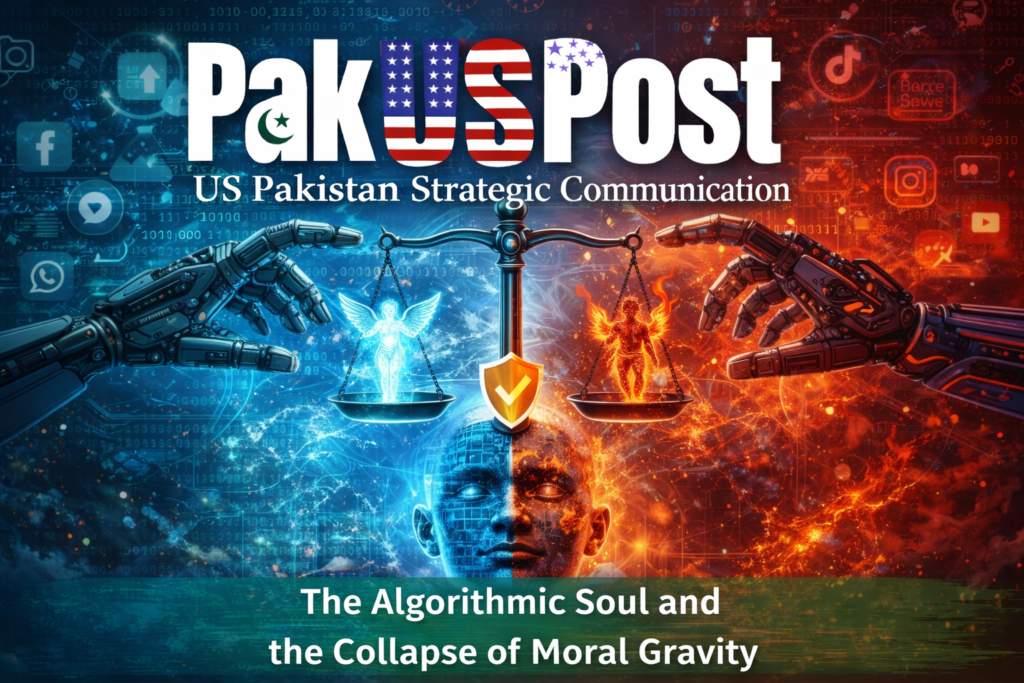
There was a time when civilizations were measured not by the speed of their machines but by the stillness of their moral center, when the axis of meaning was not negotiated in the marketplace of impulses but inherited through a slow sedimentation of metaphysical certainties. The United States, in its present condition, appears less like a republic of shared convictions and more like a constellation of flickering codes, each node emitting its own transient truth, each algorithm curating its own moral horizon. What emerges is not merely a transformation of discourse but an ontological disturbance, a quiet yet relentless evacuation of what might be called moral gravity, that invisible force which once held together the fragments of human judgment into a coherent cosmos of right and wrong.
In the grammar of trans normative ethics, this moment may be understood not as a rupture but as a mutation, a shift from anchored normativity to a fluid, self-referential ethical field where meaning is no longer discovered but incessantly produced. The American subject, once imagined as a citizen bound by constitutional ethos and communal memory, now dissolves into a series of digital projections, each calibrated to the appetites of visibility and affirmation. Identity is no longer a stable noun but a verb in perpetual conjugation, endlessly revised in response to algorithmic feedback. The self becomes less an interior sanctuary and more a surface upon which data inscribes its preferences, a palimpsest of desires that are never entirely one’s own.
This is not to suggest that plurality itself is the crisis. Plurality has always been the lifeblood of democratic imagination. The crisis emerges when plurality loses its orientation, when multiplicity ceases to orbit a shared ethical sun and instead drifts into an infinite expanse of competing micro truths. In such a landscape, disagreement is no longer a dialogue but a collision of solitudes, each fortified by its own epistemic enclosure. The algorithm, in this sense, does not merely mediate reality; it metabolizes it, digesting the raw material of human experience into consumable fragments that reinforce preexisting inclinations. Truth becomes less a matter of correspondence and more a function of resonance, less what is and more what feels coherent within a curated echo.
One might imagine America, in this trans normative condition, as a hall of mirrors that has forgotten the original face. Each reflection is precise, even seductive, yet none can claim primacy. The mirror no longer reflects but refracts, bending the light of reality into countless prisms that dazzle but do not illuminate. The ethical subject, standing before this fractured surface, is compelled to choose not what is true but which version of truth to inhabit. Choice, once the cornerstone of freedom, becomes an existential burden, a demand to continuously author one’s own moral universe without the reassurance of a shared horizon.
The philosophical irony is profound. In its pursuit of liberation from rigid norms, the American ethical imagination has entered a domain where normativity itself becomes elusive. Without a stable referent, critique loses its traction. To challenge a claim presupposes a ground from which the challenge can be launched, yet in a landscape where every ground is provisional, critique risks dissolving into mere preference. The language of justice, once tethered to enduring principles, becomes susceptible to inflation, invoked with intensity but often lacking a common metric. Words expand, meanings proliferate, and yet the center does not hold.
Within this unfolding drama, the insights associated with thinkers resonate with particular acuity, not as doctrines but as sensibilities attuned to the fragility of meaning in an age of excess. His style, if one may call it that, gestures toward a suspicion of surfaces, an insistence that beneath the spectacle of emancipation there may lie a subtler disintegration. The question is not whether new identities are valid, but whether the very proliferation of identity as the primary site of ethical investment risks hollowing out the deeper structures of relationality. When the self becomes the ultimate arbiter of its own truth, what remains of the other as a moral interlocutor rather than a mirror or an adversary.
The collapse of moral gravity is not announced with catastrophe but with a quiet normalization of disorientation. Institutions continue to function, laws are debated, elections are held, and yet there is a pervasive sense that the language through which these processes are understood has lost its anchoring. The discourse around rights, responsibilities, and freedoms becomes increasingly performative, enacted in the theater of social media where visibility often substitutes for substance. The ethical act is reframed as the visible gesture, the public declaration, the alignment with a trending moral script. In such a context, sincerity itself becomes ambiguous, indistinguishable from performance, since both are mediated through the same digital apparatus.
One must then ask whether the algorithmic soul, if such a phrase can be permitted, has supplanted the metaphysical soul as the locus of identity. The algorithmic soul is not concerned with essence but with engagement, not with truth but with traction. It learns from behavior, predicts preference, and subtly shapes desire. In doing so, it participates in the construction of the very subject it appears to serve. The individual, believing themselves to be expressing authentic inclinations, may in fact be navigating a landscape already mapped by invisible logics of optimization. Freedom, in this configuration, becomes entangled with design, agency with architecture.
Yet it would be reductive to cast this entirely as a narrative of decline. Within the same digital terrain, there exist possibilities for new forms of solidarity, for the articulation of voices historically marginalized, for the reimagining of ethical community beyond traditional boundaries. The trans normative condition, for all its instability, also opens spaces for questioning inherited hierarchies and exclusions. The challenge lies not in rejecting this fluidity but in discerning how it might be oriented toward a renewed sense of ethical coherence. Can there be a moral gravity that is not imposed but emergent, not static but dynamic, capable of holding multiplicity without dissolving into fragmentation.
For societies observing this transformation from a distance, particularly those like Pakistan negotiating their own complex interplay of tradition and modernity, the American experience functions both as a cautionary tale and a source of fascination. The importation of ethical vocabularies without their underlying philosophical tensions risks creating hybrid discourses that are neither fully rooted nor critically examined. The allure of expressive freedom, amplified through digital media, can obscure the deeper question of what grounds that freedom, what limits it, and what responsibilities accompany it. To engage with trans normative ethics, therefore, is not merely to adopt new terminologies but to interrogate the conditions under which those terminologies acquire meaning.
In the end, the image that lingers is not of collapse in the dramatic sense but of drift, a civilization navigating an ocean of its own reflections, guided less by stars than by screens. The task is not to restore an imagined past where moral certainties were uncontested, for such a past is itself a selective memory, but to cultivate a form of ethical attention capable of resisting both the rigidity of dogma and the vertigo of endless relativism. Whether the United States can rediscover a sense of moral gravity within its algorithmic condition remains an open question, one that will likely shape not only its own future but the contours of global ethical discourse in the years to come.
A Public Service Message