
Platform Governance, Tech Policy, and Environmental Information Integrity in Pakistan–United States Engagement

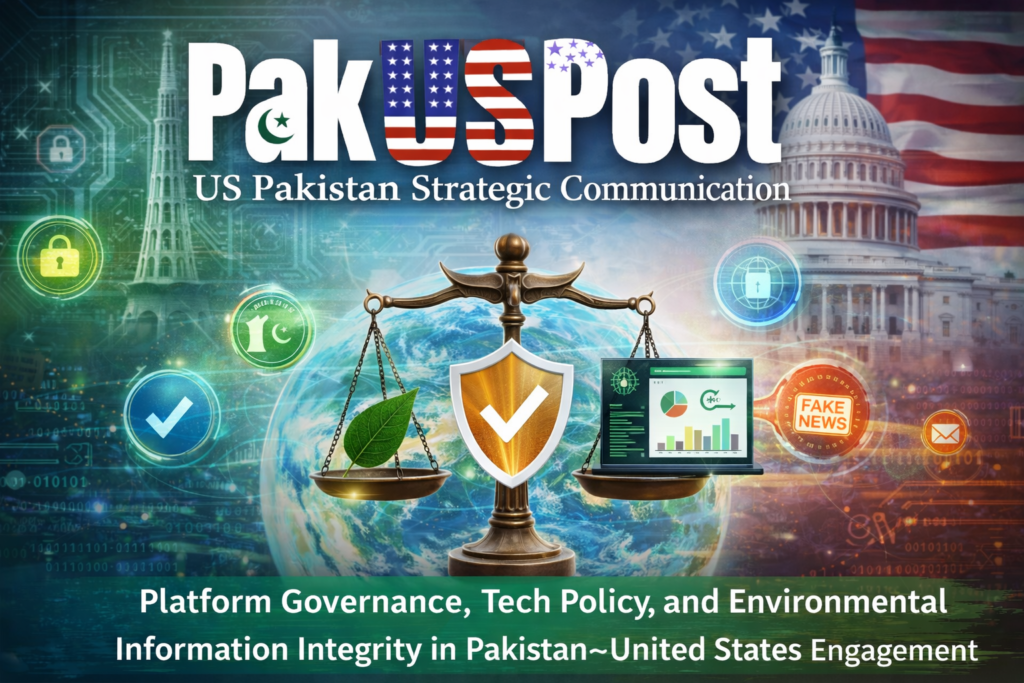
The governance of digital platforms has become a defining issue in contemporary international relations, shaping not only the flow of information but also the quality of public discourse, policy formation, and global cooperation. In the context of environmental challenges and climate change, the integrity of information circulating on social media platforms carries significant implications for national resilience, international collaboration, and public trust. For Pakistan, a country highly vulnerable to climate risks, ensuring the accuracy, visibility, and credibility of environmental information is essential to mobilizing resources, shaping policy responses, and engaging with global partners. The United States, as the home to major technology companies and a key factor in digital governance frameworks, plays a central role in determining how environmental narratives are constructed, disseminated, and regulated. The intersection of platform governance, tech policy, and environmental information integrity therefore represents a critical domain for Pakistan–U.S. engagement.
Digital platforms serve as primary channels through which climate-related information is shared, debated, and acted upon. They influence public awareness, shape perceptions of risk, and affect the prioritization of environmental policies. In Pakistan, social media has become a vital tool for communicating climate impacts, from floods and heatwaves to water scarcity and air pollution. Citizens, journalists, and institutions rely on these platforms to disseminate information, coordinate responses, and advocate for policy action. However, the decentralized and algorithm-driven nature of these platforms introduces challenges related to misinformation, selective amplification, and unequal representation.
Misinformation in the environmental domain can have far-reaching consequences. False or misleading information about climate risks, disaster severity, or policy responses can distort public understanding, delay action, and undermine trust in institutions. In Pakistan, where climate literacy levels vary and access to verified information may be limited, the impact of misinformation can be particularly pronounced. Exaggerated claims may lead to panic or misallocation of resources; while underreporting or denial of risks can result in inadequate preparedness and response. Ensuring the integrity of environmental information is therefore not only a communication challenge but also a matter of national security and public welfare.
The role of U.S.-based technology companies in shaping information ecosystems adds a layer of complexity to this issue. Platforms such as Meta, Google, and X operate globally but are governed by policies and regulatory frameworks rooted in the United States. Content moderation practices, algorithmic design, and data governance policies directly influence which narratives gain visibility and which are marginalized. For Pakistan, this creates both opportunities and challenges. On one hand, access to global platforms enables the country to share its climate narrative with a wide audience. On the other hand, limited influence over platform governance can result in underrepresentation, misinterpretation, or inconsistent enforcement of content standards.
Algorithmic amplification plays a crucial role in determining the reach and impact of environmental information. Platforms prioritize content that generates engagement, often favoring emotionally charged or visually compelling material. While this can increase awareness of climate issues, it can also lead to oversimplification or distortion of complex scientific and policy discussions. In the absence of contextualization, audiences may form incomplete or inaccurate understandings of environmental challenges. Pakistan must therefore engage with platform dynamics strategically, ensuring that its climate narratives are both compelling and grounded in credible data.
Regulatory developments in the United States further shape the landscape of platform governance. Debates whole data privacy, content moderation, and artificial intelligence are influencing how platforms operate and how information is managed. Emerging policies aimed at increasing transparency, accountability, and user protection have implications for cross-border information flows. For Pakistan, understanding and engaging with these regulatory trends is essential to ensuring that its interests are represented and that environmental information is treated fairly within global digital ecosystems.
Opportunities for constructive engagement are significant. Pakistan can collaborate with U.S. stakeholders, including government agencies, technology companies, and research institutions, to enhance the integrity of environmental information. Joint initiatives focused on fact-checking, data verification, and content moderation can improve the quality of information available to users. Partnerships with academic institutions can support research on misinformation patterns, algorithmic biases, and effective communication strategies. By positioning itself as a proactive partner, Pakistan can contribute to the development of global standards for environmental information integrity.
Diaspora communities again play a critical role in this domain. Pakistani professionals working in technology, policy, and academia in the United States are well-positioned to influence platform governance and advocate for fair representation. Through digital engagement, they can highlight gaps in content moderation, promote accurate narratives, and facilitate dialogue between Pakistani stakeholders and U.S. institutions. Their involvement can enhance credibility, bridge cultural and informational gaps, and support collaborative solutions.
Economic implications are closely tied to information integrity. Accurate and transparent environmental information influences investor confidence, particularly in sectors with sustainability and climate resilience. Misleading or inconsistent narratives can deter investment, while credible communication can attract funding for renewable energy, infrastructure, and environmental projects. By ensuring the integrity of its digital narratives, Pakistan can strengthen its position as a destination for sustainable investment, aligning economic objectives with environmental priorities.
Policy recommendations for Pakistan must adopt a comprehensive and multi-layered approach. First, the establishment of a national framework for environmental information governance is essential. This framework should define standards for data collection, verification, and dissemination, ensuring consistency and credibility across platforms. Second, Pakistan should engage with U.S. technology companies through formal channels, advocating for improved content moderation practices, transparency in algorithmic processes, and greater inclusion of local contexts. Third, investment in digital infrastructure and capacity-building is necessary to enhance the ability of institutions to monitor, analyze, and respond to information flows.
Collaboration with international organizations can further strengthen these efforts. Multilateral frameworks focused on digital governance and climate communication provide platforms for sharing best practices, coordinating responses, and developing common standards. Pakistan’s active participation in these forums can enhance its influence, attract support, and ensure alignment with global norms. Engagement with U.S. partners within these frameworks can reinforce bilateral cooperation while contributing to broader international objectives.
Public awareness and digital literacy are critical components of information integrity. Citizens must be equipped with the skills to identify credible sources, evaluate information critically, and engage responsibly in digital discourse. Educational initiatives, media campaigns, and community programs can promote awareness and resilience against misinformation. Collaboration with U.S. institutions can provide access to resources, expertise, and innovative approaches to digital literacy.
Operationalizing these strategies requires a phased approach. The initial phase should focus on institutional development, including the creation of dedicated units for environmental information management. The second phase should emphasize engagement with U.S. stakeholders, establishing dialogue mechanisms and collaborative initiatives. The third phase should expand to include diaspora engagement, public awareness campaigns, and partnerships with civil society. Continuous monitoring and evaluation are essential to adapt strategies to evolving challenges and opportunities.
Risk management must remain central to policy implementation. Overregulation can stifle innovation and restrict freedom of expression, while insufficient oversight can allow misinformation to proliferate. Pakistan must strike a balance that ensures accountability without compromising openness. Transparent governance, stakeholder engagement, and adherence to democratic principles are essential to achieving this balance.
In conclusion, platform governance, tech policy, and environmental information integrity are critical components of Pakistan–United States engagement in the digital age. By addressing challenges related to misinformation, algorithmic bias, and regulatory complexity, Pakistan can enhance the credibility and impact of its climate narratives. Strategic collaboration with U.S. stakeholders, supported by diaspora engagement and institutional capacity-building, offers pathways to strengthen information integrity and foster trust. As digital platforms continue to shape global discourse, proactive and coordinated policy approaches will be essential to ensuring that environmental information serves as a foundation for effective action, sustainable development, and international cooperation. Through such efforts, Pakistan can not only safeguard its national interests but also contribute to the development of a more transparent, inclusive, and resilient global information ecosystem.
A Public Service Message