Tariff Regimes And Structural Asymmetry In Trade Normalisation Pathways

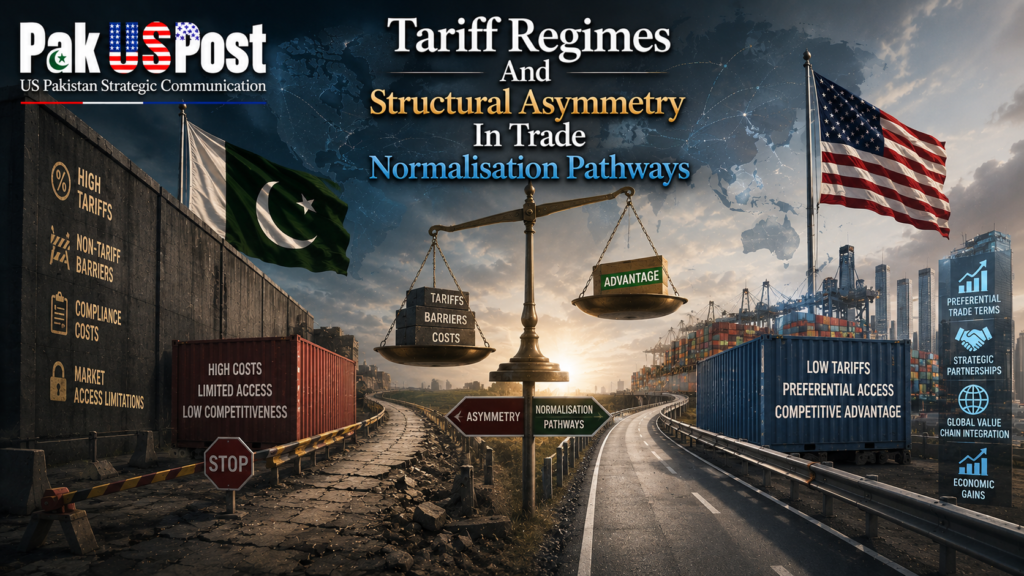
The architecture of United States tariff regimes and trade conditionalities, when examined through the prism of Pakistan’s evolving external sector dependency, reveals a calibrated system of controlled market access rather than an open regime of reciprocal commercial exchange. What is often presented in diplomatic discourse as trade normalisation is, in structural reality, a managed permeability framework in which access is extended selectively, conditioned rigorously, and withdrawn implicitly through compliance pressure points embedded within regulatory, labour, and standards based instruments. This system does not operate as a conventional tariff schedule alone but as an integrated governance mechanism that shapes industrial behaviour in partner economies while preserving asymmetrical advantages for the centre of the system.
For Pakistan, whose export basket remains heavily concentrated in textiles, apparel, and low value added agricultural processing, the United States market represents both an indispensable destination and a structurally constrained opportunity space. The apparent stability of preferential access masks a deeper conditional logic in which tariff concessions are continuously balanced against non tariff barriers, certification requirements, and evolving compliance regimes tied to environmental standards, supply chain transparency, and labour governance frameworks. These instruments function collectively as a soft regulatory perimeter that determines not only what enters the US market but how it must be produced, documented, and audited.
The critical feature of this regime is not restriction in absolute terms but stratification in functional terms. Market access is not denied; it is tiered. High value segments of global value chains remain largely inaccessible due to technological thresholds, intellectual property regimes, and capital intensive compliance structures, while low margin segments are integrated under strict operational discipline. This produces a structural asymmetry in which Pakistan’s export integration is deep but narrowly confined, generating foreign exchange stability without corresponding industrial transformation.
Within this configuration, tariff structures operate less as economic instruments and more as strategic filters. They reward compliance with predefined global norms while penalising deviation from standardized production protocols. The consequence is a gradual alignment of domestic industrial practices with external regulatory expectations, often without parallel strengthening of domestic regulatory sovereignty. This alignment is frequently framed as modernization, yet its structural effect is the embedding of external governance logic into domestic production systems.
An additional layer of complexity emerges from the interaction between tariff regimes and global supply chain reconfiguration strategies pursued by the United States in response to geopolitical fragmentation and industrial competition. As Washington seeks to diversify supply chains away from concentrated manufacturing hubs, particularly in East Asia, it selectively opens channels for alternative sourcing economies. However, this opening is conditional upon compliance with traceability systems, digital customs integration, and sectoral transparency requirements that effectively integrate exporting countries into a broader surveillance enabled trade architecture.
Pakistan’s positioning within this evolving framework is ambiguous. On one hand, it is a beneficiary of preferential access arrangements that provide critical export stability. On the other hand, it remains structurally excluded from high technology segments of global value chains due to persistent constraints in energy reliability, skill intensity, innovation capacity, and regulatory harmonisation. This duality produces what may be described as a semi peripheral export dependency, wherein participation in global trade is extensive but structurally circumscribed.
The hidden risk embedded in this arrangement lies in the gradual institutionalisation of dependency through procedural normalisation. As compliance systems become more complex, domestic firms increasingly rely on external certification bodies, international auditors, and foreign technical consultants to maintain market access. Over time, this creates a parallel regulatory ecosystem in which compliance authority is effectively externalised. The sovereignty of trade policy thus becomes diffused across multiple transnational nodes of governance.
From a macroeconomic perspective, this structure produces a paradoxical outcome. Export growth may remain stable or even expand, yet domestic industrial upgrading remains limited. The absence of meaningful technology transfer clauses in tariff linked trade arrangements means that productivity gains are not systematically internalised within the domestic economy. Instead, value addition is captured at intermediate stages outside the national production boundary, reinforcing structural stagnation within core industrial sectors.
The establishment level concern in this context is increasingly centred on strategic trade vulnerability. Over reliance on a narrow export base tied to a single preferential market exposes the economy to policy volatility, tariff recalibration, and sudden regulatory tightening. Such shifts, even when minor in administrative terms, can have disproportionate macroeconomic effects due to the concentration of export earnings. This vulnerability is further amplified by limited diversification into alternative high value markets.
Moreover, the interaction between tariff regimes and domestic fiscal architecture creates additional constraints. Export dependence on preferential access reduces incentives for deep tariff reform domestically, while simultaneously limiting the fiscal space required for industrial subsidies, technological upgrading, and export diversification strategies. This creates a policy lock in effect where external dependency constrains internal reform capacity.
A further dimension of structural asymmetry arises from labour and environmental conditionalities embedded within trade frameworks. While these standards are often justified as normative improvements, their enforcement is uneven and frequently decoupled from corresponding financial support for compliance upgrading. This places additional adjustment burdens on exporting economies, effectively transferring regulatory costs downstream while preserving competitive advantages upstream.
Policy recalibration must therefore begin with a fundamental rethinking of trade strategy beyond preferential access dependency. First, Pakistan must pursue export diversification not only in terms of markets but also in terms of product complexity, moving towards medium technology manufacturing, chemical processing, and engineering goods. This requires coordinated industrial policy rather than isolated trade facilitation measures.
Second, trade negotiations must explicitly integrate technology transfer obligations into tariff preference frameworks. Market access without capability transfer perpetuates dependency; therefore, future arrangements must condition preferential access on measurable industrial upgrading commitments from partner economies.
Third, Pakistan must develop domestic compliance infrastructure capable of reducing reliance on external certification ecosystems. This includes strengthening national standards authorities, digitising customs systems under sovereign control, and investing in traceability technologies that are not externally governed.
Fourth, regional trade integration must be pursued more aggressively to offset over concentration in Western markets. Expanded engagement with Central Asian, Middle Eastern, and East Asian secondary markets can provide alternative demand buffers and reduce exposure to single market volatility.
Fifth, industrial policy must be realigned with trade strategy in a coherent framework that links tariff incentives with domestic value chain development. Without such integration, trade policy will continue to operate as an external adjustment mechanism rather than a developmental instrument.
In broader strategic terms, the current tariff architecture reflects a global shift from liberal trade universalism to managed trade selectivity. In this environment, countries like Pakistan are not passive recipients of market access but active participants in a structured hierarchy of industrial integration. The challenge lies in negotiating within this hierarchy without becoming structurally fixed at its lower tiers.
Ultimately, tariff regimes are no longer merely fiscal instruments but instruments of industrial choreography. They determine not only who trades, but how economies are shaped through trade. For Pakistan, the imperative is to ensure that participation in this system does not translate into permanent structural subordination, but rather into a transitional platform for technological ascent and diversified economic sovereignty.
A Public Service Message