
Energy Corridors And Geopolitical Commodification Of Pakistan Geography

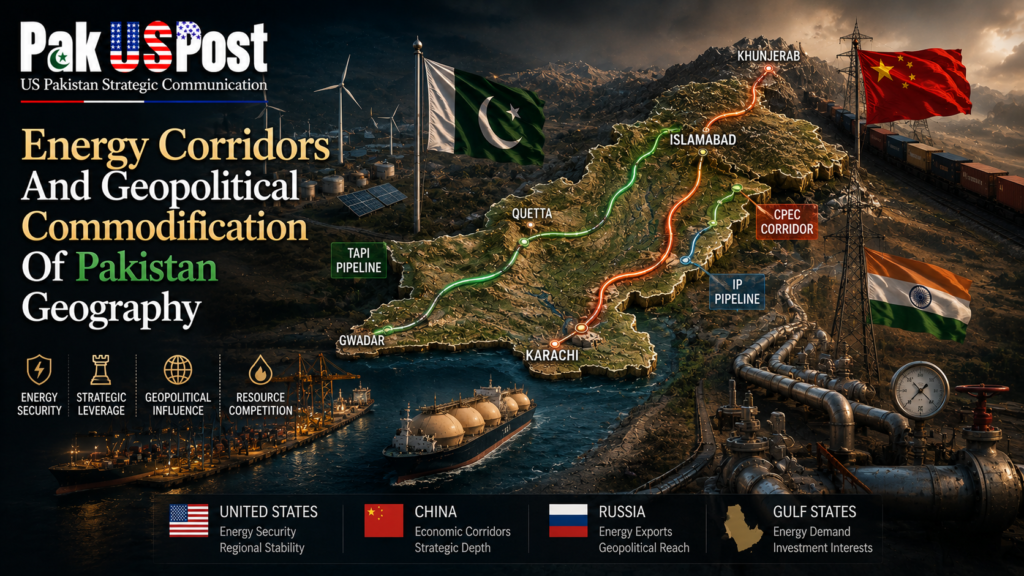
The transformation of Pakistan’s geographical positioning into a strategically commodified energy corridor represents one of the most consequential yet under-theorised shifts in contemporary regional political economy. In the evolving architecture of Eurasian connectivity, Pakistan is increasingly being reimagined not merely as a sovereign territorial unit but as a transit-enabled spatial platform through which hydrocarbons, electricity flows, fibre optic networks, and multimodal logistics systems are expected to converge, diverge, and redistribute across competing regional orders. This reframing of geography as infrastructure is not neutral; it is deeply embedded in the contestation between competing models of connectivity led by different external power centres, each seeking to inscribe its own logistical logic onto South and Central Asian space.
Within this emerging configuration, energy corridors function as both physical and epistemic constructs. Physically, they manifest as pipelines, transmission lines, road networks, and port infrastructures. Epistemically, they represent narratives of inevitability, efficiency, and integration that seek to naturalise external design over domestic spatial autonomy. Pakistan’s location, bridging the Arabian Sea with Central Asian hinterlands and bordering the energy-rich Gulf and resource-strategic Afghanistan, places it at the intersection of multiple corridor imaginaries, each with distinct geopolitical intent and financial architecture.
United States economic and strategic engagement in this domain does not necessarily seek ownership of infrastructure in conventional terms but rather seeks re-entry into a corridor ecosystem increasingly shaped by alternative financing and construction regimes. This includes attempts to influence standards of interoperability, regulatory frameworks governing transit tariffs, and the digital architecture of logistics management systems. In this sense, competition is not over geography itself but over the protocols that define how geography is operationalised.
The critical risk embedded in this transformation lies in the gradual externalisation of spatial utility. As corridors expand, transit revenues, logistics fees, and energy routing decisions become increasingly central to national economic projections. However, the governance of these systems often involves multi layered contractual arrangements with external financiers, engineering firms, and multilateral institutions that embed long term obligations into infrastructure design. These obligations frequently outlast political cycles and reduce policy flexibility in reconfiguring corridor usage in response to domestic energy priorities.
Pakistan’s evolving role as an energy transit state introduces a structural duality. On one hand, corridor development offers significant opportunities for infrastructure modernisation, revenue diversification, and regional integration. On the other hand, it risks locking the country into a transit dependent economic model where strategic value is derived primarily from passage rather than production. This distinction is critical, as transit economies often experience asymmetrical development, where infrastructure density increases without corresponding industrial deepening.
The intersection of energy corridors with broader geopolitical competition further complicates this landscape. Competing regional initiatives, including Gulf oriented export systems, Central Asian resource pathways, and China linked infrastructural networks, generate overlapping corridor geometries that may not always align with domestic energy security needs. In such a fragmented environment, Pakistan risks becoming a convergence zone of external logistical priorities rather than a sovereign planner of its own spatial-economic development.
A less visible but equally significant dimension is the financial structuring of corridor projects. These infrastructures are frequently financed through a combination of sovereign loans, public private partnerships, export credit arrangements, and multilateral development funding. Each layer introduces distinct conditionalities, repayment structures, and currency exposures that collectively shape long term fiscal stability. Over time, corridor financing can create contingent liabilities that constrain macroeconomic policy space, particularly in periods of external shock or currency depreciation.
Establishment level strategic concern in this context centres on the question of corridor sovereignty. While physical infrastructure may be located within national territory, operational control, technical standards, and revenue allocation mechanisms are often distributed across external stakeholders. This diffusion of control can lead to a situation in which the state retains formal sovereignty but exercises limited functional authority over key nodes of energy and logistics flow.
The commodification of geography also has internal distributive implications. Regions through which major corridors pass may experience accelerated infrastructure development, while peripheral zones remain structurally marginalised. This uneven spatial development can exacerbate existing regional disparities and generate political tensions over resource allocation, employment distribution, and environmental impact burdens.
Environmental considerations further intensify the complexity of corridor expansion. Large scale energy and transport infrastructure projects frequently intersect with fragile ecological zones, water scarce regions, and climate vulnerable areas. The externalisation of environmental risk, particularly when projects are financed and executed under external frameworks, can result in long term ecological liabilities that are not adequately priced into initial investment calculations.
From a policy perspective, Pakistan faces a critical imperative to redefine its engagement with corridor economies not as passive transit dependency but as active spatial governance. First, corridor agreements must be embedded within a comprehensive national spatial planning framework that prioritises domestic energy security, industrial zoning, and environmental sustainability alongside transit facilitation.
Second, contractual arrangements governing energy and logistics corridors must include robust clauses ensuring operational transparency, revenue predictability, and sovereign override mechanisms in cases of strategic necessity. Without such safeguards, corridor infrastructure risks becoming rigid systems that limit adaptive governance.
Third, Pakistan must invest in domestic logistics and energy management capabilities that allow it to derive value beyond mere transit fees. This includes the development of storage infrastructure, refining capacity, distribution networks, and industrial clusters aligned with corridor routes.
Fourth, diversification of corridor partnerships is essential to avoid overdependence on any single external infrastructure architecture. A multi vector approach reduces strategic vulnerability and enhances bargaining leverage in negotiations over standards and financing terms.
Fifth, environmental governance must be integrated into corridor planning from inception rather than appended as a compliance requirement. Independent environmental auditing bodies, community consultation mechanisms, and climate impact assessments should be institutionalised within project governance structures.
The broader geopolitical implication of Pakistan’s emergence as a corridor state is the redefinition of sovereignty itself in spatial terms. In a world where infrastructure increasingly determines strategic influence, control over flows may matter more than control over territory. Pakistan’s challenge is therefore not merely to host corridors but to govern them in a manner that reinforces, rather than dilutes, its strategic autonomy.
In conclusion, the commodification of geography through energy corridors represents a subtle yet profound shift in regional political economy. It transforms space into a tradable asset, infrastructure into a geopolitical instrument, and sovereignty into a negotiated condition. For Pakistan, the task ahead is to ensure that this transformation does not reduce its geography to a passive conduit for external systems, but instead enables it to leverage its spatial position as a platform for diversified, sovereign, and sustainable development.
A Public Service Message