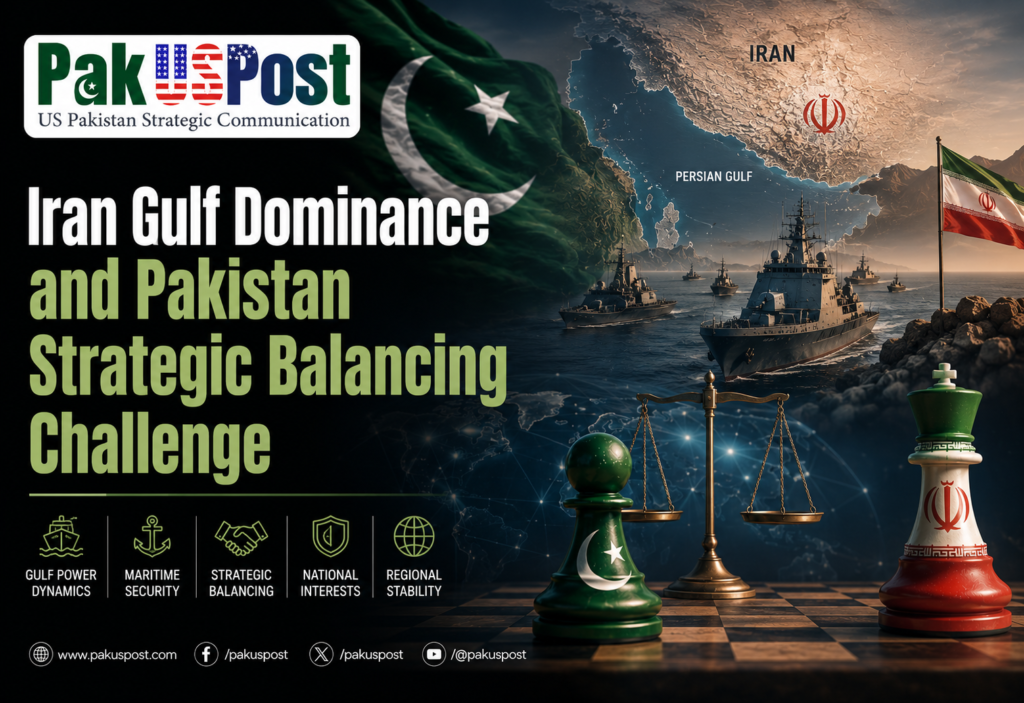
Iran Gulf Dominance and Pakistan Strategic Balancing Challenge

The hypothetical collapse of United States forward military presence in the Middle East, combined with a scenario in which Iran acquires effective influence over the Strait of Hormuz and extends its strategic reach toward Bab-el-Mandeb, would represent one of the most consequential geopolitical realignments since the end of the Cold War. For Pakistan, such a shift would not be a distant external development but an immediate structural shock to its security environment, diplomatic equilibrium, and internal cohesion. The geopolitical architecture that has underpinned Pakistan’s foreign policy for decades, balancing between Gulf monarchies, China, the United States, and a historically complex relationship with Iran, would enter a phase of compressed uncertainty where traditional assumptions about deterrence, alliance reliability, and energy security would weaken simultaneously.
In the immediate term, Pakistan would face heightened sensitivity along its western frontier. The Pakistan-Iran border, already marked by porous terrain, informal trade networks, and intermittent militant activity, would become a zone of intensified strategic attention. Any perception of Iranian regional ascendancy would likely embolden non-state actors operating in Balochistan, where separatist grievances intersect with smuggling economies and localized insurgent narratives. The possibility of proxy competition, even if indirect, would rise as regional actors recalibrate influence corridors. Islamabad would be compelled to reinforce border management not only through kinetic measures but through expanded political engagement with local populations, seeking to neutralize external exploitation of internal fissures.
At the same time, Iran’s enhanced regional position would reshape Pakistan’s relationships with Gulf partners, particularly Saudi Arabia and the United Arab Emirates. These relationships have historically been anchored in financial assistance, labor remittances, religious affinity, and strategic reassurance against Iranian influence. A shift in balance of power would introduce a new asymmetry. Gulf states, feeling strategically exposed, could seek deeper alignment with remaining US regional posture or intensify independent defense modernization, potentially increasing expectations of political solidarity from Islamabad. Pakistan would find itself under dual pressure: maintaining economic dependence on Gulf remittances and investments while avoiding overt alignment in a sharpened Iran-Gulf rivalry.
The China-Pakistan dimension would also acquire greater strategic density. China, as a long-term partner invested in the China-Pakistan Economic Corridor and maritime access through Gwadar, would likely view Iranian regional ascendancy through the lens of energy security and Belt and Road continuity. A more influential Iran, potentially integrated into China-centric economic and logistical frameworks, could create an informal continental bloc stretching from East Asia to the Persian Gulf. Pakistan’s role in such a configuration would become more pivotal but also more constrained, as strategic autonomy would be tested by converging expectations from Beijing and Tehran. Simultaneously, Russia’s incremental presence in Middle Eastern diplomacy would reinforce a multipolar bargaining environment where Pakistan must navigate overlapping but not fully aligned strategic interests.
Against this backdrop, the United States-India alignment would likely intensify in the Indo-Pacific theatre, indirectly affecting Pakistan’s strategic calculus. A US retrenchment from the Middle East does not necessarily imply global withdrawal; rather, it may accelerate resource reallocation toward East Asian maritime competition. India, benefiting from sustained technological, defence, and diplomatic convergence with Washington, would interpret regional instability as an opportunity to expand its strategic footprint in the Gulf and Central Asia. For Pakistan, this raises the risk of being structurally outflanked in multiple theatres simultaneously: western instability linked to Iran, eastern pressure through India, and economic exposure through Gulf volatility.
The internal implications for Pakistan would be equally significant. Sectarian dynamics, while historically managed through a combination of religious diplomacy and domestic regulation, could experience renewed stress under regional polarization. Any escalation in Iran-Gulf rivalry often reverberates within Pakistan’s own religious and political discourse, requiring careful state management to prevent ideological spillover. The state’s capacity to maintain neutrality in religious sentiment while preserving strategic partnerships would be tested in a more polarized information and influence environment.
From a policy perspective, Pakistan would face three broad strategic pathways, each with distinct risks and benefits. The first, often described as strategic neutrality, would involve deliberate avoidance of alignment with any regional bloc, maintaining functional relations with Iran, Gulf states, China, and the United States independently. This approach prioritizes flexibility but risks diminishing credibility if regional polarization intensifies. Neutrality in high-intensity geopolitical environments often becomes difficult to sustain without significant diplomatic capital and economic resilience.
The second pathway would involve a calibrated tilt toward Iran and China, leveraging geographic proximity, energy interdependence, and continental connectivity. This could potentially reduce vulnerability to maritime disruptions and Gulf volatility, particularly if alternative energy corridors through Iran or Central Asia become viable. However, such a shift would carry risks of Gulf financial contraction, remittance sensitivity, and potential diplomatic friction with Western partners, including indirect exposure to sanctions environments depending on escalation dynamics.
The third pathway would involve continued hedging between Gulf partnerships and residual engagement with the United States, while maintaining functional ties with Iran and China. This approach reflects Pakistan’s historical foreign policy tradition of multi-alignment but becomes more complex under conditions of intensified great power competition. The margin for diplomatic ambiguity narrows significantly when regional conflicts acquire sharper ideological and strategic contours.
A calibrated doctrine for Pakistan would therefore require a hybrid structure anchored in three principles: economic insulation, border stabilization, and diplomatic elasticity. Economic insulation would prioritize diversification of energy imports, expansion of strategic reserves, and gradual reduction of single-route dependency through Hormuz. Border stabilization would require a shift from reactive security containment to integrated socio-economic development of frontier regions, particularly in Balochistan, to reduce external penetration opportunities. Diplomatic elasticity would involve maintaining simultaneous channels with competing blocs without formal alignment commitments that could restrict strategic maneuverability.
In operational terms, Pakistan would need to accelerate infrastructure linkages with Central Asia to reduce maritime vulnerability, while simultaneously protecting its Gulf labor market access, which remains a critical source of foreign exchange. Energy policy would become central to national security planning, requiring integration of pricing scenarios into macroeconomic forecasting, particularly under conditions where global oil markets become more volatile due to perceived Iranian leverage over chokepoints.
The intelligence and security establishment would likely interpret such a scenario as a transition from linear threat perception to multi-vector uncertainty. Traditional border-based security frameworks would need to be supplemented by financial intelligence monitoring, digital influence mapping, and maritime risk assessment. The convergence of energy geopolitics and information warfare would require institutional adaptation beyond conventional defense paradigms.
Ultimately, Pakistan’s strategic challenge in this hypothetical environment would not be merely to react to regional change but to preserve decision-making autonomy in an increasingly congested geopolitical space. The erosion of US centrality in the Middle East would not create stability but rather redistribute instability across multiple nodes. For Pakistan, the key variable would be not alignment with any single axis but the ability to prevent external shocks from translating into internal fragmentation.
The strategic imperative would therefore rest on maintaining equilibrium amid asymmetric pressures, ensuring that Pakistan does not become a passive recipient of regional transformation but retains sufficient agency to shape its own security and economic trajectory. In such an environment, survival would depend less on ideological alignment and more on adaptive statecraft, calibrated risk management, and sustained institutional coherence under conditions of prolonged geopolitical volatility.
A Public Service Message