
Cyber Coercion and Pakistan Critical Infrastructure Vulnerability Matrix

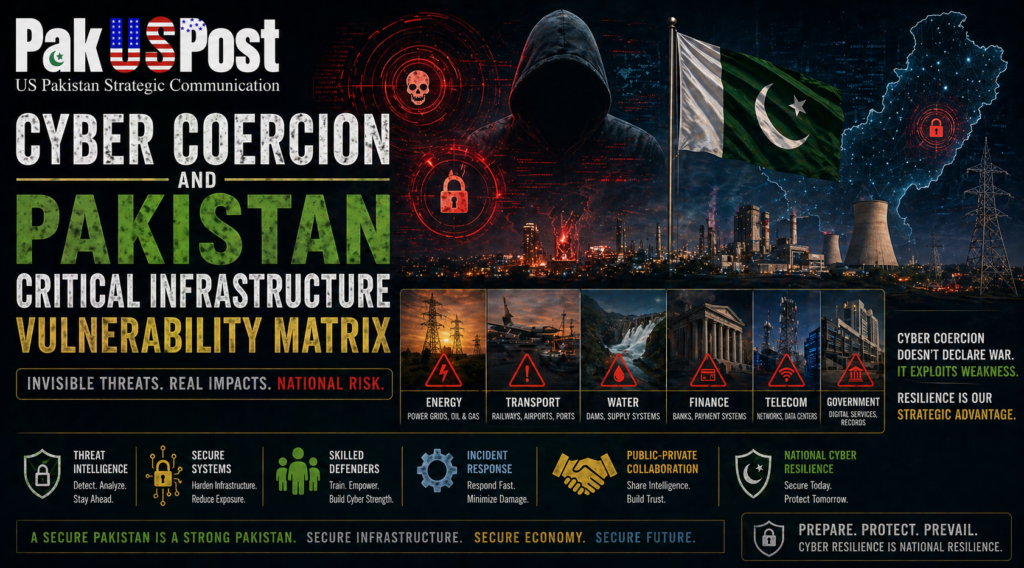
Cyber conflict is no longer an abstract extension of warfare but a continuous condition of modern state functioning, where disruption, infiltration and algorithmic manipulation operate beneath the threshold of conventional military escalation. For Pakistan, the increasing digitisation of banking systems, telecommunications networks and power distribution grids has created a structural paradox: greater efficiency and connectivity on one hand, and deeper systemic exposure to cyber coercion on the other. The central question is not whether cyber threats exist, but whether the architecture of critical infrastructure can withstand sustained pressure in moments of regional or geopolitical tension.
Unlike traditional security threats, cyber coercion does not necessarily aim at destruction. It is often calibrated to induce uncertainty, delay decision making, erode public confidence and create economic friction without triggering overt retaliation. In this sense, cyber operations function as instruments of strategic signalling. They occupy a grey zone where attribution is difficult, response is delayed and impact is cumulative rather than immediate. For states with complex but uneven digital maturity like Pakistan, this creates an asymmetric vulnerability profile that is difficult to quantify but increasingly consequential.
The banking sector represents one of the most sensitive nodes in this emerging vulnerability matrix. Pakistan’s financial system has undergone rapid digitisation over the past decade, with mobile banking, digital wallets, real time gross settlement systems and fintech platforms becoming central to economic activity. While this expansion has improved financial inclusion and transaction efficiency, it has also expanded the attack surface. Cyber intrusion into banking networks does not require physical proximity or territorial access; it requires only system weaknesses, software vulnerabilities or supply chain compromise. In a crisis scenario, even temporary disruption of banking systems could trigger liquidity panic, currency instability and erosion of public trust in financial institutions.
Telecommunications infrastructure presents an equally critical dimension. Mobile networks and internet service providers now function as the backbone of both civilian communication and state coordination mechanisms. Emergency response systems, commercial transactions, media dissemination and even governmental coordination rely heavily on uninterrupted digital connectivity. A targeted cyber disruption of telecom infrastructure, even if short lived, could generate disproportionate systemic shock. The challenge is compounded by the layered dependency on foreign hardware, imported software stacks and global routing systems that are not fully controlled domestically.
The power sector introduces a different but equally serious vulnerability profile. Modern electricity grids are increasingly digitised through supervisory control and data acquisition systems, smart meters and automated load balancing mechanisms. While these technologies enhance efficiency, they also create potential entry points for cyber interference. In many countries, critical energy infrastructure has already been tested through cyber incidents that demonstrated the feasibility of remote disruption without physical sabotage. For Pakistan, where energy distribution already faces structural inefficiencies and demand pressure, cyber induced instability could amplify existing systemic stress.
What makes cyber coercion particularly significant in the Pakistan United States strategic context is its integration into broader hybrid warfare doctrines. In contemporary geopolitical thinking, cyber operations are no longer isolated technical events but components of multi domain strategies that include information warfare, economic pressure and diplomatic signalling. The blurred boundary between civilian and military infrastructure means that attribution becomes politically sensitive and response calibration becomes strategically complex.
At the media level, cyber incidents are often framed through episodic reporting rather than systemic analysis. A breach is typically reported as a technical failure or isolated security lapse, rather than as part of a broader structural vulnerability landscape. This narrative fragmentation obscures the cumulative nature of cyber risk. It also limits public understanding of how deeply digital infrastructure is embedded in everyday life. In reality, cyber resilience is no longer a technical issue confined to IT departments; it is a governance issue that affects economic stability, public trust and national security.
Internationally, cyber security discourse has evolved into a domain of strategic competition among major powers. The United States emphasises cyber deterrence, offensive capabilities and alliance based information sharing. China focuses on cyber sovereignty, data localisation and state controlled digital ecosystems. Europe prioritises regulatory governance, privacy protection and risk mitigation frameworks. Pakistan operates in a space where elements of all three models intersect but none are fully institutionalised, resulting in a fragmented cyber governance architecture.
This fragmentation is further complicated by institutional dispersion. Responsibility for cyber security is distributed across multiple agencies, regulators and private sector actors, often without unified command structures or standardized protocols. In a high intensity cyber crisis, this dispersion could slow response time and create coordination gaps. The absence of a fully integrated national cyber command architecture remains a structural limitation in managing complex, multi sector digital threats.
The economic dimension of cyber vulnerability is often underestimated. Cyber incidents do not only affect data integrity; they affect investor confidence, credit ratings, insurance costs and foreign direct investment decisions. In an increasingly digital global economy, perceptions of cyber insecurity can translate into macroeconomic consequences. For Pakistan, which is already navigating external financing constraints and currency volatility, cyber risk adds an additional layer of systemic uncertainty that is difficult to price but impossible to ignore.
Supply chain dependency further amplifies this vulnerability. Much of Pakistan’s digital infrastructure relies on imported hardware, foreign developed software and globally integrated cloud services. This creates potential exposure to vulnerabilities embedded at the manufacturing or software development stage. In such cases, cyber risk is not limited to active attacks but includes latent vulnerabilities that may remain dormant until activated under specific conditions.
The emergence of cloud computing and outsourced data storage introduces another dimension of strategic dependency. As more financial, governmental and commercial data migrates to external servers, questions of jurisdiction, access control and data sovereignty become increasingly complex. In crisis scenarios, access to critical data may be subject to external regulatory environments, creating potential friction between national requirements and international service provider policies.
Within Pakistan, the public perception of cyber risk remains uneven. While urban populations increasingly rely on digital services, awareness of systemic cyber vulnerability remains limited. Cyber security is often perceived as an individual or corporate responsibility rather than a national infrastructure issue. This perception gap limits the development of a culture of resilience and preparedness at scale.
The Pakistan United States digital relationship introduces both opportunity and constraint in this domain. On one hand, there is potential for cooperation in cyber training, threat intelligence sharing and capacity building. On the other hand, divergent strategic priorities and trust deficits limit the depth of integration. Cyber security cooperation is inherently sensitive because it involves access to critical systems and shared visibility into vulnerabilities.
From a policy perspective, strengthening cyber resilience requires a shift from reactive security measures to anticipatory system design. This includes embedding security into infrastructure planning, developing redundancy across critical systems, investing in domestic cyber talent development and creating institutional mechanisms for real time threat monitoring. It also requires regulatory coherence across banking, telecommunications and energy sectors, which currently operate under partially overlapping but not fully integrated frameworks.
Another critical dimension is the role of artificial intelligence in cyber operations. As AI systems become more capable of automated vulnerability detection, intrusion attempts and defensive responses, the speed of cyber interaction is increasing beyond human response cycles. This creates a dynamic where cyber conflict may unfold at machine speed, compressing decision making time for human operators. For Pakistan, this raises the question of whether defensive systems can evolve quickly enough to match the accelerating tempo of cyber operations.
At a broader level, cyber vulnerability reflects a deeper transformation in the nature of sovereignty. In the physical domain, sovereignty is defined by territorial control. In the digital domain, it is defined by system integrity, data control and operational continuity. A state that cannot ensure the stability of its digital systems under external pressure faces a constrained form of sovereignty that is contingent rather than absolute.
The future of cyber coercion is likely to be shaped by increasing integration between financial systems, communication networks and energy infrastructure, creating tightly coupled systems where disruption in one domain rapidly propagates into others. This interconnectedness increases efficiency but reduces systemic resilience. For Pakistan, managing this trade off will be central to its broader digital transformation agenda.
Ultimately, cyber security is not merely a technical domain but a strategic condition of modern governance. It defines the limits of state capacity in a digitally interconnected world. For Pakistan, the challenge is to move from fragmented vulnerability management to integrated cyber resilience, where infrastructure, policy and institutional design operate within a coherent framework capable of absorbing and responding to sustained digital pressure. In an era where coercion can be executed without physical presence, resilience becomes a function not only of technology but of strategic foresight.
A Public Service Message