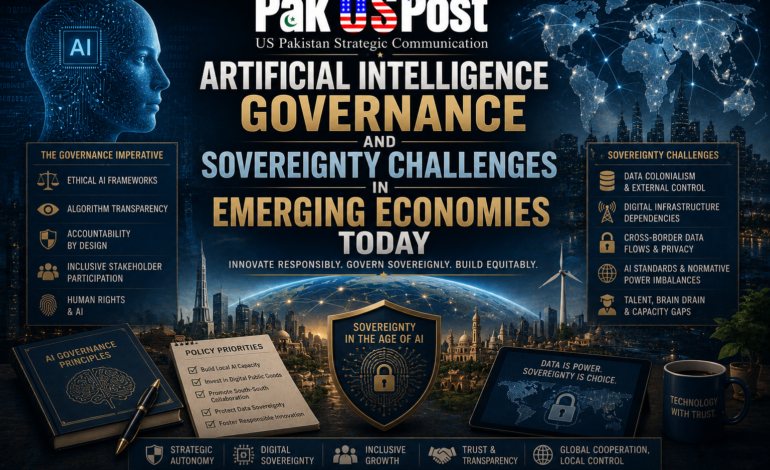
Artificial Intelligence Governance and Sovereignty Challenges in Emerging Economies Today


The accelerating diffusion of artificial intelligence across global economic, military, and administrative systems has begun to reconfigure the very grammar of sovereignty in the twenty first century. What was once understood as territorial control over physical space is increasingly being displaced by a more elusive form of authority embedded in data infrastructures, algorithmic architectures, and transnational computational ecosystems. For emerging economies such as Pakistan, this transformation is not merely technological in character; it is profoundly political, epistemological, and structural, reshaping how states imagine development, regulate knowledge, and exercise autonomy in an interconnected digital order increasingly shaped by United States led innovation regimes.
The contemporary AI landscape is dominated by a small cluster of technologically advanced states and corporate actors whose platforms define not only the capabilities of artificial intelligence systems but also the normative frameworks governing their deployment. These frameworks, while often presented in universalist language of safety, ethics, and transparency, are deeply embedded in specific geopolitical and economic interests. The United States occupies a particularly influential position in this configuration, given its control over foundational model development, cloud infrastructure ecosystems, semiconductor supply chains, and the financial architectures that sustain global technological scaling.
For emerging economies, this concentration of technological power produces a structural dependency that is subtle yet pervasive. It is not dependency in the traditional sense of resource extraction or direct political coercion, but rather a form of infrastructural conditioning in which the possibilities of governance are preconfigured by external technological design choices. When administrative systems rely on predictive algorithms trained on non local datasets, when public policy tools are optimized through foreign cloud services, and when digital governance platforms are hosted on external servers, sovereignty begins to shift from the domain of decision making to the domain of system configuration.
Pakistan’s engagement with artificial intelligence reflects this broader global tension. On one hand, AI offers transformative potential across sectors such as agriculture, healthcare, urban planning, taxation, and public administration. Predictive analytics can enhance crop yields, machine learning systems can improve diagnostic accuracy in under resourced health facilities, and automated governance tools can reduce bureaucratic inefficiencies that have long constrained state capacity. On the other hand, the integration of these systems into domestic governance structures raises fundamental questions about data ownership, algorithmic transparency, and epistemic autonomy.
The central challenge lies in the asymmetry of knowledge production embedded within AI systems. Large scale models are trained predominantly on datasets originating from technologically advanced societies, embedding within them linguistic biases, cultural assumptions, and institutional logics that may not align with the socio political realities of South Asian states. When such systems are deployed without contextual recalibration, they risk producing governance outputs that are technically efficient yet socially misaligned. This misalignment does not manifest as overt error but as subtle distortion in policy recommendations, risk assessments, and resource allocation models.
At the global level, emerging discussions on artificial intelligence governance have attempted to address these concerns through frameworks focused on safety alignment, ethical AI principles, and regulatory standardization. However, these discussions are increasingly shaped by institutions and actors located within the United States and its allied technological ecosystems. While this leadership has generated important advances in model governance and risk mitigation, it has also resulted in a form of normative centralization where the epistemological foundations of AI ethics are disproportionately influenced by a narrow set of geopolitical perspectives.
For Pakistan and similar emerging economies, participation in these global governance structures is both necessary and strategically complex. Exclusion would result in technological marginalization, limiting access to advanced AI systems and the infrastructure required for digital modernization. Yet uncritical inclusion risks reinforcing dependency cycles in which domestic regulatory frameworks are subordinated to externally defined compliance regimes. The challenge is therefore not participation versus exclusion, but rather the construction of calibrated engagement strategies that allow for both integration and autonomy.
A critical dimension of this challenge lies in data sovereignty. Data has emerged as the foundational resource of the artificial intelligence economy, functioning simultaneously as input, commodity, and strategic asset. In the absence of robust domestic data governance frameworks, emerging economies risk becoming extractive frontiers for global AI systems, supplying raw informational material while remaining excluded from high value algorithmic innovation. This asymmetry mirrors earlier patterns of economic dependency, yet it is more deeply embedded because it operates at the level of cognition and prediction rather than physical production.
Pakistan’s demographic scale, linguistic diversity, and rapidly expanding digital footprint position it as a significant generator of data flows that are increasingly valuable for global model training. However, without institutional mechanisms to capture, regulate, and ethically monetize this data, the country risks contributing to global AI advancement without corresponding gains in technological sovereignty or economic leverage. This imbalance underscores the urgency of developing sovereign data infrastructures that are not isolated from global systems but integrated through negotiated frameworks that preserve domestic control over data utilization and access.
Another critical dimension is infrastructural dependency. The global AI ecosystem is heavily reliant on cloud computing platforms controlled by a small number of US based technology corporations. These platforms provide the computational backbone for model training, deployment, and scaling. For emerging economies, reliance on external cloud infrastructure introduces vulnerabilities related to data security, pricing volatility, regulatory exposure, and geopolitical risk. In scenarios of diplomatic tension or shifting regulatory environments, access to essential computational resources can be restricted or conditioned, creating structural uncertainties for domestic digital ecosystems.
The strategic response to this condition cannot be purely defensive. Attempts at technological autarky are neither economically viable nor technologically efficient in the contemporary global order. Instead, what is required is a strategy of selective technological interdependence, in which states like Pakistan engage with global infrastructure while simultaneously investing in localized computational capabilities, hybrid cloud architectures, and regional data centers governed under domestic legal frameworks. Such an approach would allow for participation in global AI ecosystems without total dependence on external infrastructural nodes.
The question of regulatory sovereignty is equally pressing. As artificial intelligence systems become embedded in governance processes, regulatory frameworks must evolve to address issues of algorithmic accountability, decision transparency, and institutional responsibility. However, most existing regulatory models are derived from jurisdictions with advanced technological capacities and may not be directly transferable to emerging economies with different institutional constraints and developmental priorities.
Pakistan’s regulatory challenge is therefore twofold. It must develop internal capacity to evaluate and audit AI systems deployed within its jurisdiction while simultaneously engaging in international standard setting processes to ensure that global norms reflect diverse developmental contexts. This requires the cultivation of specialized regulatory expertise capable of interfacing with both domestic governance structures and international technological institutions.
Beyond institutional design, there is a deeper epistemological challenge. Artificial intelligence systems do not merely process information; they encode assumptions about what constitutes knowledge, relevance, and causality. These assumptions are shaped by the datasets on which models are trained and the institutional contexts in which they are developed. For emerging economies, this raises the question of epistemic sovereignty, the ability to define and preserve local forms of knowledge within global computational systems.
In the absence of such sovereignty, there is a risk that AI driven governance systems will increasingly privilege forms of knowledge that are statistically dominant rather than contextually appropriate. This could lead to policy frameworks that are efficient in abstract computational terms but misaligned with local social realities, cultural norms, and institutional constraints. Addressing this challenge requires investment not only in technical infrastructure but also in linguistic datasets, cultural repositories, and localized model training initiatives.
The broader geopolitical context further complicates this landscape. Artificial intelligence has become a central domain of strategic competition between major powers, particularly the United States and China. This competition is not limited to technological superiority but extends to the shaping of global governance norms, supply chain control, and digital infrastructure standards. Emerging economies are increasingly drawn into this competition, often required to navigate between competing technological ecosystems with distinct regulatory philosophies and infrastructural dependencies.
For Pakistan, this geopolitical environment creates both opportunities and constraints. Engagement with multiple technological ecosystems can provide access to diverse innovation streams and reduce dependency on any single external actor. However, it also increases the complexity of regulatory alignment and infrastructure integration. Strategic navigation of this environment requires a nuanced foreign policy approach that treats technology not merely as an economic sector but as a core dimension of national security and sovereignty.
Policy makers must therefore adopt a multi layered strategy. At the foundational level, investment in domestic AI research and development capacity is essential. This includes strengthening universities, research institutions, and public private partnerships capable of generating indigenous innovation. At the infrastructural level, development of sovereign data centers and hybrid cloud systems is necessary to ensure control over critical digital assets. At the regulatory level, the establishment of independent AI governance authorities with technical auditing capabilities is crucial. At the diplomatic level, active participation in global AI governance forums must be pursued to shape emerging norms in ways that reflect the interests of emerging economies.
Equally important is the need to develop human capital capable of operating within this complex technological environment. The future of AI governance will require not only engineers and data scientists but also legal experts, ethicists, policy analysts, and diplomatic negotiators with interdisciplinary fluency. Without such capacity, states risk becoming passive recipients of externally designed systems rather than active participants in their construction.
Ultimately, the challenge of artificial intelligence governance for emerging economies is not merely about technology adoption but about the redefinition of sovereignty itself. In a world where power is increasingly embedded in algorithms, datasets, and computational infrastructures, sovereignty must be understood as the capacity to shape, interpret, and regulate these systems in accordance with domestic priorities and values.
For Pakistan, the path forward lies not in resisting technological integration but in reshaping the terms under which it occurs. This requires a shift from reactive adaptation to proactive institutional design, from dependency to calibrated interdependence, and from technological consumption to epistemic participation. Only through such a transformation can emerging economies ensure that the age of artificial intelligence does not become an era of diminished sovereignty, but rather an opportunity for its rearticulation in new and more complex forms.
A Public Service Message