
Pak US Post, Can Strategic Equidistance Survive Prolonged Confrontation?

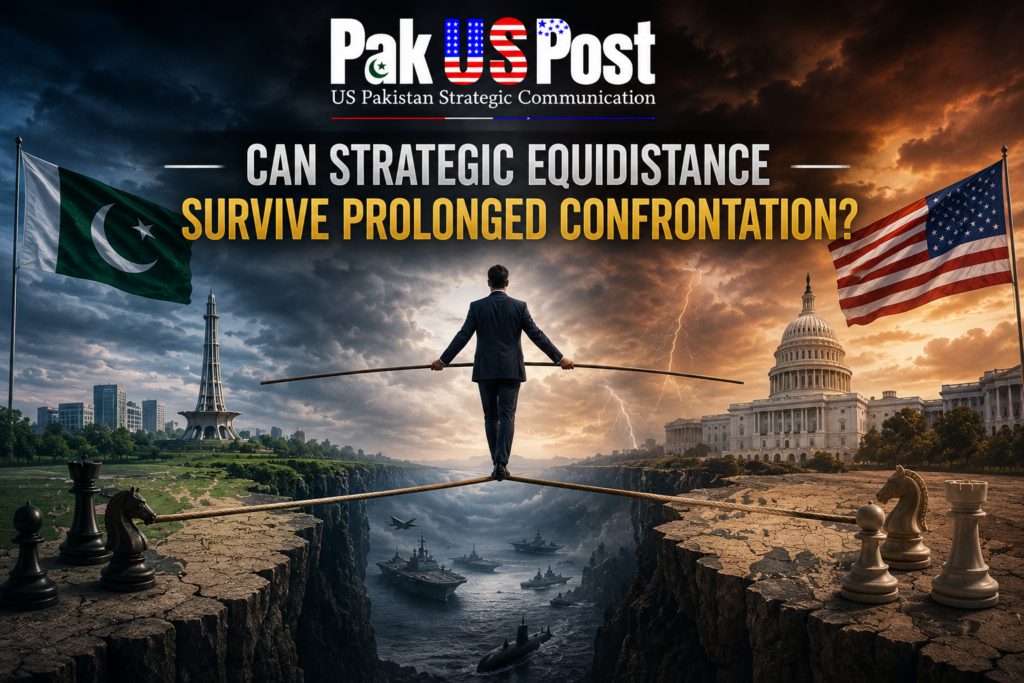
Pak US Post must treat the Pakistan, United States, Iran triangle as a problem of managed exposure rather than a conventional test of diplomatic neutrality. Pakistan’s geographic adjacency to Iran, dependence on Gulf energy routes, counterterrorism requirements along its western frontier and continuing engagement with Washington have created an unusually compressed strategic equation. A prolonged US, Iran confrontation would make that equation materially harder to sustain because decisions taken for one relationship could generate liabilities in another. Islamabad’s diplomatic space therefore cannot rest upon declaratory neutrality alone. It requires an institutional doctrine capable of separating diplomatic positioning from operational cooperation, sanctions compliance from political alignment, and border security from military signalling.
The central difficulty is that Pakistan does not possess symmetrical relationships with Washington and Tehran. The United States remains important for financial access, counterterrorism cooperation, defence engagement, intelligence liaison, multilateral diplomacy and economic credibility. Iran is Pakistan’s immediate western neighbour, sharing a frontier across Balochistan where communities, markets, migration routes and security concerns routinely disregard the neatness of sovereign boundaries. The relationship with Tehran also carries religious, cultural and regional sensitivities that cannot be managed exclusively through the language of strategic interest. Pakistan’s policy therefore faces an asymmetry of geography and leverage. Washington is distant but consequential. Tehran is proximate and unavoidable.
That distinction should become the organising principle of Islamabad’s crisis doctrine. Strategic equidistance should not be interpreted as equal political affinity, equal strategic dependence or moral equivalence between competing actors. It should mean maintaining sufficient diplomatic autonomy to prevent Pakistan’s territory, institutions, markets and security apparatus from becoming instruments of another state’s confrontation. Such equidistance would be credible only if accompanied by predictable conduct. Washington would need assurance that Pakistan would not facilitate sanctions evasion, illicit financial transfers, weapons proliferation or intelligence activities directed against American interests. Tehran would need confidence that Pakistan would not permit its territory to become an operational platform for hostile action against Iran.
This is where diplomatic ambiguity becomes insufficient. Islamabad should communicate a narrow set of non negotiable principles through parallel channels with Washington and Tehran. Pakistani territory will not be available for offensive operations against either party. Pakistan will comply with applicable international obligations and domestic legal requirements concerning illicit finance, proliferation and sanctioned transactions. Counterterrorism cooperation will remain threat based rather than bloc based. Humanitarian considerations will be insulated, wherever legally possible, from coercive economic measures. Any request for Pakistani military participation in a conflict outside these parameters would require political authorisation at the highest level and a formal assessment of escalation, legal exposure, economic consequences and domestic security risks.
The operational value of such signalling lies in reducing uncertainty before a crisis reaches its most volatile stage. Pakistan should establish a standing interagency US, Iran Crisis Cell bringing together foreign affairs, defence, interior, finance, energy, commerce, intelligence, customs, border management and maritime authorities. Its mandate should not be to formulate rhetoric. It should maintain a continuously updated exposure map identifying sanctions vulnerabilities, critical imports, banking channels, border crossings, aviation routes, shipping dependencies, vulnerable infrastructure and politically sensitive populations. The cell should operate through scenario triggers rather than ad hoc meetings. A missile exchange involving Iranian territory, closure of a major Gulf energy route, expanded secondary sanctions, mass displacement or an American request for operational assistance should automatically activate predefined response protocols.
Border security would become the immediate test of credibility. Pakistan’s western frontier cannot be treated as a static security line during a prolonged confrontation. Intensified hostilities could produce irregular crossings, militant infiltration, arms trafficking, smuggling, refugee movements and attempts by hostile intelligence networks to exploit local grievances. Islamabad should therefore strengthen layered surveillance rather than simply increase troop density. Biometric verification at formal crossings, integrated watchlists, cargo risk profiling, geospatial monitoring, controlled humanitarian corridors and real time information exchange among civilian and security agencies would provide greater resilience than indiscriminate restrictions on border communities.
The frontier should simultaneously remain economically functional. Excessive closure could push legitimate commerce into informal channels, increasing precisely the illicit activity that sanctions enforcement seeks to prevent. A calibrated border regime should distinguish humanitarian movement, documented commercial trade, low risk local commerce and high risk consignments. Customs authorities should deploy automated risk scoring against manifests, beneficial ownership records, declared commodity values and historical trading patterns. Suspicious transactions should be referred for enhanced scrutiny without converting the entire border economy into a presumption of criminality. This is especially important in Balochistan, where governance legitimacy depends partly upon maintaining lawful economic connectivity.
Energy constitutes the most formidable structural vulnerability. Pakistan’s exposure to disruptions in Gulf energy markets means that a US, Iran confrontation could transmit through prices even if Pakistani territory remained outside the conflict. A prolonged interruption in shipping through the Strait of Hormuz, attacks on energy infrastructure or insurance restrictions on regional shipping could affect petroleum costs, electricity generation, fertiliser production and transport inflation simultaneously. Islamabad therefore needs an energy contingency mechanism rather than a crisis import response. Strategic fuel stocks should be calibrated against realistic disruption scenarios, while procurement should be diversified across suppliers, shipping routes and contractual structures where commercially feasible.
Iranian electricity supplies require particularly careful treatment. Cross border electricity arrangements can have practical value for underserved areas, but their continuity may become more complicated under intensified sanctions. Islamabad should establish a legal and financial review mechanism capable of distinguishing permitted humanitarian and energy transactions from activities that could trigger sanctions exposure. Any expansion of energy cooperation with Tehran during heightened confrontation should be subjected to sanctions screening, banking due diligence and documented legal review. The objective should not be to eliminate every economic interaction with Iran, which would be unrealistic, but to prevent informal mechanisms from creating systemic exposure for Pakistani banks, firms and public institutions.
Washington’s expectations will also require disciplined management. American policymakers are likely to judge Pakistan less by its diplomatic vocabulary than by observable conduct. Intelligence cooperation against transnational militant organisations, action against terrorist financing, border controls and prevention of illicit procurement could preserve confidence even if Islamabad refuses to endorse American military action against Iran. Pakistan should therefore make a deliberate distinction between refusing alignment and refusing cooperation. A state can decline participation in a conflict while continuing to exchange actionable intelligence concerning terrorist networks, protect diplomatic facilities, investigate financial crimes and prevent attacks against third country interests.
Tehran will apply a different test. Iranian officials are likely to examine whether Pakistan’s security cooperation with Washington acquires an anti Iranian operational character. Islamabad should address this concern through verifiable restraints rather than rhetorical assurances. Existing bilateral security mechanisms should be used to establish direct communication concerning border incidents, militant movement, airspace violations and unusual military activity. A permanent western frontier deconfliction channel could provide an immediate mechanism for investigating incidents before they become accusations. The military value of such a channel would be substantial because misperception along a heavily securitised frontier can escalate faster than diplomatic ministries can respond.
Religious diplomacy requires equal precision. Sectarian narratives can transform a geopolitical conflict into a domestic security problem with remarkable speed. Pakistani authorities should resist importing external conflict narratives into domestic political discourse while maintaining constitutional protections for peaceful expression and religious practice. The Council of Islamic Ideology, religious scholars, parliamentary interlocutors and recognised religious institutions could contribute to a preventive communication architecture designed to discourage sectarian mobilisation and misinformation. The objective should not be state management of religious opinion. It should be the prevention of foreign conflict from becoming a catalyst for domestic violence.
Crisis communication should consequently be treated as a security instrument. Contradictory statements from ministries, unexplained military movements or unverified claims circulating through digital platforms could create strategic consequences disproportionate to the original event. Pakistan should designate a single senior interagency communication mechanism for major developments affecting US, Iran relations. Public messaging should disclose what can safely be disclosed, distinguish verified information from assessment and avoid attributing hostile intent without evidence. Diplomatic communication with Washington and Tehran should run in parallel with public communication, ensuring that neither capital learns Pakistan’s actual position through media speculation.
Sanctions management presents another institutional challenge. Pakistan’s banks, exporters, importers, shipping companies and state owned enterprises require practical compliance guidance rather than general warnings. The State Bank, Finance Ministry, customs authorities and relevant regulators should maintain a consolidated sanctions risk register, supported by transaction screening, beneficial ownership verification and enhanced scrutiny of high risk commodities. Commercial actors should receive clear guidance on prohibited conduct, reporting requirements and escalation procedures. A national sanctions compliance framework would protect Pakistan not merely from legal penalties but from de risking by international banks, which can be more economically damaging than a formal sanction.
The Gulf dimension cannot be separated from this calculation. Saudi Arabia, the United Arab Emirates, Qatar and other Gulf partners are simultaneously energy suppliers, investment partners, labour markets and security interlocutors. Pakistan cannot afford to allow its Iran policy to generate doubts among Gulf capitals about its reliability. Yet Gulf relationships should not be converted into a proxy instrument for pressure on Tehran. Islamabad’s most useful message to Gulf partners would be that Pakistan seeks regional stability, protection of energy infrastructure and uninterrupted commercial flows rather than participation in bloc competition. This position would be more credible if Pakistan strengthens maritime security and emergency energy coordination without attaching those measures to offensive military objectives.
A prolonged confrontation could also produce refugee movements. Pakistan should prepare for displacement without prematurely securitising vulnerable populations. Border authorities, humanitarian agencies and provincial administrations need contingency plans covering temporary reception, registration, health screening, family reunification and onward movement. Such planning should include funding arrangements before an emergency rather than after the arrival of large populations. Security screening must remain rigorous, but collective suspicion would be counterproductive. The objective should be controlled humanitarian management that prevents both exploitation by militant networks and unnecessary destabilisation of border communities.
Three strategic scenarios deserve continuous rehearsal. If hostilities remain limited and geographically contained, Pakistan should preserve diplomatic engagement, maintain sanctions compliance and strengthen border monitoring without altering its broader foreign policy. If conflict expands into Gulf energy infrastructure, Islamabad should activate energy substitution measures, maritime risk coordination and emergency economic protocols while intensifying diplomacy for de escalation. If confrontation generates direct pressure on Pakistan to adopt an explicit military or political position, Islamabad should invoke its declared red lines, offer mediation or communication channels where useful and refuse operational commitments that could convert Pakistani territory into a theatre of conflict.
The credibility of neutrality will ultimately depend on capability. A government cannot sustain strategic autonomy while relying upon improvised decisions during emergencies. Pakistan needs a permanent crisis planning architecture that integrates diplomatic, military, financial, energy and border assessments. Annual table top exercises involving civilian ministries, the armed forces, intelligence agencies, financial regulators and provincial authorities could test assumptions before they become vulnerabilities. Parliamentary oversight, where compatible with operational security, would further strengthen political legitimacy and reduce the risk of contradictory national messaging.
Strategic equidistance should therefore be understood as an active doctrine of risk management, not passive non alignment. Pakistan cannot choose its geography, and it cannot insulate itself from the economic consequences of a major confrontation involving Iran and the United States. It can, however, determine how much strategic exposure it accepts, how rapidly it detects emerging risks and how consistently it communicates its limits.
The decisive policy question is not whether Islamabad can remain neutral in an abstract diplomatic sense. It is whether Pakistan can preserve freedom of action while satisfying minimum security expectations on both sides. That requires Washington to understand that Pakistani cooperation against terrorism does not imply participation in a campaign against Iran, while Tehran must understand that Pakistani security cooperation with Washington does not automatically constitute strategic hostility. The most durable position is therefore neither equidistance as symbolism nor alignment as expediency. It is disciplined differentiation.
For the Pakistani establishment, the practical doctrine should be clear: keep territory unavailable for offensive use, keep borders controllable, keep financial channels compliant, keep energy contingencies funded, keep Gulf relationships insulated from bloc politics, keep Washington informed, keep Tehran engaged and keep domestic communication ahead of external narratives. If confrontation becomes prolonged, neutrality will survive only where institutions make it operationally credible. Pakistan’s strategic autonomy will not be protected by distance from the conflict. It will be protected by the precision with which Islamabad manages every channel through which the conflict can reach Pakistan.
A Public Service Message