Who Governs the Data Behind Pakistan US Security AI?


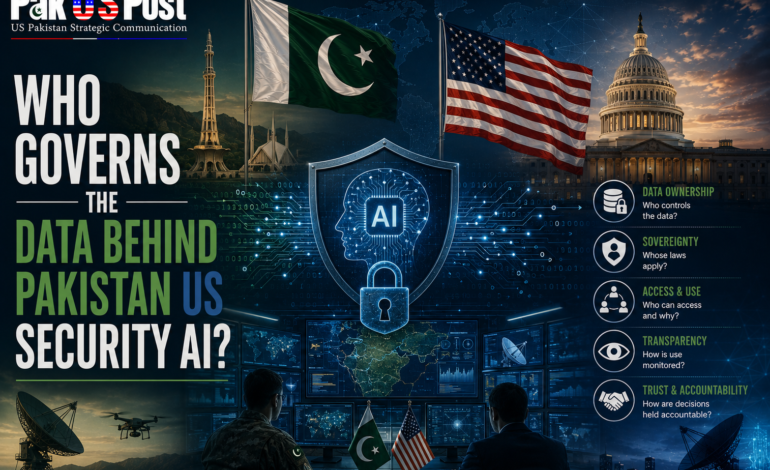
Pak US Post, artificial intelligence is becoming less a question of technological acquisition than of sovereign control over the information architecture from which security decisions are produced. Pakistan and the United States have credible reasons to explore cooperation in machine assisted counterterrorism, border monitoring, cyber investigations, disaster prediction and financial crime detection, yet the strategic value of such cooperation will ultimately depend on an issue that procurement documents often obscure: who governs the data behind the algorithm. A model can be technically impressive while its underlying dataset is incomplete, politically distorted, unlawfully obtained or operationally misclassified. It can identify a suspicious transaction, vehicle, network or digital identity with remarkable statistical confidence and still produce the wrong conclusion. For security institutions, therefore, the central question is not whether an algorithm can predict risk, but whether the state can demonstrate how that prediction was generated, who validated it, what legal authority supported its use and which institution remains accountable when the machine is wrong.
The temptation in bilateral security cooperation is to treat artificial intelligence as another capability transfer. Sensors produce data, cloud systems aggregate it, algorithms detect patterns and commanders or investigators receive prioritised outputs. That model is insufficient for a relationship involving two jurisdictions with different statutory regimes, institutional cultures, intelligence architectures and approaches to privacy. Pakistan needs access to advanced analytical capabilities without surrendering control over strategically sensitive national datasets. Washington, meanwhile, will require assurances that information supplied by American agencies, companies or security partners will be protected from unauthorised disclosure, repurposing and insecure onward transfer. The resulting governance problem is therefore reciprocal. Data sovereignty cannot become a euphemism for opacity in Islamabad, just as technological superiority cannot become a justification for unrestricted American access.
A bilateral AI security framework should begin with data provenance. Every operational dataset exchanged under a Pakistan US arrangement should carry a machine readable provenance record identifying its source institution, collection authority, date of acquisition, geographic scope, permitted purpose, classification status, retention period and known limitations. Information obtained from a sensor should be distinguishable from information derived from a human source, an open source platform, a financial institution, a telecommunications provider or an intelligence database. Historical datasets should not automatically become legitimate training material merely because they already exist within government systems. Their original collection authority must be examined before they are incorporated into a new model. A dataset collected for immigration administration, for example, should not silently become a counterterrorism training corpus without an explicit legal and institutional determination.
This distinction matters because artificial intelligence does not merely consume information. It transforms it. A model may create inferred relationships that never existed in the original database, assign probability to individuals or entities, generate risk classifications and identify associations that investigators subsequently regard as intelligence. The resulting information cannot be treated as ordinary government records. Pakistan and the United States should define ownership and control at several levels, distinguishing original data, processed data, model weights, analytical outputs, derived intelligence and operational decisions. Ownership of a dataset should not automatically confer ownership over every inference produced from it. Equally, the institution operating an algorithm should not acquire unrestricted rights over intelligence generated from another country’s sovereign information.
A practical bilateral protocol should establish a joint data governance board with authority extending beyond diplomatic coordination. Pakistan’s National Database and Registration Authority, Federal Investigation Agency, National Cyber Emergency Response arrangements, financial intelligence authorities and relevant defence and intelligence institutions would require designated data governance officers for each cooperative AI programme. On the American side, participating agencies should appoint equivalent accountable officials. The board should maintain a bilateral register of approved datasets, authorised models, participating institutions, permitted analytical purposes and applicable restrictions. No dataset should enter a shared analytical environment merely because a technical team has obtained access credentials.
Classification requires equal precision. Excessive secrecy can prevent parliamentary and civilian institutions from evaluating a programme, while indiscriminate disclosure can expose sources, methods, vulnerabilities and operational intentions. The appropriate solution is differentiated access. Strategic policymakers should receive information sufficient to assess objectives, legal authority, financial exposure, reliability metrics and institutional risk. Authorised security committees should have access to more detailed classified assessments. Technical auditors should receive controlled access to model documentation and testing records. Operational personnel should receive only the information necessary for their functions. This architecture would preserve confidentiality without allowing classification to become a blanket exemption from accountability.
The most consequential issue is false positives. In counterterrorism, a false positive can place an innocent individual under surveillance, trigger an investigation, restrict movement or contaminate intelligence assessments. At a border, an inaccurate risk score can delay legitimate travellers or distort threat prioritisation. In financial crime detection, an algorithmic alert can disrupt lawful commerce and damage a company’s reputation. During a disaster, an erroneous prediction can divert emergency resources away from communities facing greater danger. These are not abstract statistical errors. They are institutional decisions with legal, economic and human consequences.
Accordingly, no bilateral security AI system should possess autonomous authority to impose coercive consequences against an individual or organisation solely on the basis of an algorithmic output. Human review should be mandatory whenever an AI generated assessment could lead to detention, denial of access, financial restriction, targeted investigation, heightened surveillance or other consequential state action. The human reviewer should not merely click an approval button. The protocol should require documented consideration of the underlying evidence, confidence level, known model limitations and alternative explanations. Where the algorithm contradicts material evidence available to the investigator, the human decision maker should have authority to override the system and record the reason.
Model auditing must become a continuing obligation rather than a procurement stage exercise. Before deployment, bilateral systems should undergo independent testing for accuracy, bias, robustness, data contamination, adversarial manipulation and performance degradation. Testing should be conducted against representative Pakistani datasets rather than relying exclusively on validation performed in American operational environments. A model trained primarily on one population may perform poorly when applied to another. Language, geography, financial behaviour, naming conventions, migration patterns, digital practices and institutional data quality can materially alter performance. A model that appears reliable in laboratory conditions may therefore become unreliable when transferred across jurisdictions.
The bilateral protocol should require an algorithmic impact assessment before any high consequence system enters operational service. The assessment should identify the purpose of the model, categories of affected persons, data sources, legal authority, expected benefits, foreseeable harms, human review procedures, audit frequency, retention rules and termination conditions. It should also specify a measurable threshold beyond which the system must be suspended. If false positive rates rise above an agreed level, if training data are compromised, if material model drift is detected or if the provenance of critical inputs becomes uncertain, operational use should stop pending investigation.
Cross border data access presents an additional strategic vulnerability. Pakistan should resist arrangements in which sensitive national datasets are transferred permanently into foreign controlled environments merely because those environments offer superior computational capacity. Where feasible, bilateral cooperation should use federated or controlled analytical architectures that allow models to be trained or queried against authorised datasets without unnecessarily relocating the underlying information. Sensitive information could remain within designated Pakistani infrastructure while approved analytical functions operate through controlled interfaces. Such arrangements would not eliminate all risks, but they would reduce the assumption that computational cooperation requires wholesale data migration.
The same principle should apply to cloud infrastructure and commercial technology providers. A bilateral agreement must identify where data are physically stored, who administers the infrastructure, which subcontractors can access the environment, what jurisdiction governs the provider and what happens when a vendor changes ownership or terms of service. Security cooperation cannot depend upon contractual language that policymakers have never examined. Vendor access should be logged, independently auditable and revocable. Sensitive datasets should not be incorporated into commercial model training without explicit authorisation. The right to terminate an arrangement should include the right to retrieve, delete or securely quarantine relevant data and derived artefacts.
Cyber investigations require an especially disciplined architecture because digital evidence is inherently mutable. Hash values, timestamps, chain of custody records and acquisition procedures should accompany information shared through AI enabled investigative systems. An algorithm may identify a pattern across devices, accounts or infrastructure, but the underlying evidence must remain independently available for verification. Intelligence confidence and evidentiary admissibility should not be conflated. A predictive system can be useful for generating investigative leads without becoming a substitute for legally obtained evidence.
Financial crime detection presents a similar distinction. Pakistan and the United States could gain substantially from machine assisted analysis of illicit financial flows, trade based money laundering, sanctions evasion and suspicious transaction networks. Yet automated systems should distinguish risk screening from guilt determination. Financial institutions and investigators should receive structured alerts containing confidence indicators and explanatory factors rather than opaque conclusions. Individuals and businesses affected by consequential decisions should have access to an appropriate review mechanism under the applicable legal regime. Cooperation will be stronger if algorithms accelerate investigations without quietly becoming adjudicators.
Disaster prediction offers a comparatively constructive field for early bilateral experimentation because the consequences of error can be evaluated through measurable public interest indicators rather than coercive enforcement. Joint models could integrate meteorological, hydrological, satellite and infrastructure information to improve flood forecasting, heat risk assessment and emergency logistics. Such cooperation would also allow both countries to establish governance practices in a lower sensitivity environment before applying AI to intelligence and law enforcement. The institutional lesson would be important: trust should be built through controlled operational success rather than proclaimed through diplomatic communiques.
Pakistan should also insist upon reciprocal capacity development. A sustainable partnership cannot leave Pakistani institutions dependent upon foreign vendors for model interpretation, audit capability and system maintenance. Joint programmes should include training for Pakistani data scientists, legal experts, investigators, auditors and senior officials. Technical documentation should be available to authorised Pakistani institutions at a level sufficient to evaluate material system characteristics. Where proprietary restrictions prevent disclosure of source code, independent verification should still be possible through controlled testing, documentation, performance records and audit access. Intellectual property protection is legitimate, but it should not become an all purpose shield against accountability.
For Washington, the incentive is equally clear. American security cooperation will be more durable if Pakistan can demonstrate disciplined stewardship of shared information. Data leakage, unauthorised onward transfer or politically motivated misuse would quickly undermine confidence and invite restrictions. A rigorous governance framework therefore serves American interests as much as Pakistani sovereignty. It creates predictable rules for access, improves evidentiary integrity and reduces the possibility that a technical failure becomes a diplomatic crisis.
Parliamentary and civilian oversight should be designed around capabilities rather than operational secrets. Authorised committees should receive periodic classified briefings covering programme objectives, expenditure, datasets approved for use, model performance, significant incidents, audit findings and corrective measures. They need not receive source identities, tactical configurations or real time operational details. Auditors should be able to examine procurement contracts, performance metrics and access logs. Independent review bodies should have authority to investigate complaints and material algorithmic failures. This is mature confidentiality: restricting sensitive information according to demonstrable security necessity rather than institutional convenience.
The governing principle for Pakistan US AI security cooperation should therefore be simple but demanding. No algorithm should possess more authority than the legal and institutional framework surrounding it. Data should remain traceable from collection to inference. Models should remain contestable through independent review. Human decision makers should remain responsible for consequential action. Cross border access should be proportionate to an identified purpose. Commercial providers should operate under enforceable controls. Parliamentary oversight should examine strategy, expenditure, legality and performance without exposing operational methods. And every high consequence system should contain a defined mechanism for suspension when its reliability becomes uncertain.
The strategic opportunity is substantial. Pakistan can use artificial intelligence to improve border intelligence, accelerate cyber investigations, detect complex financial networks, strengthen disaster preparedness and enhance the analytical capacity of security institutions. But technologically sophisticated cooperation must not be confused with indiscriminate automated surveillance. The objective should be a security architecture in which machines expand the state’s analytical reach while institutions retain command over judgment, legality and accountability. For Pakistan and the United States, the decisive measure of an AI partnership will not be the number of models deployed or the quantity of data exchanged. It will be whether both governments can prove, under scrutiny, where the data came from, why the algorithm was trusted, when it was challenged and who answered when it got the answer wrong.
A Public Service Message