American Semiconductor Controls And Pakistan’s Technological Future

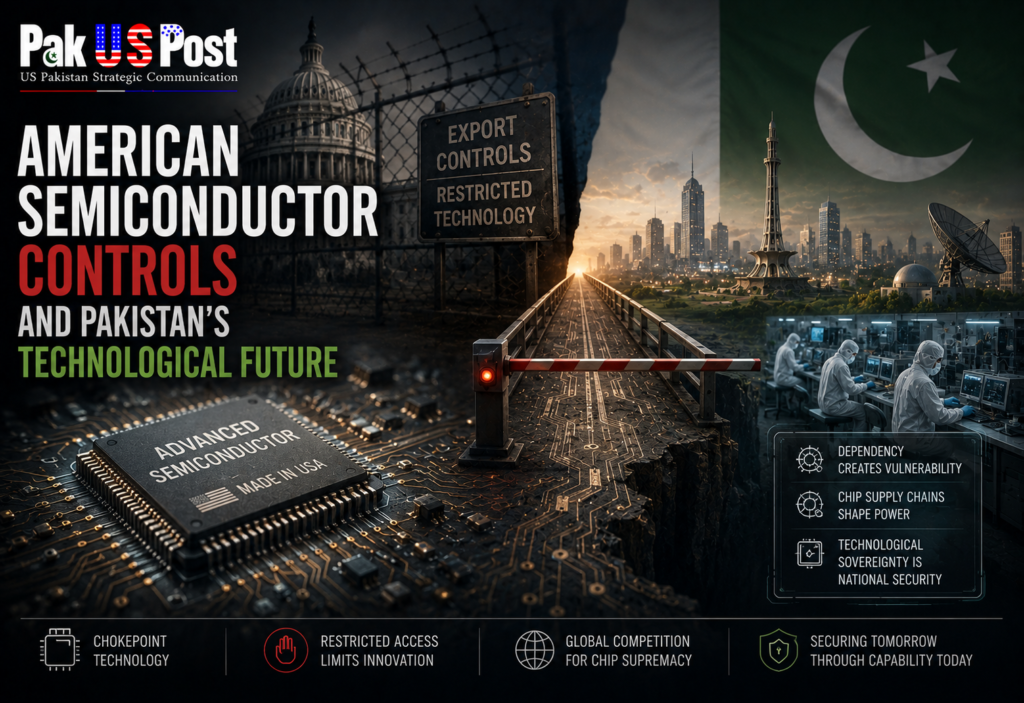
The semiconductor has become the defining strategic commodity of the twenty first century. Earlier eras measured national influence through access to energy reserves, industrial production or military hardware. Contemporary competition increasingly revolves around computational capability, advanced chip fabrication, artificial intelligence accelerators and the scientific ecosystems capable of sustaining technological leadership. Washington’s expanding semiconductor export controls therefore represent far more than a commercial policy. They constitute an integrated national security instrument designed to shape the future distribution of technological power, industrial productivity and strategic influence. For emerging economies including Pakistan, these restrictions are redefining development pathways, compelling governments to reconsider assumptions surrounding industrialisation, research collaboration, technological partnerships and national innovation policy.
American semiconductor restrictions have progressively evolved from targeted export licensing into an interconnected architecture encompassing advanced computing processors, electronic design automation software, fabrication equipment, cloud computing access, quantum technologies and sophisticated manufacturing inputs. The objective extends beyond limiting immediate technology transfers. It seeks to preserve long term technological advantages by slowing the emergence of competitors capable of producing advanced computing infrastructure with military, intelligence and commercial applications. This transformation reflects an increasingly accepted strategic doctrine within Washington that technological superiority cannot remain detached from economic security, defence preparedness and geopolitical competition.
Unlike traditional sanctions, semiconductor controls operate through technological ecosystems rather than isolated commodities. Modern integrated circuits require access to intellectual property libraries, specialised manufacturing chemicals, precision lithography systems, advanced packaging technologies, testing facilities, software verification platforms and highly trained engineering communities. Restricting any critical layer within this ecosystem can substantially delay technological advancement across entire industrial sectors. Consequently, export controls increasingly influence investment decisions, university research priorities, multinational supply chains and industrial planning far beyond countries directly targeted by American regulations.
Pakistan currently occupies only a marginal position within global semiconductor manufacturing. Nevertheless, the indirect consequences of evolving American technology controls are becoming increasingly significant. The country’s ambitions regarding digital manufacturing, industrial automation, artificial intelligence, defence electronics, telecommunications infrastructure and advanced research all depend upon reliable access to sophisticated computing technologies. Future competitiveness will therefore depend less upon acquiring isolated imported equipment and more upon developing resilient innovation systems capable of adapting to changing international technology governance.
The emerging semiconductor landscape exposes structural vulnerabilities within Pakistan’s industrial ecosystem. Domestic electronics manufacturing remains concentrated in assembly operations with limited value addition. Indigenous production of integrated circuits, precision sensors, microcontrollers or advanced electronic components remains minimal. Universities continue producing talented graduates, yet research commercialisation remains fragmented. Industrial laboratories rarely maintain sustained collaboration with academic institutions, while venture financing for deep technology enterprises remains underdeveloped. Consequently, Pakistan imports technological capability rather than systematically cultivating domestic innovation capacity.
Washington’s expanding technology licensing framework also introduces greater uncertainty into international research cooperation. Universities, technology firms and multinational corporations increasingly evaluate partnerships through national security considerations alongside commercial objectives. Research involving advanced computing, machine learning, aerospace engineering, semiconductor materials or quantum science now attracts heightened regulatory scrutiny across multiple jurisdictions. Pakistani institutions consequently encounter a more selective international environment where scientific collaboration increasingly intersects with export compliance, intellectual property protection and strategic technology assessments.
Higher education therefore emerges as one of the most important theatres affected by semiconductor geopolitics. Universities no longer compete solely through publication metrics or graduate numbers. They increasingly compete through laboratory infrastructure, computational capacity, international research credibility and intellectual property generation. Countries capable of integrating engineering education with industrial innovation become attractive partners within global technology networks. Those unable to modernise scientific institutions risk prolonged dependence upon imported technologies whose availability may become increasingly conditional.
Pakistan’s engineering education demonstrates considerable human potential but insufficient institutional integration. Electrical engineering departments, computer science faculties, material science laboratories and industrial design programmes frequently operate independently rather than contributing towards coordinated national technological objectives. Doctoral research often remains publication driven without corresponding industrial application. Technology transfer offices remain administratively weak, while patent commercialisation receives limited strategic attention. Without structural reforms, highly capable graduates may continue contributing to foreign innovation ecosystems rather than strengthening domestic technological competitiveness.
The semiconductor ecosystem also highlights the strategic importance of scientific infrastructure. Contemporary chip design increasingly relies upon high performance computing clusters, sophisticated simulation software, clean room facilities, nanoscale fabrication laboratories and advanced measurement instruments. Although establishing world class semiconductor fabrication facilities exceeds Pakistan’s current industrial capacity, significant opportunities exist within semiconductor design, embedded systems, testing services, electronic packaging, specialised materials research and industrial electronics. These sectors require sustained investment but remain considerably more attainable than immediately pursuing leading edge fabrication capabilities.
Pakistan’s defence industrial ecosystem possesses additional relevance within this evolving technological environment. Modern defence platforms increasingly depend upon advanced processors, secure communications, embedded artificial intelligence, autonomous systems and electronic warfare capabilities. Semiconductor restrictions therefore possess implications extending beyond commercial manufacturing into strategic resilience. Defence preparedness increasingly requires indigenous competence in electronics integration, secure software development, trusted hardware verification and resilient supply chain management. Dependence upon vulnerable external technology sources may gradually constrain operational flexibility during periods of geopolitical uncertainty.
The expanding convergence between civilian and military technologies further complicates policy formulation. Artificial intelligence processors, advanced graphics units, satellite electronics, robotics controllers and communication chips possess extensive commercial applications while simultaneously supporting military capabilities. Consequently, export licensing decisions increasingly evaluate end use, research partnerships and institutional affiliations. Pakistan must therefore strengthen transparent technology governance mechanisms capable of reassuring international partners regarding responsible utilisation while simultaneously protecting legitimate national security requirements.
Digital manufacturing represents another area profoundly influenced by semiconductor availability. Smart factories increasingly integrate industrial sensors, programmable logic controllers, robotic systems, predictive maintenance algorithms and machine vision technologies. These systems depend upon reliable access to increasingly sophisticated electronic components. Export restrictions affecting advanced processors or industrial automation technologies could indirectly reduce manufacturing productivity across developing economies unable to cultivate alternative supply arrangements or indigenous technological capabilities.
Pakistan’s industrial modernisation agenda consequently requires greater emphasis upon electronics resilience. Textile production, pharmaceutical manufacturing, agricultural machinery, automotive assembly and logistics automation all increasingly depend upon semiconductor intensive technologies. Industrial competitiveness will therefore depend not merely upon labour costs or energy availability but also upon technological adaptability and engineering sophistication. Countries capable of integrating digital technologies throughout manufacturing ecosystems will capture disproportionate productivity gains over the coming decade.
Technology partnerships similarly require strategic recalibration. Earlier industrial models often relied upon bilateral equipment procurement or isolated foreign investments. Contemporary innovation increasingly develops through multinational research consortia, cross border engineering collaboration, venture capital ecosystems and open innovation platforms. Pakistan should therefore diversify technology relationships across multiple advanced and emerging innovation centres while maintaining constructive engagement with American institutions wherever feasible. Diversification enhances resilience without encouraging technological isolation.
American universities, despite evolving regulatory frameworks, continue leading global research across semiconductor science, computational engineering and advanced materials. Pakistani institutions should expand collaborative engagement within permissible scientific domains including microelectronics education, chip verification methodologies, power electronics, cybersecurity engineering, semiconductor reliability studies and industrial automation research. Carefully structured academic partnerships remain valuable instruments for strengthening domestic expertise while respecting evolving international compliance requirements.
The private sector must simultaneously assume greater responsibility for technological upgrading. Industrial competitiveness increasingly depends upon continuous innovation rather than periodic equipment replacement. Pakistani electronics firms should expand investments in embedded software, industrial design, printed circuit board engineering, firmware development and specialised manufacturing solutions tailored to domestic market requirements. Such incremental capabilities gradually establish technological depth capable of supporting more sophisticated industrial activities over time.
Financial institutions likewise possess an underappreciated role within technological transformation. Deep technology enterprises require patient capital, extended research horizons and specialised investment evaluation frameworks. Conventional commercial lending rarely accommodates these characteristics. Pakistan should therefore encourage innovation financing mechanisms supporting semiconductor adjacent enterprises, university spin offs, engineering start ups and applied research commercialisation. Sovereign innovation funds, public private technology partnerships and targeted fiscal incentives could substantially strengthen domestic entrepreneurial ecosystems.
Industrial policy must also distinguish between strategic ambition and operational realism. Constructing leading edge semiconductor fabrication facilities requires extraordinary financial resources, specialised expertise and sustained economies of scale. Attempting immediate entry into advanced chip manufacturing would likely divert scarce national resources from more attainable opportunities. Pakistan should instead concentrate upon design services, specialised electronics, industrial control systems, power semiconductors, embedded software and advanced manufacturing support technologies where comparative advantages can gradually emerge.
Supply chain resilience should become another national priority. Semiconductor shortages during recent years demonstrated how disruptions rapidly affect automotive production, telecommunications, healthcare equipment and consumer electronics worldwide. Pakistan should identify critical electronic components supporting essential infrastructure including energy systems, banking networks, telecommunications, transportation and defence communications. Strategic inventories, supplier diversification and domestic assembly capabilities would strengthen resilience against future technological disruptions.
National research priorities require corresponding adjustment. Scientific funding frequently disperses resources across numerous disconnected projects producing limited cumulative impact. A mission oriented research strategy focusing upon electronics engineering, advanced materials, artificial intelligence hardware optimisation, industrial automation and secure communications could generate stronger technological outcomes. Universities, research councils, defence laboratories and industrial stakeholders should participate within coordinated national technology missions supported through multi year funding commitments.
Human capital development remains the decisive variable. Semiconductor ecosystems ultimately depend upon scientists, engineers, technicians, software architects and manufacturing specialists capable of sustaining innovation across decades. Pakistan should modernise engineering curricula to emphasise integrated circuit design, hardware security, semiconductor physics, advanced manufacturing technologies and electronic systems integration. Greater interaction between universities and industrial employers would improve graduate readiness while strengthening applied research.
Technical and vocational education deserves equivalent attention. Semiconductor adjacent industries require precision technicians capable of operating sophisticated manufacturing equipment, calibration instruments and quality assurance systems. Expanding vocational programmes aligned with industrial electronics, automation maintenance and advanced manufacturing would strengthen workforce competitiveness while attracting higher value investments.
Regulatory modernisation also warrants consideration. Emerging technology industries depend upon predictable intellectual property frameworks, efficient customs procedures, secure digital infrastructure and internationally recognised standards certification. Administrative uncertainty discourages high technology investment regardless of labour availability or market size. Regulatory reforms should therefore prioritise transparency, institutional consistency and internationally compatible compliance mechanisms facilitating participation within global technology value chains.
Cybersecurity increasingly intersects with semiconductor governance. Advanced electronic systems constitute attractive targets for cyber espionage, intellectual property theft and supply chain manipulation. Pakistan should strengthen hardware assurance standards, secure procurement protocols and semiconductor supply verification mechanisms protecting critical infrastructure against technological compromise. Cyber resilience should become an integral component of industrial policy rather than a separate information technology function.
Artificial intelligence introduces additional complexity. Advanced language models, autonomous systems and predictive analytics require increasingly powerful computing infrastructure. Semiconductor restrictions affecting high performance processors may influence AI development trajectories across emerging economies. Pakistan should therefore invest in computational efficiency research, distributed computing architectures and algorithm optimisation enabling productive AI deployment despite potential hardware limitations.
Diplomatically, Pakistan should avoid framing semiconductor competition through simplistic geopolitical binaries. The global technology ecosystem remains deeply interconnected despite strategic rivalries. Constructive engagement with American technology institutions, European research networks, East Asian manufacturing partners and regional innovation initiatives should proceed simultaneously where consistent with national interests and international obligations. Technological diversification strengthens sovereignty more effectively than exclusive alignment with any single external partner.
Establishment institutions should recognise that technological dependence increasingly represents a strategic vulnerability comparable to energy insecurity or critical infrastructure exposure. National resilience now depends upon secure access to trusted computing systems, reliable electronics supply chains and indigenous engineering competence. Strategic planning should therefore integrate technological preparedness into broader national security assessments encompassing economic stability, defence modernisation and digital governance.
The federal government should establish a National Semiconductor and Advanced Electronics Strategy integrating industrial development, higher education reform, defence technology planning and scientific research. Such a strategy should define measurable objectives regarding engineering talent, research commercialisation, electronics exports, industrial partnerships and technological resilience. Fragmented institutional initiatives cannot effectively respond to increasingly coordinated international technology policies.
Public procurement can become a powerful catalyst for domestic innovation. Government agencies responsible for telecommunications, transportation, healthcare, energy and defence should encourage procurement frameworks rewarding local engineering capability, systems integration and technological adaptation rather than exclusively lowest cost imports. Carefully designed procurement policies stimulate domestic technological learning while maintaining international quality standards.
International investors similarly evaluate institutional coherence alongside commercial incentives. Stable technology policies, predictable taxation, efficient dispute resolution and research partnerships significantly influence investment decisions within advanced manufacturing sectors. Pakistan should therefore project policy continuity demonstrating long term commitment towards technological upgrading irrespective of political transitions.
Ultimately, American semiconductor export controls represent neither a temporary commercial dispute nor an isolated regulatory development. They signify a profound restructuring of international technological governance where innovation, security and industrial competitiveness increasingly converge. Countries capable of anticipating these structural transformations will strengthen economic resilience and strategic autonomy. Those relying exclusively upon imported technological capability risk prolonged dependence within increasingly restrictive global innovation networks.
For Pakistan, the appropriate response is neither technological pessimism nor unrealistic ambition. The strategic imperative lies in systematically expanding indigenous scientific capability, strengthening engineering institutions, modernising industrial policy and cultivating diversified international technology partnerships. Semiconductor geopolitics has redefined the foundations of national competitiveness. Pakistan’s future position within the global digital economy will depend less upon external technology availability than upon its determination to construct resilient domestic innovation ecosystems capable of sustaining technological advancement across generations. The contest shaping industrial leadership is already underway, and preparedness rather than aspiration will determine which nations emerge as meaningful contributors to the next technological era.
A Public Service Message