

The Indo Pacific Maritime Data Architecture: Could Pakistan Become Invisible Within America’s Expanding Ocean Intelligence Network?

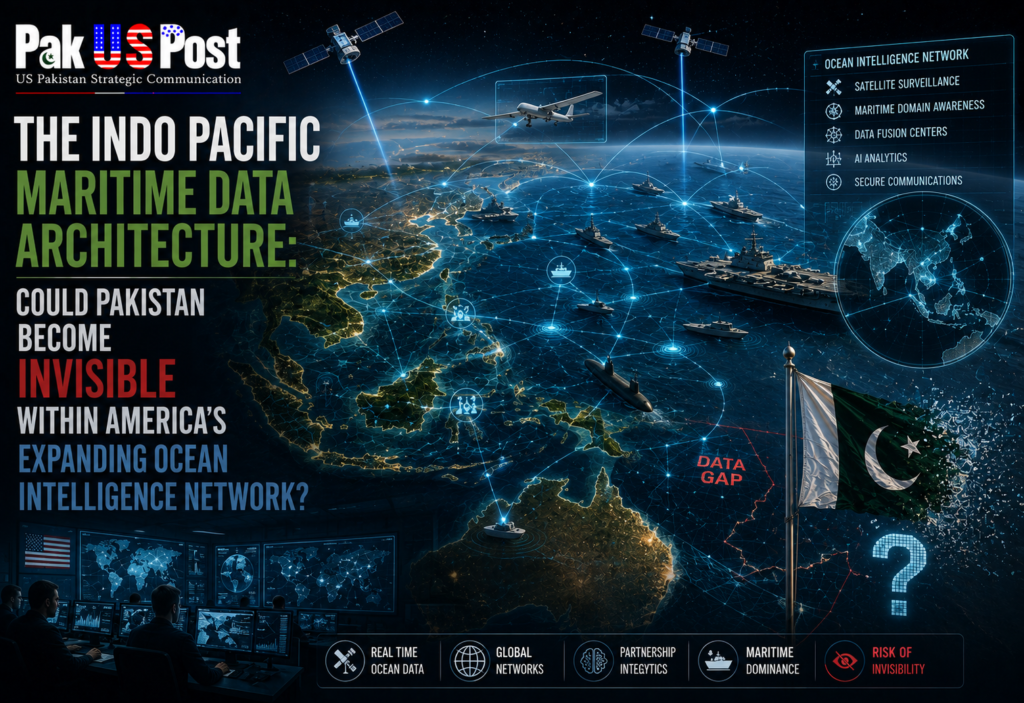
The twenty first century Indo Pacific is no longer defined primarily by fleets, aircraft carriers or visible naval deployments. Increasingly, maritime influence is being exercised through data rather than displacement. Beneath the surface of traditional naval competition, an extensive digital ocean intelligence architecture is emerging that integrates satellites, autonomous maritime platforms, seabed sensor networks, commercial shipping databases, artificial intelligence driven analytics and multinational information fusion centres. Supported by the United States and its strategic partners, this evolving maritime ecosystem is transforming the character of naval power from physical sea control towards persistent information superiority.
This transformation raises significant strategic questions for Pakistan. As maritime domain awareness becomes increasingly dependent upon continuous digital surveillance rather than episodic naval patrols, Pakistan confronts the possibility that portions of its maritime environment could become persistently visible to external actors while remaining only partially visible to its own institutions. The central challenge is therefore no longer simply protecting territorial waters but ensuring sovereign awareness across Pakistan’s Exclusive Economic Zone, commercial sea lanes and critical maritime infrastructure.
The United States has progressively institutionalised a multilayered maritime intelligence architecture across the Indo Pacific. Military reconnaissance satellites are increasingly complemented by commercial Earth observation constellations capable of providing near continuous imagery. Automatic Identification System transmissions from merchant vessels are fused with synthetic aperture radar imagery, electro optical satellites, underwater acoustic monitoring, unmanned surface vessels and oceanographic modelling. Artificial intelligence platforms process enormous volumes of maritime data, enabling anomaly detection, vessel behaviour prediction and early warning of suspicious activities across vast ocean spaces.
This architecture operates through multinational information sharing arrangements involving allied navies, coast guards, regional maritime fusion centres and commercial technology providers. Instead of relying solely upon forward deployed naval assets, decision makers increasingly possess a comprehensive digital representation of maritime activity extending from the Western Pacific to the Arabian Sea. Maritime influence is therefore becoming less dependent upon the number of ships deployed and more dependent upon access to integrated information ecosystems.
For Pakistan, this evolution carries profound implications. The country’s strategic geography places it adjacent to some of the world’s most significant maritime communication routes. Gwadar Port, Karachi Port, Port Qasim and associated energy infrastructure are increasingly integrated into regional trade and logistics networks. Simultaneously, Pakistan’s Exclusive Economic Zone contains fisheries, offshore energy prospects and critical seabed resources whose protection depends upon sustained maritime awareness rather than occasional naval patrols.
Traditional maritime security relied upon visible naval presence, coastal radar installations and periodic aerial reconnaissance. Contemporary maritime competition demands persistent multidomain surveillance integrating satellites, unmanned platforms, underwater sensors and predictive analytics. States unable to generate comprehensive maritime intelligence risk becoming informationally dependent upon external actors for understanding activities occurring within their own maritime jurisdictions.
Commercial shipping has also become a strategic intelligence source. Modern container logistics generate continuous digital records covering vessel movements, cargo routing, port operations and supply chain behaviour. Shipping analytics companies increasingly combine satellite imagery with port management systems and insurance databases to produce sophisticated assessments of maritime commerce. Such information possesses both commercial value and strategic significance, enabling governments to monitor trade flows, identify sanctions circumvention, analyse naval logistics and assess economic vulnerabilities.
Pakistan’s maritime commerce therefore exists within an increasingly transparent digital environment. The challenge extends beyond physical port protection towards safeguarding digital maritime infrastructure including logistics databases, vessel traffic management systems, customs platforms and maritime communication networks. Cyber resilience has become inseparable from maritime security.
Port security itself is undergoing technological transformation. Artificial intelligence assisted surveillance integrates high resolution cameras, drone monitoring, automated cargo inspection, biometric access control and predictive threat analysis. Smart ports increasingly function as interconnected digital ecosystems rather than isolated logistics facilities. While enhancing efficiency, this integration simultaneously creates new vulnerabilities involving cyber intrusion, data manipulation and supply chain disruption.
Pakistan has initiated important modernisation efforts within selected ports and naval facilities, yet institutional fragmentation remains evident. Maritime governance responsibilities remain distributed across naval organisations, maritime security agencies, fisheries authorities, port administrations, customs institutions and scientific organisations. Information sharing between these entities remains uneven, limiting the creation of an integrated national maritime operating picture.
Oceanographic research represents another strategic dimension frequently overlooked in national security debates. Contemporary naval operations increasingly depend upon detailed understanding of underwater geography, acoustic propagation, ocean currents, salinity patterns and environmental conditions. Such scientific knowledge directly influences submarine operations, underwater communications, autonomous underwater vehicles and seabed infrastructure protection.
Major maritime powers invest heavily in oceanographic research because environmental intelligence enhances operational effectiveness. Pakistan possesses important scientific institutions and university capabilities, yet sustained investment in marine science, hydrographic surveying and underwater technology remains comparatively limited relative to emerging regional requirements.
Autonomous maritime systems are similarly reshaping naval planning. Unmanned surface vessels, autonomous underwater vehicles and long endurance maritime drones provide persistent surveillance at significantly lower operational costs than conventional platforms. Combined with artificial intelligence, these systems generate continuous situational awareness while reducing personnel requirements and extending operational endurance.
The future maritime battlespace will increasingly involve cooperation between crewed vessels and autonomous platforms connected through secure digital networks. Pakistan’s naval modernisation therefore requires balanced investment not only in traditional combat platforms but also in intelligent maritime surveillance technologies capable of operating across extensive Exclusive Economic Zone waters.
Satellite capability represents another critical pillar of maritime independence. Indigenous Earth observation satellites, secure satellite communications and space based maritime monitoring substantially enhance sovereign situational awareness. While complete strategic autonomy may remain economically challenging, diversified international partnerships can reduce dependence upon any single external information provider while expanding access to advanced maritime technologies.
Institutional reform is equally essential. Pakistan requires an integrated National Maritime Information Fusion Centre capable of consolidating data from naval sensors, coast guard operations, port authorities, customs agencies, meteorological organisations, fisheries departments and commercial shipping platforms into a unified maritime intelligence architecture. Artificial intelligence supported decision systems should assist analysts in identifying emerging patterns, illegal fishing, smuggling networks, maritime terrorism and environmental threats.
Policy should further encourage closer collaboration between universities, defence research organisations, technology firms and maritime industries. Indigenous software development, geospatial analytics, autonomous systems engineering and marine science should become central components of national maritime innovation policy. Human capital development remains as important as technological procurement.
International cooperation should remain diversified and pragmatic. Partnerships with multiple regional and extra regional actors in hydrography, marine science, satellite technology, environmental monitoring and maritime safety can strengthen national capability without compromising strategic autonomy. Such cooperation should prioritise capacity building, knowledge transfer and institutional resilience rather than technological dependence.
The broader strategic lesson is increasingly clear. Maritime influence in the Indo Pacific is shifting from visible naval deployment towards invisible information dominance. Nations able to observe, interpret and anticipate maritime activity through integrated digital intelligence architectures will shape regional stability more effectively than those relying exclusively upon conventional naval strength.
For Pakistan, preserving maritime sovereignty in this emerging environment requires recognising that data has become a strategic maritime asset equal in importance to ships, ports and sea lanes. National resilience will increasingly depend upon the ability to generate independent maritime intelligence, integrate scientific knowledge with operational planning and build institutional architectures capable of transforming information into strategic advantage. The future contest across the Arabian Sea may ultimately be decided not by who controls the largest fleet, but by who possesses the most comprehensive understanding of the ocean itself.
A Public Service Message


