
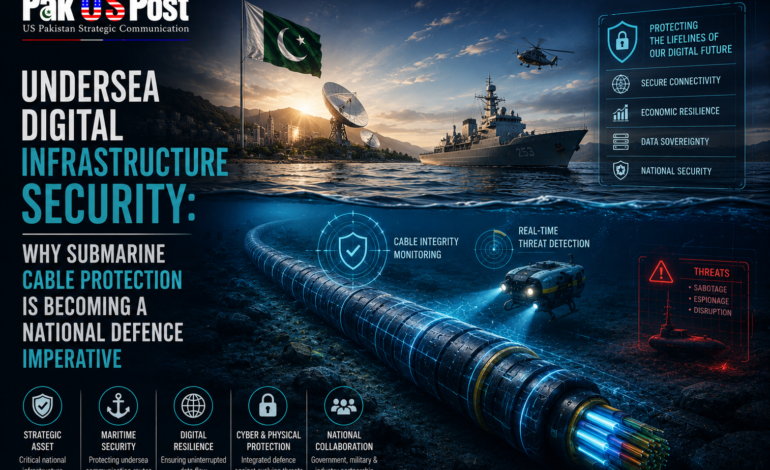
Undersea Digital Infrastructure Security: Why Submarine Cable Protection Is Becoming A National Defence Imperative


The global digital economy rests upon an infrastructure that remains largely invisible to public attention yet indispensable to modern statecraft. More than ninety five percent of international internet traffic, financial transactions, cloud computing exchanges and government communications travel through submarine fibre optic cables laid across the world’s oceans. These undersea networks have become the nervous system of the international economy, enabling everything from military command and control to banking settlements, artificial intelligence data transfers, scientific collaboration and digital commerce. As geopolitical competition increasingly extends beneath the oceans, submarine cable protection has evolved from a commercial telecommunications concern into a central national defence priority.
The strategic significance of submarine cables has expanded because digital dependence has deepened across every sector of governance. Financial markets rely upon uninterrupted low latency connectivity for cross border payments, stock exchanges and international banking. Defence establishments increasingly integrate secure digital communications into operational planning, intelligence sharing and logistics coordination. Government agencies depend upon international connectivity for diplomatic communications, immigration systems, customs operations and digital public services. Cloud computing providers distribute data across multiple continents through interconnected submarine cable networks. Consequently, disruption of even a limited number of cables may produce cascading consequences extending far beyond telecommunications.
Recent technological developments have significantly altered the security environment surrounding undersea infrastructure. Advances in seabed mapping technologies, autonomous underwater vehicles, remotely operated submersibles and high resolution underwater sensing have made previously inaccessible maritime environments increasingly transparent. These technologies provide valuable scientific and commercial benefits, yet they also expand opportunities for surveillance, reconnaissance and potential interference with critical infrastructure. Sophisticated underwater systems can identify cable routes, inspect infrastructure conditions and potentially facilitate covert operations against strategically important digital assets.
Autonomous underwater vehicles represent a particularly important development. Originally designed for oceanographic research, offshore energy exploration and environmental monitoring, these systems are becoming increasingly capable of conducting long endurance missions with limited human supervision. Their ability to operate quietly at considerable depths creates new security considerations for states seeking to monitor extensive undersea infrastructure. While legitimate commercial applications remain predominant, technological diffusion requires governments to strengthen awareness regarding dual use capabilities that could affect critical national infrastructure.
Cyber security challenges further complicate submarine cable protection. Modern cable systems extend beyond physical fibre lines to include landing stations, network management software, cloud infrastructure and operational control systems. Adversaries may target digital management platforms through cyber intrusion without physically damaging cables themselves. Manipulating traffic routing, compromising maintenance systems or disrupting operational software may generate significant strategic consequences while avoiding the visibility associated with physical attacks. Consequently, cable security increasingly requires integrated protection of both physical infrastructure and digital network architecture.
Ownership patterns within the global submarine cable industry have also undergone substantial transformation. Traditional telecommunications operators increasingly share ownership with hyperscale technology companies whose cloud computing services require enormous international bandwidth. Private sector investment has accelerated cable deployment while simultaneously introducing complex governance questions regarding operational responsibility, supply chain security, maintenance access and regulatory oversight. Strategic competition increasingly encompasses not merely cable construction but also standards setting, equipment manufacturing, repair capabilities and trusted vendor relationships.
The United States has responded by progressively integrating submarine cable resilience into broader critical infrastructure protection strategies. American policy increasingly recognises digital infrastructure as essential national security infrastructure requiring coordinated cooperation among defence agencies, intelligence organisations, telecommunications regulators, private technology companies and allied governments. Recent initiatives emphasise diversified routing, enhanced supply chain assurance, stronger cyber resilience, trusted equipment procurement and international information sharing regarding maritime infrastructure risks. The objective is not solely preventing disruption but ensuring rapid recovery through redundancy and coordinated contingency planning.
International partnerships have become central to American approaches because submarine cables inherently traverse multiple jurisdictions and international waters. Cooperative frameworks increasingly focus upon maritime domain awareness, infrastructure mapping, intelligence exchange, coordinated incident response and common technical standards for cable resilience. Public private partnerships similarly recognise that effective infrastructure protection depends upon sustained collaboration between governments and commercial operators responsible for constructing and maintaining global networks.
For Pakistan, submarine cable security possesses growing strategic importance. Pakistan’s expanding digital economy, financial sector modernisation, e governance initiatives and international commercial integration depend heavily upon reliable international connectivity delivered through submarine cable landing stations along the Arabian Sea. Increasing adoption of cloud computing, digital banking, electronic commerce, software exports and digital public administration amplifies national dependence upon uninterrupted international bandwidth. Consequently, undersea infrastructure resilience directly affects economic stability, administrative continuity and national competitiveness.
Pakistan’s geographical position presents both opportunities and vulnerabilities. The country’s coastline provides access to major international cable systems connecting South Asia, the Middle East, East Africa and Europe. This location supports Pakistan’s ambition to develop as a regional digital connectivity hub while simultaneously requiring enhanced protection of strategically important maritime infrastructure. Concentration of international connectivity through limited landing facilities may create vulnerabilities requiring diversified routing, infrastructure redundancy and comprehensive contingency planning.
Maritime security institutions traditionally focused upon naval operations, fisheries protection and conventional maritime threats must increasingly incorporate digital infrastructure awareness into operational planning. Protecting submarine cables requires integration among naval forces, maritime security agencies, telecommunications regulators, cyber security organisations, intelligence institutions and private infrastructure operators. Such coordination demands new operational procedures, shared situational awareness and specialised technical expertise regarding underwater infrastructure monitoring.
Pakistan should prioritise development of a comprehensive national critical digital infrastructure strategy explicitly recognising submarine cable protection as an essential component of national resilience. Such a strategy should establish institutional responsibilities, clarify regulatory authorities and define mechanisms for coordinated crisis management involving both government agencies and commercial operators. National legislation should incorporate dedicated provisions addressing protection of undersea telecommunications infrastructure consistent with international maritime law while strengthening legal penalties for deliberate interference.
Technological investment should focus upon improving maritime domain awareness surrounding cable landing zones and critical offshore infrastructure. Enhanced coastal surveillance, integrated maritime sensor networks, satellite supported monitoring and underwater environmental observation systems can strengthen early detection of anomalous maritime activities without requiring prohibitively expensive capabilities. Artificial intelligence assisted maritime analytics may further improve identification of unusual vessel behaviour potentially affecting critical infrastructure.
Cyber resilience requires equal attention. Landing stations, network operations centres and telecommunications management systems should adopt robust cyber security standards incorporating continuous monitoring, network segmentation, encryption, multifactor authentication and independent security audits. Redundant operational capabilities should enable rapid restoration of services following cyber incidents or physical disruptions. Regular resilience exercises involving both government agencies and private operators would strengthen preparedness for complex hybrid scenarios affecting digital infrastructure.
Infrastructure redundancy represents another strategic priority. Pakistan should encourage diversification of international connectivity through multiple submarine cable systems, geographically dispersed landing facilities and complementary terrestrial fibre connections linking neighbouring regions where feasible. Redundancy reduces dependence upon individual infrastructure assets while improving national resilience against both accidental damage and deliberate disruption. Investment incentives may encourage private operators to participate in diversified infrastructure development aligned with national resilience objectives.
Institutional capacity building remains essential. Pakistan should establish specialised expertise within relevant ministries, telecommunications authorities, maritime security organisations and emergency management institutions dedicated to critical digital infrastructure protection. Academic institutions and research centres can contribute through interdisciplinary programmes combining cyber security, maritime engineering, international law and strategic studies. Such knowledge development supports evidence based policymaking while strengthening indigenous analytical capability.
International cooperation should complement domestic reforms. Pakistan can expand engagement with regional and global partners regarding maritime domain awareness, cyber resilience, emergency response coordination and technical standards governing submarine infrastructure protection. Constructive participation within international telecommunications organisations, maritime institutions and digital governance forums enhances access to best practices while reinforcing Pakistan’s reputation as a responsible stakeholder supporting secure global connectivity.
Private sector collaboration will remain indispensable because commercial operators own and maintain most submarine cable infrastructure. Structured information sharing, joint risk assessments, coordinated emergency exercises and public private investment mechanisms can strengthen resilience while respecting commercial confidentiality. Government policies should encourage trusted partnerships balancing national security requirements with market efficiency and technological innovation.
The future of strategic competition will increasingly extend beneath the oceans where digital lifelines quietly sustain national economies and state institutions. Submarine cable protection is no longer solely an engineering challenge but a multidimensional national security responsibility encompassing maritime governance, cyber resilience, legal frameworks, technological innovation and international diplomacy. For Pakistan, recognising undersea digital infrastructure as critical national infrastructure represents an essential step toward strengthening economic resilience, safeguarding strategic communications and positioning the country as a reliable participant within an increasingly interconnected global digital order.
A Public Service Message


