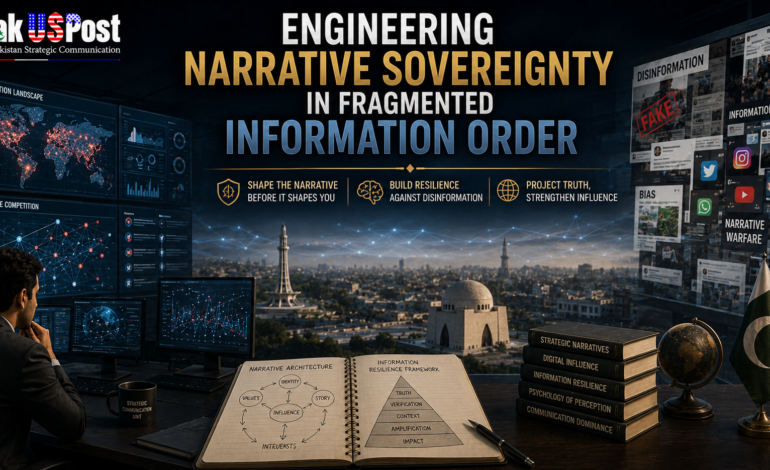
Engineering Narrative Sovereignty in Fragmented Information Order


The contemporary state no longer operates solely within the domain of territorial governance or conventional diplomatic signaling; it now exists inside a dense, algorithmically mediated information ecosystem where perception precedes policy and narrative volatility can destabilise institutional credibility faster than material shocks. For Pakistan, this condition is amplified by structural fragmentation in its communication architecture, where diplomatic messaging, domestic media cycles, and external perception management remain institutionally decoupled. The result is not merely inconsistent storytelling but strategic interpretive disorder, in which external audiences construct meaning from fragmented signals rather than coherent state intent.
In the post-truth global information environment, narrative has become a form of soft sovereignty. States that fail to institutionalise narrative coherence risk ceding interpretive authority to external media ecosystems, platform algorithms, and episodic crisis reporting cycles. Pakistan’s strategic communication deficit is therefore not cosmetic; it is structural, affecting how policy decisions are perceived, how crises are framed, and how long-term strategic intentions are decoded by international actors.
A critical hidden risk lies in the substitution of narrative reaction for narrative construction. Reactive communication systems respond to external framing rather than preemptively shaping it. This inversion creates a perpetual lag between event and interpretation, allowing external actors to define the semantic boundaries within which Pakistan is subsequently forced to operate. Over time, this produces a reputational inertia that becomes increasingly difficult to reverse, regardless of substantive policy improvements.
The global communication order is now governed by algorithmic amplification systems, where visibility is not determined by diplomatic importance but by engagement metrics, virality potential, and platform-specific distribution logic. This structural shift has diluted the effectiveness of traditional diplomatic messaging, which remains linear, state-centric, and temporally delayed. In contrast, contemporary narrative battles are nonlinear, decentralised, and instantaneous. Without institutional adaptation, states operating with legacy communication frameworks are systematically disadvantaged.
Pakistan’s narrative environment is further complicated by internal institutional silos. Foreign policy messaging, internal security communication, economic signalling, and media regulation often operate without synchronized coordination. This produces interpretive dissonance, where different arms of the state project divergent narratives to domestic and international audiences simultaneously. Such dissonance is not merely inefficient; it is strategically corrosive, as it undermines credibility in high-stakes diplomatic negotiations.
The establishment concern in this context is coherence erosion. When internal messaging lacks alignment, external actors discount official statements as negotiable or unstable, thereby increasing the cost of diplomatic engagement. Over time, this reduces strategic leverage, as credibility becomes a precondition for influence in international negotiations.
A post-sovereign information order also introduces a new category of vulnerability: perception-driven policy constraint. States increasingly adjust policy behaviour not solely in response to material realities but in anticipation of reputational consequences shaped by global media narratives. For Pakistan, this dynamic is particularly significant given its exposure to security-related framing, which often dominates international coverage cycles irrespective of broader policy diversification efforts.
To address these structural deficiencies, Pakistan must transition from fragmented communication practices to a unified strategic communication architecture. This does not imply centralised censorship but rather coordinated narrative engineering, where all state communication channels operate within a shared strategic framework. The objective is coherence without rigidity, ensuring message alignment while preserving institutional autonomy.
A foundational requirement is the establishment of a central strategic communication coordination mechanism capable of synchronising diplomatic messaging, domestic media engagement, and international perception management. This institution must function as an integrative node rather than a controlling authority, ensuring that narrative outputs across ministries and agencies are aligned with overarching foreign policy objectives.
Another critical dimension is anticipatory narrative design. Instead of responding to global discourse after it emerges, the state must develop forward-looking narrative frameworks that pre-structure interpretive possibilities. This involves identifying emerging geopolitical themes, such as regional connectivity, climate vulnerability, digital transformation, and economic restructuring, and embedding them into proactive communication strategies before external narratives crystallise.
The diaspora dimension represents an underutilised narrative multiplier. In the contemporary information ecosystem, diaspora communities function as parallel communication vectors that can either reinforce or undermine state narratives. A structured diaspora engagement strategy, integrated into formal communication architecture, can significantly enhance narrative reach and resilience, particularly in Western media ecosystems.
Digital platforms introduce another layer of complexity. Algorithmic governance of information flows means that visibility is increasingly determined by engagement dynamics rather than institutional authority. This requires the development of algorithm-aware communication strategies, including content formatting optimisation, rapid response narrative units, and platform-specific messaging calibration. Without such adaptation, official state communication risks structural invisibility in high-velocity information environments.
A further hidden risk lies in narrative over-securitisation. When state communication is excessively framed through security paradigms, it narrows interpretive bandwidth and limits the ability to project economic, cultural, or developmental narratives. This results in an externally imposed identity compression, where complex state functions are reduced to singular security-focused interpretations. Rebalancing narrative portfolios is therefore essential for strategic repositioning.
Institutionally, media regulation frameworks must evolve from control-oriented models to coherence-oriented models. The objective should not be suppression of information but harmonisation of messaging across state and quasi-state actors. This requires regulatory modernisation, professionalisation of communication cadres, and integration of data analytics into narrative strategy formulation.
At the international level, narrative sovereignty is increasingly linked to diplomatic leverage. States that can consistently project coherent narratives gain disproportionate influence in multilateral forums, development financing negotiations, and strategic partnerships. Conversely, narrative fragmentation weakens bargaining power even when material capabilities remain unchanged.
Pakistan’s challenge is therefore dual: internal coordination and external projection. Without internal coherence, external messaging will remain unstable; without external adaptation, internal narratives will remain globally ineffective. Bridging this gap requires institutional innovation that transcends traditional bureaucratic boundaries.
A long-term strategic objective must be the creation of a narrative intelligence capability within the state apparatus. This would function as an analytical and predictive system, mapping global discourse trends, identifying emerging narrative risks, and calibrating communication strategies accordingly. Such capability would shift Pakistan from reactive communication cycles to anticipatory narrative governance.
Ultimately, narrative sovereignty is not about controlling information flows but about ensuring interpretive stability in a volatile global communication environment. For Pakistan, achieving this requires structural integration of communication systems, strategic foresight in narrative construction, and disciplined alignment across institutional actors. Without such transformation, the state will continue to operate within narratives constructed elsewhere, constrained by interpretations it does not control, and limited in influence by its inability to consistently define itself in a fragmented informational world.
A Public Service Message