
Reducing Geoeconomic Vulnerability under External Constraint Regimes

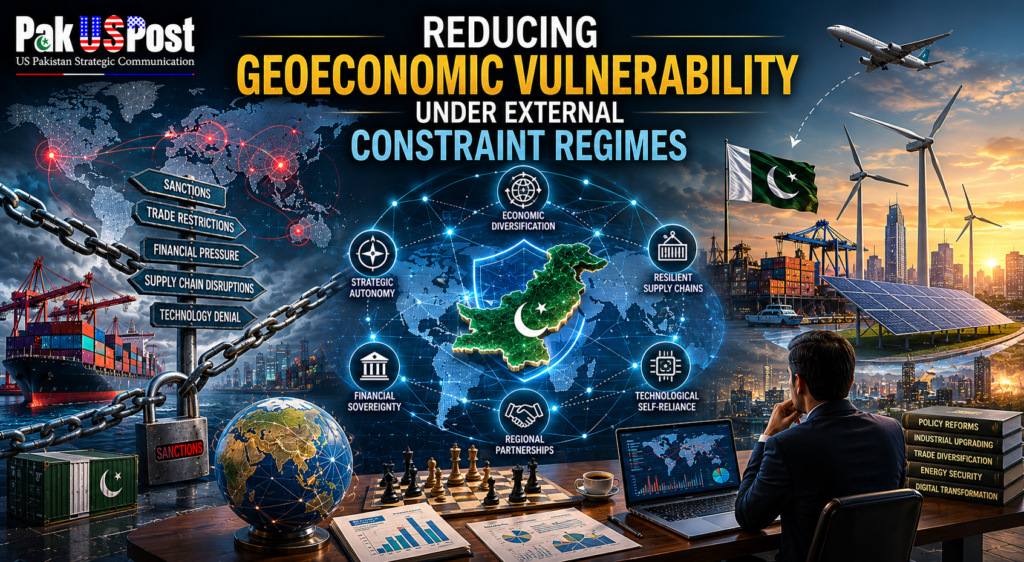
Pakistan’s economic architecture is increasingly shaped by an external constraint regime that operates through overlapping mechanisms of tariff modulation, conditional liquidity provisioning, and supply chain reconfiguration led by advanced economies. Within this evolving geoeconomic order, sovereignty is no longer defined by formal autonomy in policy articulation but by the degree of insulation a state can construct against externally transmitted macroeconomic shocks. Pakistan’s persistent exposure to such shocks reflects not episodic mismanagement alone, but a deeper structural condition in which fiscal fragility, export concentration, and external financing dependency converge into a self reinforcing vulnerability loop.
The contemporary global economy is no longer governed by the classical logic of free trade optimisation but by strategic economic nationalism. Tariff structures are increasingly deployed as instruments of industrial policy, designed to incentivise domestic production in advanced economies while penalising external dependencies. Simultaneously, multilateral financial institutions function not merely as stabilisation mechanisms but as governance actors embedding conditionalities that reshape domestic fiscal architectures. Supply chains, once optimised for efficiency, are now being reorganised for resilience and geopolitical alignment. In this environment, Pakistan occupies a structurally exposed position due to its narrow export base and limited integration into high value production networks.
A critical hidden risk emerges from the misinterpretation of external financial support as stabilisation rather than structural dependency reproduction. Successive cycles of balance of payments relief, while preventing immediate default scenarios, have reinforced a recurring dependence on external liquidity injections. This has created what can be described as a stabilisation paradox, where short term macroeconomic stability is achieved at the cost of long term structural rigidity. The consequence is a diminishing policy space for autonomous economic decision making.
At the heart of Pakistan’s vulnerability lies export monoculture. A disproportionate reliance on low value textile exports exposes the economy to demand volatility, tariff fluctuations, and buyer driven pricing power concentrated in external markets. This structural limitation is compounded by limited diversification into knowledge based services, agro industrial value chains, and advanced manufacturing segments. As global trade fragments into competing regulatory blocs, economies with concentrated export profiles face increasing marginalisation.
The United States and its allied economic systems are progressively embedding geoeconomic conditionalities within trade and financial frameworks. These include reshoring incentives, friend shoring mechanisms, and regulatory compliance standards that privilege politically aligned supply chains. For countries like Pakistan, this translates into indirect exclusion from high value segments of global production networks unless proactive integration strategies are pursued. The risk is not overt exclusion but gradual displacement from value intensive nodes of the global economy.
Another structural vulnerability arises from the externalisation of fiscal adjustment mechanisms. Domestic economic stabilization is frequently achieved through externally anchored programmes that prioritise macroeconomic balance over structural transformation. While such programmes provide temporary relief, they often impose contractionary pressures that suppress industrial expansion and limit long term growth potential. This creates a cyclical trap in which stabilization efforts undermine the very growth necessary for sustainable debt servicing.
A further hidden risk is the increasing financialisation of sovereignty itself. Access to external capital is often contingent upon compliance with policy prescriptions that extend beyond macroeconomic indicators into governance, regulatory, and institutional domains. This expands the scope of economic conditionality into areas traditionally considered within sovereign discretion. The result is a blurred boundary between economic assistance and structural governance influence.
To counter these dynamics, Pakistan must transition toward a geoeconomic resilience framework grounded in diversification, regional integration, and institutional strengthening. The first pillar of this transformation is export reconfiguration. This requires deliberate policy intervention to expand beyond textile dependence into diversified sectors such as IT enabled services, pharmaceutical production, agricultural processing, and light engineering goods. Such diversification is not merely sectoral expansion but a structural shift in economic identity.
The second pillar is regional economic embedding. Pakistan’s geographic positioning offers latent connectivity advantages across South Asia, Central Asia, the Middle East, and Western China. However, these advantages remain underutilised due to fragmented trade policy and underdeveloped logistics infrastructure. Strategic engagement with regional economic corridors can reduce dependence on singular Western markets and distribute risk across multiple demand centres.
The third pillar involves the creation of sovereign trade buffers. These include currency swap arrangements, regional settlement mechanisms, and diversified reserve asset strategies designed to reduce exposure to dollar centric volatility. While complete decoupling from global financial systems is neither feasible nor desirable, calibrated insulation can significantly enhance macroeconomic stability.
A particularly significant establishment concern is the institutional fragmentation of economic governance. Fiscal policy, trade policy, monetary policy, and industrial policy often operate in siloed institutional environments, resulting in incoherent strategic direction. This fragmentation weakens Pakistan’s ability to respond to coordinated external pressures. A unified geoeconomic command architecture, integrating relevant ministries and regulatory bodies, is therefore essential to ensure policy coherence.
Supply chain coercion represents another emerging risk vector. As global production networks become increasingly politicised, access to intermediate goods, critical technologies, and export markets is subject to strategic screening. Pakistan’s limited integration into diversified supply chains increases its susceptibility to external disruptions. The absence of domestic value chain depth further exacerbates this vulnerability, as external shocks transmit rapidly through the economy without internal absorption capacity.
In this context, economic sovereignty must be redefined as adaptive resilience rather than absolute independence. The objective is not autarky but strategic flexibility, enabling the economy to absorb external shocks while maintaining functional continuity. This requires investment in domestic productive capacity, technological upgrading, and institutional learning systems capable of rapid policy adjustment.
The role of multilateral financial institutions must also be reinterpreted within this framework. Rather than viewing these institutions solely as sources of constraint, Pakistan must develop sophisticated negotiation strategies that maximise policy space within existing frameworks. This requires technical capacity enhancement in debt structuring, fiscal modelling, and macroeconomic forecasting. Without such capacity, negotiation asymmetries will persist, perpetuating structural dependency.
An additional hidden risk lies in demographic pressure without productive absorption. Pakistan’s expanding labour force, if not integrated into productive sectors, risks becoming a source of macroeconomic instability rather than demographic dividend. This underscores the urgency of labour-intensive industrial policy and human capital transformation aligned with emerging global demand structures.
Digital economic transformation offers a partial pathway toward mitigation. However, without regulatory coherence, infrastructure investment, and skill development, digital integration may remain superficial. The objective must be to embed digital services within export structures rather than treating them as ancillary sectors.
Ultimately, the challenge of geoeconomic vulnerability is not merely technical but strategic. It requires a fundamental reorientation of economic thinking from reactive crisis management to anticipatory structural design. Pakistan must internalise the reality that in the contemporary global order, economic sovereignty is contingent upon structural adaptability, institutional coherence, and strategic diversification.
Failure to undertake this recalibration risks long term marginalisation within an increasingly segmented global economy, where value is concentrated in technologically advanced, institutionally coherent, and geopolitically aligned economic blocs. The imperative, therefore, is not resistance to external systems but intelligent insertion into them on terms that minimise dependency and maximise adaptive capacity.
A Public Service Message