
Immigration Reform, Refugee Policy, and Multilateral Responsibility: Global Implications of U.S. Policy Shifts


The United States’ immigration and refugee policies have long served as both a reflection of domestic priorities and a barometer of its global values. As the country navigates the post-pandemic era, shifting geopolitical dynamics, and increasing migratory pressures, the formulation and execution of immigration policy has taken on unprecedented strategic, social, and humanitarian significance. Immigration and refugee reform is no longer a matter solely of border security; it encompasses economic development, labor market dynamics, public health, human rights obligations, and multilateral credibility. These policy decisions reverberate far beyond the immediate operational sphere, shaping perceptions in the Muslim world, influencing cooperation with European allies, and impacting global governance frameworks. For Pakistan, a nation that engages with migratory flows, refugee hosting, and bilateral cooperation with the United States, understanding these policy shifts provides both comparative insights and lessons for its domestic and regional policy planning.
The U.S. approach to immigration has historically oscillated between periods of restrictive enforcement and expansive humanitarian accommodation. In recent years, policymakers have sought to balance national security imperatives with obligations to protect vulnerable populations, including asylum seekers and refugees displaced by conflict, persecution, or environmental crises. Executive orders, legislative initiatives, and agency guidance collectively define the operational architecture of U.S. migration policy. These mechanisms determine eligibility for entry, the scope of protections, and the processes by which individuals are screened, admitted, and integrated into American society. The recalibration of these policies is motivated not only by domestic political considerations but also by the recognition that migration is increasingly a transnational phenomenon, shaped by conflict zones, climate stressors, and global economic inequalities.
At the domestic level, U.S. policy shifts have tangible consequences for social cohesion, labor markets, and public services. Refugee resettlement programs and expanded asylum eligibility provide opportunities for labor market supplementation in sectors facing chronic shortages, including healthcare, agriculture, and technology. At the same time, integration initiatives require coordinated investment in language acquisition, vocational training, education, housing, and healthcare infrastructure. Policymakers are confronted with the dual challenge of ensuring efficient operational processing while mitigating social tension, addressing public concerns, and maintaining the legitimacy of democratic institutions. In states that bear the brunt of migratory inflows, effective policy implementation can enhance social resilience, create local economic benefits, and bolster civic trust. Conversely, gaps in policy coordination can exacerbate inequality, fuel political polarization, and strain social services, highlighting the delicate equilibrium between enforcement, inclusion, and human rights.
The humanitarian dimension of U.S. policy is particularly salient in the context of refugee protection. The country’s obligations under international conventions, notably the 1951 Refugee Convention and its 1967 Protocol, as well as commitments to multilateral agencies such as the United Nations High Commissioner for Refugees (UNHCR), shape both domestic regulatory frameworks and operational procedures. Refugees fleeing war-torn countries, ethnic persecution, or climate-induced displacement require processing systems that ensure safety, due process, and access to essential services. Policy reforms that streamline resettlement, improve screening accuracy, and enhance post-arrival support directly influence both the effectiveness of humanitarian intervention and the perception of the United States as a global advocate for human rights. These reforms also signal a commitment to equitable burden-sharing, an issue that resonates with both European allies and the broader Muslim world, particularly nations that host large refugee populations.
The perceptions of U.S. immigration and refugee policies in the Muslim world are multi-layered and consequential. Countries such as Pakistan, Turkey, Jordan, and nations across the Gulf Cooperation Council monitor U.S. policy for both symbolic and practical cues. On the symbolic plane, policies that prioritize humane treatment and equitable protection reinforce the United States’ credibility as a champion of human rights. Conversely, restrictive measures, arbitrary travel bans, or protracted asylum adjudication generate skepticism and may affect broader diplomatic relations. On the practical plane, migration management and refugee resettlement intersect with bilateral aid, development cooperation, and security partnerships. For instance, Pakistan hosts one of the largest populations of Afghan refugees in the world, and U.S. policies toward Afghan migration influence humanitarian programming, aid allocation, and regional security planning. The perception of U.S. policies in the Muslim world therefore carries direct consequences for diplomatic trust, operational collaboration, and the willingness of partner nations to participate in multilateral solutions.
European allies, particularly members of the European Union, maintain a vested interest in U.S. immigration reform, not only due to shared security concerns but also because of economic interdependence and multilateral coordination obligations. Transatlantic cooperation encompasses intelligence sharing, joint border management initiatives, asylum adjudication practices, and the harmonization of refugee protection standards. EU nations often operate under comprehensive frameworks such as the Common European Asylum System and General Data Protection Regulation, which intersect with U.S. policies on privacy, data sharing, and human rights protections. Divergence between U.S. and European approaches can create friction in operational collaboration, while alignment facilitates smoother cooperation, shared capacity-building, and a coordinated response to crises. European observation of U.S. policies also informs domestic public opinion on migration, influencing transatlantic relations, bilateral aid priorities, and joint advocacy in multilateral forums.
The global governance implications of U.S. policy reforms are profound. By setting standards for due process, refugee vetting, and resettlement programming, the United States influences normative expectations for international actors and multilateral institutions. UNHCR and related agencies often rely on U.S. operational models to design capacity-building programs in regions hosting large refugee populations, including parts of South Asia and the Middle East. Moreover, the credibility of U.S. engagement in international humanitarian law, conflict resolution, and disaster relief is reinforced when domestic policies demonstrate consistency with globally recognized standards. Policy decisions that undermine these norms, in contrast, risk eroding U.S. influence in international negotiations, weakening coalition-building efforts, and diminishing the efficacy of multilateral interventions.
A comparative lens with Pakistan reveals several instructive parallels. Pakistan’s experience in hosting large refugee populations, particularly from Afghanistan, demonstrates the complex interplay between domestic capacity, international aid, and long-term development planning. Lessons from the U.S. experience include the value of structured integration programs, the importance of transparency and accountability in resettlement procedures, and the necessity of balancing domestic political considerations with humanitarian obligations. Pakistan’s ongoing challenges in education, health services, and urban planning underscore the operational complexities of hosting large populations under protracted displacement conditions, highlighting opportunities for policy transfer and cooperative engagement with the United States on technical, financial, and strategic levels.
Economic considerations further underscore the interconnectedness of domestic policy and international impact. Immigration reform and refugee resettlement influence labor markets, economic growth trajectories, and innovation ecosystems. Refugees often contribute to entrepreneurship, innovation, and labor market dynamism, while also generating demand for public services and housing. Effective policy design maximizes these benefits, ensuring that economic integration aligns with labor market needs and regional development priorities. For Pakistan, understanding these dynamics informs the design of domestic labor policy, vocational training programs, and strategies to attract foreign investment in sectors affected by migration and displacement.
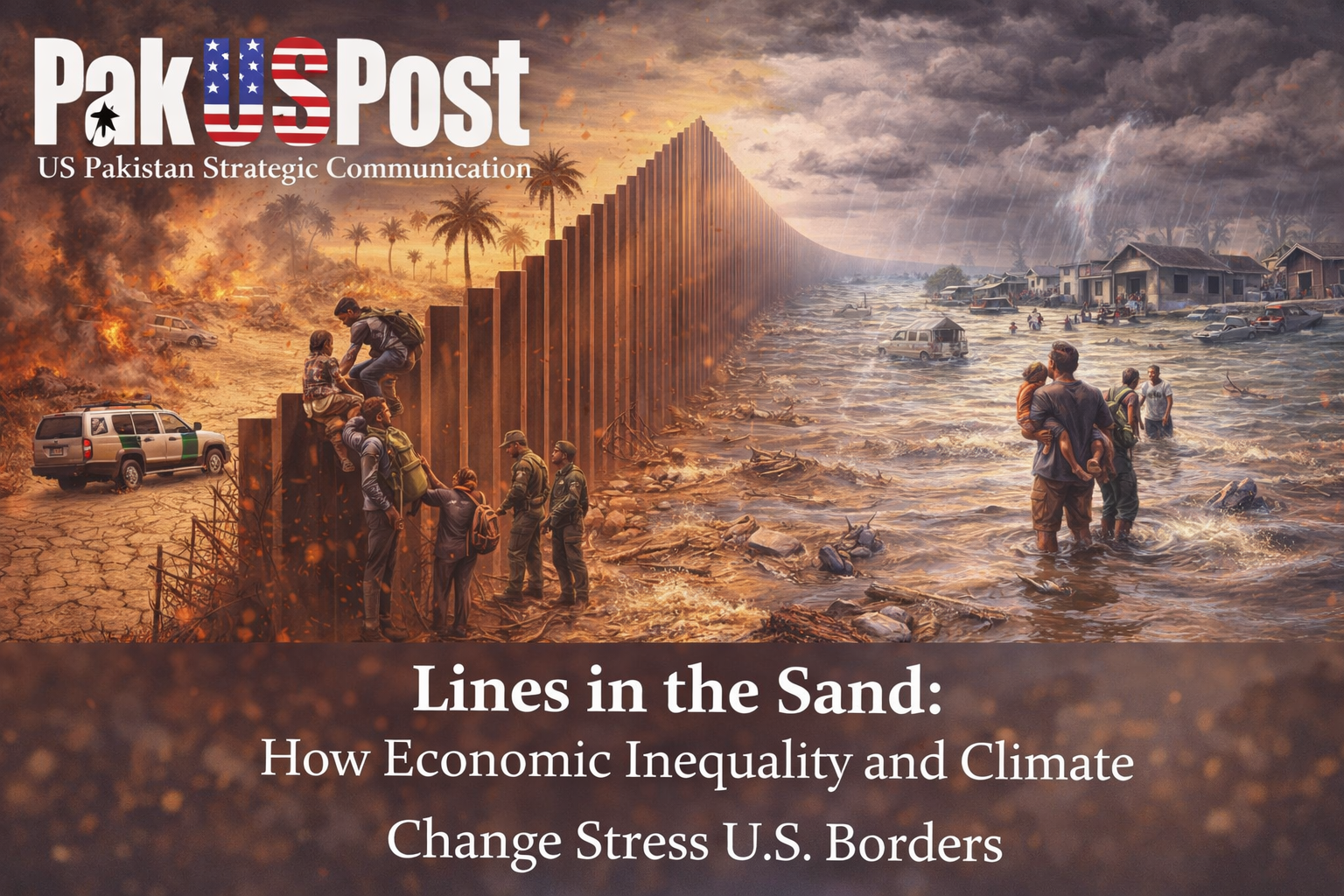
The environmental dimension of migration policy is increasingly salient. Climate change exacerbates displacement pressures, generating both internal and cross-border movements. U.S. policy frameworks now consider climate-induced migration as a factor in resettlement planning, disaster response, and bilateral cooperation with affected nations. The policy challenge lies in ensuring that displaced populations receive timely protection while simultaneously addressing the structural vulnerabilities that drive migration. Engagement with European allies and multilateral institutions allows for shared approaches, coordinated funding, and the development of predictive models that can mitigate humanitarian crises. Pakistan’s own experience with climate-induced displacement — particularly in flood-prone and drought-affected regions — illustrates the necessity of proactive policy frameworks that integrate environmental, social, and economic planning.
Technology and data management intersect with refugee and immigration policy, shaping operational effectiveness and accountability. Case management systems, biometric verification, and predictive analytics improve efficiency, enhance security, and provide valuable insights for program planning. However, these technologies also raise questions of privacy, data protection, and potential misuse. U.S. policy has sought to embed safeguards that balance operational efficiency with rights protection, establishing principles that can inform broader international practice. For Pakistan, adopting similar principles in refugee registration, social service delivery, and migration management enhances governance capacity while aligning domestic operations with international best practices.
Public opinion and media narratives significantly shape the political feasibility of immigration and refugee reforms. Domestic constituencies weigh perceptions of economic impact, cultural integration, and security considerations, while international observers, particularly in the Muslim world and Europe, interpret policy decisions as reflections of U.S. values and credibility. Strategic communication, transparency, and stakeholder engagement are therefore critical to maintaining legitimacy, managing expectations, and fostering cooperative relationships across borders. Missteps in public engagement can amplify misinformation, fuel political polarization, and undermine policy objectives, highlighting the importance of integrated communication strategies in both domestic and international contexts.
In sum, U.S. immigration and refugee policy operates at the nexus of domestic governance, humanitarian responsibility, and global influence. Its implications extend to labor markets, social cohesion, international norms, and diplomatic credibility. For Pakistan and other nations engaged in similar challenges, the U.S. experience offers a repository of operational lessons, strategic insights, and policy design principles. Effective immigration reform and refugee protection demand an integrated approach: one that harmonizes national security, humanitarian standards, economic objectives, and global commitments. By embedding these considerations into both domestic and foreign policy, the United States can enhance operational effectiveness, maintain international credibility, and contribute constructively to global governance, while offering actionable models for partner nations navigating the complex realities of migration and displacement.
The policy roadmap emerging from this analysis emphasizes several core imperatives. First, it underscores the need for integrated planning that combines enforcement, humanitarian assistance, economic development, and public engagement. Second, it highlights the importance of multilateral coordination, ensuring that U.S. policy aligns with European frameworks, UN obligations, and regional partner expectations. Third, it reinforces the centrality of rights-based governance, embedding accountability, transparency, and ethical safeguards into operational frameworks. Finally, it offers a comparative perspective for Pakistan, demonstrating how adaptive, inclusive, and proactive policy design can maximize social and economic benefits while mitigating risks associated with displacement, migration, and humanitarian crises.
The United States’ ongoing reforms in immigration and refugee policy are therefore not only a matter of domestic administration but a strategic lever with far-reaching consequences. How the nation manages these challenges will reverberate across labor markets, humanitarian operations, multilateral institutions, and global perceptions of U.S. credibility and leadership. In the Muslim world, in Europe, and in partner states such as Pakistan, these policies influence bilateral cooperation, development programming, and regional stability. By embracing policy frameworks that integrate enforcement, human rights, and international cooperation, the United States can continue to fulfill its dual obligations as a sovereign state and as a leading actor in global governance, offering both a model and a partner in navigating the complex realities of twenty-first-century migration.
A Public Service Message