
Social Media Diplomacy and Parallel Power in Pakistan US Discourse System

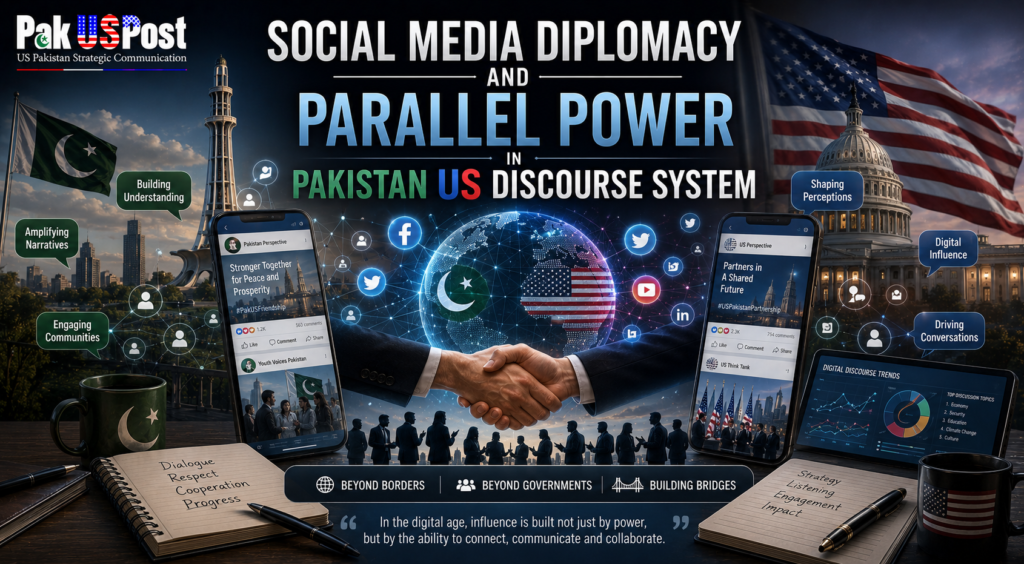
In the contemporary configuration of global diplomacy, the monopoly of states over international narrative construction has been irreversibly diluted. Diplomatic meaning is no longer exclusively authored within foreign ministries, embassies, or structured bilateral channels, but is increasingly co-produced within decentralized digital ecosystems where social media platforms function as parallel arenas of diplomatic negotiation, contestation, and symbolic power projection. For Pakistan in its evolving engagement matrix with the United States, this shift has created a complex informational environment in which official diplomacy is continuously refracted through unofficial, algorithmically amplified, and emotionally charged narrative circuits.
The emergence of platforms such as X, YouTube, and regionally embedded digital networks has fundamentally altered the temporal and structural dynamics of diplomatic communication. Traditional diplomacy operated on calibrated timeframes, where statements were drafted, reviewed, issued, and interpreted through relatively controlled channels. In contrast, digital diplomacy operates within compressed temporal cycles where interpretation precedes clarification, and narrative formation often outpaces official articulation. This inversion has profound consequences for states like Pakistan, whose diplomatic messaging is frequently absorbed into preexisting narrative templates before formal clarification can be established.
Within United States mediated digital ecosystems, Pakistan related discourse is often shaped by a hybrid assemblage of actors, including policy commentators, think tank analysts, diaspora communities, investigative journalists, and algorithmically boosted content producers. These actors collectively function as informal diplomatic intermediaries, generating interpretive frameworks that significantly influence how official policy circles perceive developments in Pakistan. The effect is the emergence of a semi autonomous interpretive layer that exists between state communication and institutional policy reception.
In this environment, social media does not merely reflect diplomatic reality; it actively constructs diplomatic plausibility. A policy statement, bilateral meeting, or strategic announcement does not enter a neutral interpretive space but is immediately embedded within competing narrative ecosystems that assign meaning, credibility, and political weight. Engagement metrics such as shares, reposts, watch time, and comment intensity become indirect indicators of diplomatic salience, even though they are not designed for such analytical purposes.
For Pakistan, this creates a condition in which diplomatic credibility is increasingly dependent on narrative survivability within high velocity digital environments. Official positions must compete with alternative framings that may be more emotionally resonant, visually compelling, or algorithmically optimized. The asymmetry between policy precision and narrative virality often results in the dilution of nuanced diplomatic messaging, particularly in complex issue areas such as security cooperation, financial negotiations, and regional mediation initiatives with the United States.
A particularly significant dimension of this transformation is the rise of what may be described as distributed diplomatic agency. In earlier diplomatic models, only accredited representatives of the state possessed interpretive authority over foreign policy positions. In the current digital environment, however, interpretive authority is widely dispersed across non state actors who can shape international perceptions without formal accountability. Influencers, commentators, and digitally mobilized communities often generate narrative momentum that can rival or even precede official diplomatic clarification.
This decentralization introduces a new category of diplomatic risk, namely narrative volatility risk. In the case of Pakistan United States relations, sensitive issues such as security cooperation, counterterrorism coordination, and economic assistance are frequently subject to rapid narrative escalation on social media platforms. Once a narrative reaches a critical threshold of visibility, it becomes structurally difficult for official statements to fully reassert interpretive control, even when those statements are factually precise and diplomatically calibrated.
Compounding this challenge is the role of algorithmic amplification systems that prioritize engagement intensity over informational accuracy. Content that generates strong emotional reactions, whether supportive or critical, tends to achieve greater visibility than content that emphasizes procedural nuance or institutional complexity. As a result, diplomatic narratives that require contextual understanding are often disadvantaged in comparison to simplified or polarizing interpretations.
In addition, the geopolitical dimension of platform governance introduces asymmetries in visibility distribution. Content related to Pakistan circulating within United States digital ecosystems is subject to different moderation standards, recommendation structures, and engagement optimization models than content circulating within regional platforms. This creates divergent narrative realities, where the same diplomatic event may be interpreted as strategic cooperation in one ecosystem and as strategic uncertainty in another.
The cumulative effect is the fragmentation of diplomatic reality into multiple coexisting narrative layers. There is no singular public interpretation of Pakistan United States relations, but rather a series of overlapping and sometimes contradictory narrative fields, each shaped by platform architecture, audience composition, and algorithmic prioritization. This fragmentation complicates traditional diplomatic signaling, which assumes a relatively unified interpretive audience.
From a strategic standpoint, this condition requires a reconceptualization of diplomacy itself. Diplomatic engagement can no longer be understood solely as state to state interaction but must be expanded to include state to platform and platform mediated public interaction. The diplomatic field now includes not only governments but also the infrastructural systems that determine how information is distributed, ranked, and resurfaced.
For Pakistan, this necessitates the development of a structured digital diplomatic capability that operates alongside conventional foreign policy institutions. Such a capability would need to perform three interlinked functions. First, continuous monitoring of narrative flows across major platforms to identify emerging interpretive shifts in real time. Second, strategic engagement with high influence digital nodes that shape discourse formation within United States policy and media ecosystems. Third, proactive narrative construction that anticipates interpretive distortions and addresses them before they consolidate into stable perceptions.
However, the objective of such engagement cannot be to control discourse in an absolute sense, which is neither feasible nor normatively desirable. Rather, the goal must be to increase narrative resilience, ensuring that official diplomatic positions remain visible, intelligible, and contextually preserved within volatile informational environments.
An additional strategic consideration involves the relationship between digital diplomacy and domestic political expression. In Pakistan’s case, domestic political discourse is highly visible on global platforms, and frequently intersects with external narrative formation. This creates a feedback loop in which internal political contestation is immediately externalized, interpreted, and reinserted into international discourse about Pakistan’s stability and policy coherence.
Within United States policy environments, such visibility can influence perceptions of institutional reliability, particularly when domestic political debates are framed in adversarial or destabilizing terms. The challenge is not the existence of political pluralism, which is a legitimate feature of democratic systems, but the absence of structured narrative mediation that can translate domestic complexity into externally coherent diplomatic messaging.
At a broader level, social media diplomacy reflects a deeper transformation in power itself. Influence is no longer solely a function of material capability or formal alliances, but also of narrative persistence within algorithmically governed attention systems. States that are able to maintain coherent, continuous, and adaptive narrative presence across digital ecosystems gain an informational advantage that complements traditional forms of power.
For Pakistan, the strategic imperative is therefore to integrate digital narrative management into the core architecture of foreign policy formulation. This requires institutional recognition that diplomacy now operates within a hybrid space where official communication, media ecosystems, and platform algorithms are structurally interdependent.
Engagement with United States related digital discourse environments is particularly critical, given their disproportionate influence on global policy interpretation. Narratives that gain traction within these ecosystems often cascade into broader international perception structures, shaping multilateral engagement patterns and institutional responses.
Ultimately, the evolution of social media into a parallel diplomatic arena signifies the emergence of a new layer of international relations, one in which legitimacy, credibility, and strategic relevance are continuously negotiated within decentralized and algorithmically mediated environments. For Pakistan, navigating this environment requires a shift from reactive communication strategies to anticipatory narrative architecture.
The future of Pakistan United States relations will increasingly depend not only on diplomatic agreements or strategic cooperation frameworks but also on the stability of interpretive ecosystems in which those agreements are received, debated, and remembered. In this sense, diplomacy has expanded beyond negotiation into the domain of continuous narrative management, where the survival of meaning is as important as the production of policy itself.
A Public Service Message