Hormuz Crisis Could Redefine Pakistan Economic Trajectory

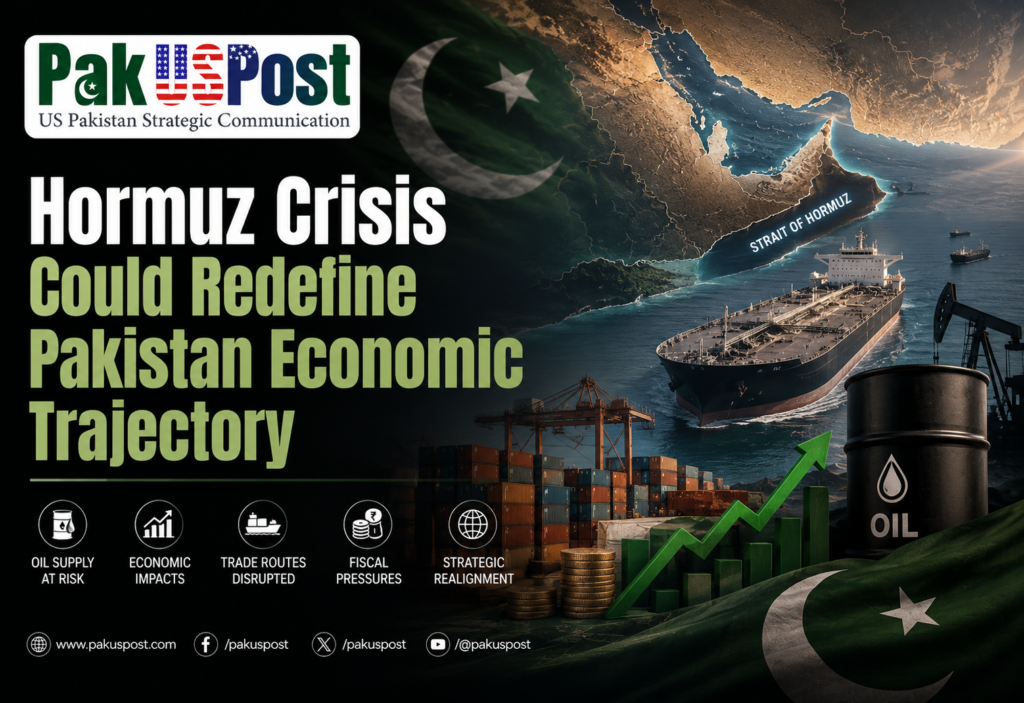
Few waterways in modern history possess the strategic significance of the Strait of Hormuz. Barely a few dozen kilometres’ wide at its narrowest point, this maritime corridor carries a substantial portion of the world’s seaborne energy trade and serves as the principal gateway connecting the hydrocarbon wealth of the Gulf to global markets. For decades, uninterrupted navigation through Hormuz has been treated as a foundational assumption of the international economic order. Yet assumptions that appear permanent often reveal their fragility during periods of geopolitical turbulence. The prospect of recurring tensions, restricted navigation, military confrontation, or sustained Iranian leverage over the strait represents one of the most consequential strategic risks confronting the global economy. For Pakistan, such a scenario would not merely constitute an external shock. It could become a defining test of economic resilience, strategic planning, and national adaptability.
The relationship between Pakistan and the Gulf energy system is deep, multidimensional, and structural. Pakistan imports a substantial share of its petroleum requirements from Gulf producers. Industrial production, transportation networks, electricity generation, agricultural logistics, and urban economic activity all remain heavily dependent upon imported energy. Consequently, any disruption affecting Hormuz would immediately reverberate throughout Pakistan’s economy.
The first and most visible consequence would emerge through energy prices. Global markets respond not only to actual supply disruptions but also to anticipated risks. Even the perception of instability within Hormuz can trigger speculative price increases across crude oil markets. For a country such as Pakistan, where energy imports exert significant pressure upon foreign exchange reserves, higher oil prices translate directly into increased economic vulnerability.
A sustained rise in crude prices would widen Pakistan’s import bill. Every additional increase in international oil prices creates pressure on the balance of payments. Foreign exchange reserves, already subject to periodic fluctuations, would face additional strain. Currency markets would likely react negatively, increasing depreciation pressures on the rupee and amplifying imported inflation.
Inflation itself would become a central policy challenge. Higher fuel costs inevitably cascade throughout the broader economy. Transportation expenses rise. Manufacturing input costs increase. Agricultural supply chains become more expensive. Consumer prices follow. The cumulative effect can erode purchasing power, reduce household consumption, and generate political pressures that complicate economic management.
For policymakers, the dilemma would be particularly acute. Governments confronted by rising fuel prices generally face two unattractive choices. They can pass costs onto consumers, risking public dissatisfaction and inflationary pressures, or absorb part of the burden through subsidies, increasing fiscal deficits and debt obligations. Neither option offers a sustainable long-term solution.
Industrial competitiveness would face similar pressures. Pakistani exporters already operate within a challenging international environment characterized by intense competition, fluctuating exchange rates, and evolving supply chains. Elevated energy costs would increase production expenses across sectors including textiles, manufacturing, chemicals, agriculture, and logistics. Export margins could narrow significantly, affecting Pakistan’s ability to compete in global markets.
Yet crises often expose opportunities that remain hidden during periods of stability. A prolonged Hormuz crisis could force Pakistan to undertake structural reforms that might otherwise be delayed. Historically, major economic transformations frequently emerge from periods of external pressure rather than domestic consensus.
One of the most significant opportunities would involve accelerating energy diversification. Pakistan’s dependence upon imported hydrocarbons has long been recognized as a strategic vulnerability. Despite repeated policy discussions, progress toward diversification has often been constrained by financial limitations, institutional inefficiencies, and short term political considerations.
A sustained energy shock would alter these calculations. Investments in renewable energy would become increasingly attractive. Solar and wind technologies continue to experience declining costs globally. Pakistan possesses substantial renewable energy potential, particularly in regions characterized by favorable climatic conditions. Expanding renewable capacity would reduce exposure to external supply disruptions while supporting long term sustainability objectives.
Hydropower development would likewise assume greater strategic importance. Although challenges related to financing, environmental concerns, and water management remain significant, hydropower represents one of the most viable domestic energy sources available to Pakistan. Strategic investment in generation and transmission infrastructure could enhance energy security while reducing import dependence.
Nuclear energy presents another avenue for consideration. Pakistan already possesses experience in civilian nuclear power generation. Expanding capacity under internationally accepted safeguards could contribute to long term energy diversification. While nuclear projects require substantial capital investment and lengthy implementation periods, they offer reliable baseload generation independent of external energy markets.
Natural gas infrastructure would also warrant renewed attention. Liquefied natural gas imports have become increasingly important within Pakistan’s energy mix. However, reliance upon seaborne LNG remains vulnerable to disruptions affecting maritime routes. Diversification of suppliers, storage facilities, and transportation networks could improve resilience.
Regional pipeline projects, frequently discussed but rarely implemented, may acquire renewed relevance under conditions of sustained uncertainty. Energy connectivity with neighboring regions could provide alternative supply channels. Political complexities remain considerable, yet changing geopolitical circumstances often create opportunities for previously stalled initiatives.
The strategic significance of Gwadar becomes particularly pronounced within this context. Situated near the entrance to the Gulf, Gwadar occupies a location of exceptional geopolitical importance. For years, discussions surrounding the port have focused primarily upon connectivity, trade corridors, and infrastructure development. A Hormuz crisis would elevate its importance within broader energy and logistics calculations.
If properly integrated into regional transportation networks, Gwadar could emerge as a critical node connecting maritime commerce with inland markets. Such a role would require substantial investment, enhanced security, efficient governance structures, and commercial viability. Nevertheless, the potential strategic dividends are considerable.
The broader China Pakistan Economic Corridor framework would likewise assume greater significance. Global supply chains increasingly seek redundancy and diversification. Strategic uncertainty within traditional routes often encourages investment in alternative corridors. Pakistan’s geographic position provides opportunities to capitalize upon these trends, provided supporting infrastructure and regulatory reforms are implemented effectively.
Another important dimension concerns remittances. Millions of Pakistanis reside and work across Gulf states. Their contributions constitute a vital source of foreign exchange earnings and household income. Any prolonged regional instability affecting Gulf economies could influence labor markets, investment patterns, and employment opportunities for expatriate workers.
At the same time, Gulf states themselves may pursue ambitious economic diversification strategies in response to changing geopolitical conditions. These transformations could create new opportunities for skilled Pakistani professionals, engineers, technicians, and entrepreneurs. The outcome will depend largely upon Pakistan’s ability to enhance human capital and workforce competitiveness.
Financial markets would inevitably respond to a Hormuz crisis. Investors generally favor predictability. Geopolitical uncertainty increases risk perceptions and can reduce capital inflows into emerging markets. Pakistan would therefore need to strengthen macroeconomic fundamentals to maintain investor confidence during periods of regional instability.
Debt management would become particularly important. Rising energy costs combined with currency pressures can increase debt servicing burdens, especially for countries with significant external obligations. Prudent fiscal management, improved revenue collection, and structural economic reforms would be essential to preserving financial stability.
The role of strategic reserves deserves special attention. Many advanced economies maintain emergency petroleum reserves designed to mitigate short term supply disruptions. Pakistan’s capacity in this regard remains limited. Expanding strategic storage facilities could enhance resilience against temporary market shocks and provide policymakers with greater flexibility during crises.
Food security considerations should not be overlooked. Modern agriculture relies heavily upon energy intensive inputs including fertilizers, transportation, irrigation systems, and processing facilities. Higher energy prices can therefore contribute indirectly to food inflation. Strengthening agricultural productivity and supply chain efficiency would help reduce vulnerability.
The international dimension of a Hormuz crisis extends beyond energy markets. Global economic growth could slow as higher energy costs affect production and consumption patterns worldwide. Export demand from major trading partners may weaken. International financial conditions could tighten. Developing economies would face heightened competition for investment and financing.
Under such circumstances, regional economic cooperation becomes increasingly valuable. South Asia, Central Asia, the Gulf, and Western China collectively represent a vast economic space characterized by complementary strengths. Enhanced connectivity, trade facilitation, and infrastructure integration could generate mutual benefits while reducing dependence upon distant markets.
Pakistan possesses the potential to function as a bridge connecting these regions. Geography provides an advantage that few countries enjoy. Yet geographic opportunity alone is insufficient. Effective institutions, regulatory transparency, infrastructure quality, and political stability remain essential prerequisites.
From a strategic perspective, policymakers should view economic resilience as a national security imperative. Traditional security concepts focused primarily upon military capabilities. Contemporary realities require a broader understanding. Economic vulnerabilities can constrain strategic autonomy as effectively as conventional military threats.
Therefore, Pakistan’s response to a potential Hormuz crisis should extend beyond short term crisis management. It should encompass a comprehensive national strategy integrating energy policy, industrial planning, infrastructure development, financial stability, and regional diplomacy.
Several policy priorities emerge from this assessment. First, diversification of energy sources must become a central objective. Excessive dependence upon any single energy route or supplier creates vulnerabilities that can be exploited during periods of instability. Second, investments in renewable energy, hydropower, and nuclear generation should be accelerated. Third, strategic petroleum reserves should be expanded to improve crisis preparedness.
Fourth, infrastructure supporting Gwadar and regional connectivity initiatives should receive sustained attention. Fifth, fiscal discipline and debt management must remain priorities to preserve macroeconomic stability. Sixth, workforce development programs should prepare Pakistani labor for evolving opportunities within Gulf economies undergoing transformation.
Seventh, regional diplomacy should focus upon promoting stability and economic cooperation. Pakistan’s interests are best served by a secure and prosperous Gulf region. Diplomatic engagement with all major stakeholders can contribute to reducing tensions and encouraging constructive dialogue.
Eighth, industrial policy should emphasize energy efficiency and technological modernization. Reducing energy intensity across economic sectors can enhance competitiveness while mitigating exposure to external shocks. Ninth, financial sector resilience should be strengthened through prudent regulation and risk management practices.
Finally, strategic planning institutions should adopt scenario based approaches capable of anticipating long term geopolitical developments. The future rarely unfolds exactly as expected. However, preparedness significantly improves the ability to manage uncertainty.
A Hormuz crisis would undoubtedly present serious challenges for Pakistan. Higher energy costs, inflationary pressures, external account vulnerabilities, and financial uncertainty could generate substantial economic difficulties. Yet focusing exclusively upon risks would overlook the transformative potential embedded within periods of disruption.
History suggests that nations capable of adapting to changing circumstances often emerge stronger from crises. External shocks can create political momentum for reforms that prove difficult during normal times. They can encourage innovation, accelerate investment, and reshape strategic priorities.
For Pakistan, the central question is not whether global energy markets will experience future disruptions. Such disruptions are inevitable. The more important question concerns preparedness. Will the country continue relying upon assumptions shaped by previous decades, or will it proactively build resilience against emerging uncertainties.
The answer will determine whether a future Hormuz crisis becomes merely another episode of economic stress or a catalyst for strategic transformation. Pakistan possesses the geographic advantages, human resources, and strategic relevance necessary to convert vulnerability into opportunity. Achieving this outcome requires foresight, institutional discipline, and a willingness to pursue long term national interests beyond immediate political horizons.
In the evolving landscape of global geopolitics, energy security increasingly defines economic sovereignty. Nations capable of ensuring reliable access to affordable energy possess greater strategic flexibility. Those dependent upon unstable external conditions remain vulnerable to forces beyond their control. A prolonged Hormuz crisis would therefore represent more than a regional confrontation. It would serve as a test of whether Pakistan can transition from a reactive economy shaped by external shocks into a resilient state capable of shaping its own economic destiny. The choices made today will determine the answer for decades to come.
A Public Service Message