
Pakistan Between Retreat And Regional Strategic Realignment


For more than seven decades, the Middle East has functioned as one of the principal pillars of American global power. Military bases stretching from the Gulf to the Eastern Mediterranean, naval dominance across vital sea lanes, security guarantees for Arab monarchies, and strategic alignment with Israel collectively enabled Washington to shape regional outcomes while protecting the energy architecture upon which the global economy depended. Yet history rarely preserves a balance of power indefinitely. The cumulative effects of prolonged military engagements, domestic political fatigue, fiscal pressures, rising great power competition, and changing energy dynamics are generating questions that only a decade ago appeared unthinkable. What would happen if the United States substantially reduces its operational footprint in the Middle East, and what would such a transformation mean for Pakistan.
The question is no longer theoretical. Across strategic communities in Washington, Beijing, Moscow, Tehran, Riyadh, Ankara and Islamabad, planners are examining scenarios that assume a gradual shift from direct American military dominance toward a more distributed regional security architecture. The implications extend far beyond the Gulf. They affect energy markets, maritime trade routes, military alliances, technological competition, and the emerging geopolitical order connecting Asia, Europe and Africa.
For Pakistan, the stakes are exceptionally high. Few states sit at the intersection of as many competing strategic vectors. Pakistan maintains a longstanding security relationship with the United States, an all weather strategic partnership with China, expanding ties with Russia, deep religious and economic connections with the Gulf monarchies, and a sensitive but strategically important relationship with Iran. Any significant alteration in Middle Eastern power balances will inevitably influence Pakistan’s national security environment.
The first consequence of an American retrenchment would be the emergence of a regional power vacuum. History demonstrates that vacuums do not remain empty. They attract competition. Iran would almost certainly seek to expand strategic influence across areas where American deterrence previously constrained its ambitions. Tehran’s network of partners and allied actors across Iraq, Syria, Lebanon and Yemen would gain greater strategic depth. This does not necessarily imply outright military domination, but it would significantly enhance Iran’s bargaining leverage across the region.
For Gulf Arab states, such a development would trigger a reassessment of national security assumptions that have guided policy for decades. Saudi Arabia, the United Arab Emirates, Bahrain and other partners have historically relied upon the American security umbrella as a cornerstone of deterrence. A perception of declining American commitment would accelerate indigenous military modernization, diversification of strategic partnerships, and greater diplomatic engagement with emerging powers.
Pakistan would find itself navigating an increasingly complex environment. Islamabad has traditionally avoided becoming a direct participant in Middle Eastern rivalries. This policy of calibrated neutrality has served national interests reasonably well. Pakistan’s armed forces have maintained professional ties with Gulf states while avoiding direct involvement in regional conflicts. Simultaneously, Pakistan has preserved working relations with Iran despite periodic tensions along the shared border.
The sustainability of this balancing strategy may become more challenging in a post American regional order. As competition intensifies among regional actors, pressure will increase on middle powers to clarify strategic alignments. Pakistan’s leadership will need to resist false binary choices that frame foreign policy as a contest between rival camps. Instead, Islamabad must preserve strategic flexibility while strengthening national resilience.
China’s role will become increasingly important under such circumstances. Beijing’s economic dependence on Middle Eastern energy supplies creates strong incentives for greater regional engagement. Unlike the United States, China has generally avoided large scale military interventions. Its preferred approach emphasizes economic connectivity, infrastructure investment, trade integration and diplomatic mediation. However, growing Chinese interests may eventually require a more substantial security presence to protect investments and energy routes.
For Pakistan, this trend creates both opportunities and risks. Enhanced Chinese involvement could increase investment flows into regional connectivity projects, including those linked to the China Pakistan Economic Corridor. At the same time, Pakistan must avoid becoming perceived as merely an extension of broader Chinese strategic objectives. National interests require maintaining productive relations with multiple major powers.
Russia represents another variable. Moscow’s expanding engagement with the Middle East reflects a broader effort to challenge Western influence and promote multipolarity. Russian diplomacy has demonstrated a capacity to engage simultaneously with Iran, Gulf states, Israel and Türkiye. While Russia lacks the economic resources to replace American influence comprehensively, it possesses significant military capabilities and diplomatic reach.
Pakistan’s evolving relationship with Moscow offers opportunities in energy cooperation, defense dialogue and regional security coordination. Yet policymakers must remain mindful that great power competition often creates unintended consequences for middle powers. Strategic diversification should complement existing partnerships rather than undermine them.
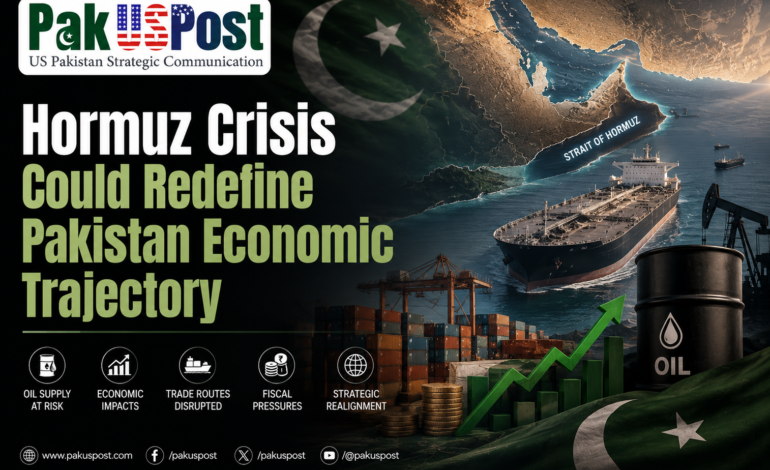
An equally important dimension concerns maritime security. The Strait of Hormuz remains one of the world’s most critical energy chokepoints. Any disruption affecting freedom of navigation would reverberate throughout global markets. For Pakistan, whose economy remains highly vulnerable to energy price fluctuations, stability in the Gulf is not merely a foreign policy concern. It is a national economic imperative.
The strategic significance of Gwadar becomes particularly relevant in this context. Positioned near vital maritime routes, Gwadar possesses the potential to evolve into a major logistics and connectivity hub linking South Asia, Central Asia, the Middle East and Western China. Realizing this potential, however, requires long term stability, infrastructure development and investor confidence. Security challenges and regional rivalries continue to constrain progress.
Beyond economics, demographic realities also shape Pakistan’s interests. Millions of Pakistani expatriates reside across Gulf states, contributing substantially to remittance inflows that support domestic economic stability. Any deterioration in Gulf security conditions could affect employment opportunities, labor mobility and remittance flows. Policymakers therefore have a direct stake in preserving regional stability.
Another factor involves sectarian dynamics. Pakistan’s internal cohesion has occasionally been tested by external influences originating from regional rivalries. A more polarized Middle East could generate renewed efforts by competing actors to project influence through ideological networks. Preventing external geopolitical competition from aggravating domestic fault lines must remain a strategic priority.
At the military level, Pakistan’s defene establishment faces a changing operational environment. Traditional assumptions regarding regional security architecture may no longer apply. Strategic planners will need to monitor developments across the Gulf, Arabian Sea and western border regions with greater attention. Maritime domain awareness, naval modernization and integrated intelligence capabilities will become increasingly important.
The rise of unmanned systems, cyber capabilities, space based surveillance and artificial intelligence is transforming modern conflict. Future competition in the Middle East may be characterized less by conventional warfare and more by hybrid methods. Pakistan must invest in technologies that enhance deterrence while preserving strategic stability.
The broader geopolitical environment also warrants consideration. The Middle East is becoming increasingly connected to Indo Pacific dynamics. Energy flows, maritime routes, technological competition and military deployments link developments across these regions. Pakistan’s strategic location positions it at the crossroads of these transformations.
Yet geography alone does not guarantee influence. National power ultimately depends upon economic strength, institutional effectiveness and political stability. Pakistan’s ability to benefit from shifting geopolitical conditions will depend largely upon domestic reforms. A weak economy limits strategic options. A resilient economy expands them.
Therefore, geoeconomics must occupy a central place in national strategy. Pakistan should prioritize energy diversification, export competitiveness, technological modernization and regional connectivity. Strategic autonomy cannot be sustained without economic capacity. The experiences of emerging powers demonstrate that economic strength increasingly determines geopolitical influence.
Diplomatically, Islamabad should intensify engagement with all major stakeholders. Constructive relations with Washington remain valuable despite broader geopolitical shifts. The United States continues to possess unmatched military capabilities, technological leadership and influence within global financial institutions. Simultaneously, Pakistan must deepen engagement with China, Russia, Gulf partners, Türkiye, Central Asian states and Iran.
This multidirectional diplomacy reflects strategic realism rather than indecision. The emerging international system is likely to be characterized by fluid alignments rather than rigid blocs. States capable of engaging multiple centres of power will possess greater flexibility and resilience.
For Pakistan’s national security establishment, one of the most significant challenges involves anticipating rather than reacting to change. Strategic surprises often occur because institutions remain anchored to outdated assumptions. The possibility of a transformed Middle Eastern security order requires proactive planning across military, diplomatic and economic domains.
Several policy recommendations emerge from this assessment. First, Pakistan should institutionalize a comprehensive Middle East strategy integrating security, economic and diplomatic objectives. Second, maritime security capabilities should receive greater investment given the importance of regional sea lanes. Third, engagement with Iran and Gulf states must proceed simultaneously to reduce the risk of strategic polarization. Fourth, economic resilience should be treated as a national security priority. Fifth, Pakistan should expand strategic dialogues with major powers while avoiding exclusive dependence upon any single partner.
Additionally, intelligence cooperation with regional stakeholders should focus on counterterrorism, maritime threats and emerging security challenges. Enhanced coordination can help mitigate risks arising from regional instability. Defence diplomacy should likewise be expanded to strengthen military to military relationships across diverse partners.
From a geoeconomic perspective, Pakistan should accelerate efforts to transform itself into a regional connectivity hub. Infrastructure investments, regulatory reforms and trade facilitation measures can position the country to benefit from evolving supply chains and transportation corridors. The objective should not merely be transit revenue but broader economic integration.
Looking toward the next decade, the most likely outcome is not complete American withdrawal but rather a gradual recalibration of engagement. Washington may seek to reduce direct military burdens while preserving strategic influence through partnerships, technology, intelligence cooperation and selective force deployments. Even such a limited adjustment, however, would reshape regional calculations.
Pakistan must therefore prepare for an era defined by multipolar competition, strategic uncertainty and accelerating geopolitical change. Success will depend upon maintaining flexibility, strengthening national institutions and pursuing a foreign policy grounded in pragmatic national interests rather than ideological preferences.
The coming transformation of the Middle East will not simply determine the future of regional security. It will influence the broader balance of power across Eurasia and the Indo Pacific. For Pakistan, the challenge is not choosing sides within this evolving order. The challenge is ensuring that national interests remain protected regardless of how the balance ultimately evolves.
The strategic lesson is clear. Nations that adapt early to systemic change shape outcomes. Nations that react late are shaped by them. As the architecture of Middle Eastern security enters a period of transition, Pakistan possesses the geographic position, diplomatic relationships and strategic relevance necessary to emerge as a stabilizing middle power. Whether it succeeds will depend upon the quality of statecraft, the coherence of national strategy and the willingness of policymakers to recognize that the future regional order is already taking shape. The decisions taken today will determine whether Pakistan becomes a passive observer of geopolitical transformation or an active architect of its own strategic destiny.
A Public Service Message