Energy Security, Oil Price Volatility, Pakistan Economic Stability, Inflation and Fiscal Pressure, Global Energy Markets


A sudden or gradual United States disengagement from the Middle East, combined with an expanded Iranian strategic footprint across key maritime chokepoints, would force Pakistan into an unusually compressed strategic environment where geopolitical, geo-strategic, economic, and financial risks converge rather than operate in isolation. In such a scenario, Pakistan’s policy challenge would not be episodic crisis management but continuous multi-domain equilibrium maintenance under conditions of regional volatility and global financial fragmentation.
Three broad scenarios would define the operating environment. A managed US exit would imply calibrated withdrawal with residual deterrence capacity, allowing Gulf states to adjust gradually while preserving partial stability in energy markets. A chaotic US exit would generate abrupt power vacuums, intensified proxy competition, and sharp oil price volatility. A third scenario, US remains war ready, would sustain high military posture without full disengagement, resulting in prolonged strategic tension and intermittent escalation risk. Pakistan’s policy architecture must be designed to remain functional across all three trajectories without requiring structural recalibration.
Within this context, Pakistan’s national interests converge around four core pillars. Energy security remains the most immediate vulnerability, given heavy dependence on imported hydrocarbons and exposure to maritime chokepoint risk. Border stability, particularly along the western frontier with Iran and Afghanistan, represents a second structural concern due to the potential for asymmetric spillover and non-state actor activation. Gulf remittances, estimated at approximately seven billion dollars annually, constitute a critical external financial lifeline that directly stabilizes household consumption and foreign exchange inflows. Finally, continuity of the China-Pakistan Economic Corridor remains essential for long-term connectivity, infrastructure development, and strategic positioning within emerging Eurasian trade routes.
The intersection of these interests requires a multi-dimensional policy toolkit that integrates diplomacy, economic management, security doctrine, and financial strategy. On the diplomatic front, Pakistan must maintain calibrated engagement with all major regional actors, including Gulf states, Iran, China, Russia, and the United States, without entering rigid alliance structures that reduce strategic flexibility. Diplomatic positioning must prioritize issue-based alignment rather than bloc-based commitment, allowing Pakistan to adjust its posture dynamically in response to shifting regional conditions.
On the economic dimension, resilience requires diversification of energy imports, expansion of strategic reserves, and gradual reduction of dependency on single maritime supply routes. Pakistan must also accelerate regional trade integration with Central Asia and enhance overland connectivity to reduce exposure to maritime volatility. Domestic energy efficiency reforms, industrial modernization, and tariff rationalization are necessary to reduce structural import intensity and improve macroeconomic resilience.
On the security dimension, Pakistan’s doctrine must evolve from a primarily border-centric model to a multi-domain security framework. Western frontier management must integrate intelligence-led border control, socio-economic stabilization of peripheral regions, and counter-influence mechanisms designed to reduce external penetration opportunities. On the eastern front, deterrence stability with India remains central, but must now be complemented by hybrid threat preparedness, including cyber resilience, information security, and economic coercion response mechanisms. Nuclear deterrence remains foundational, but no longer sufficient as a standalone stabilizing factor in a diversified threat environment.
On the financial dimension, Pakistan must pursue cautious diversification of external exposure. This includes gradual currency diversification in trade settlements, expansion of bilateral swap arrangements, and selective integration into alternative payment systems such as non-dollar clearing networks. However, financial strategy must remain anchored in macroeconomic stability requirements, particularly IMF program constraints and global capital market access. Abrupt financial realignment would risk triggering capital market instability and external financing disruption.
Action planning must be structured across three-time horizons. In the first zero to six months, Pakistan’s priority would be crisis preparedness, including energy reserve expansion, foreign exchange buffer stabilization, and diplomatic contingency activation with Gulf partners and China. In the six-to-twenty-four-month window, structural adjustments would include energy diversification projects, border security modernization, and initial integration into regional payment alternatives. Over a two-to-five-year horizon, Pakistan would aim to institutionalize a hybrid connectivity-security model, reduce import intensity of growth, and embed financial resilience mechanisms within the central banking framework.
Certain strategic red lines must be clearly maintained. Pakistan must avoid formal alignment in any Iran Gulf confrontation that could trigger sanctions exposure or rupture critical financial relationships. It must avoid overdependence on any single external financial system, whether dollar-based or alternative currency-based, to prevent asymmetric leverage. It must also avoid allowing internal sectarian or political fragmentation to become externally exploitable through regional polarization. Finally, Pakistan must preserve uninterrupted access to IMF and multilateral financing channels, even while diversifying trade settlement mechanisms.
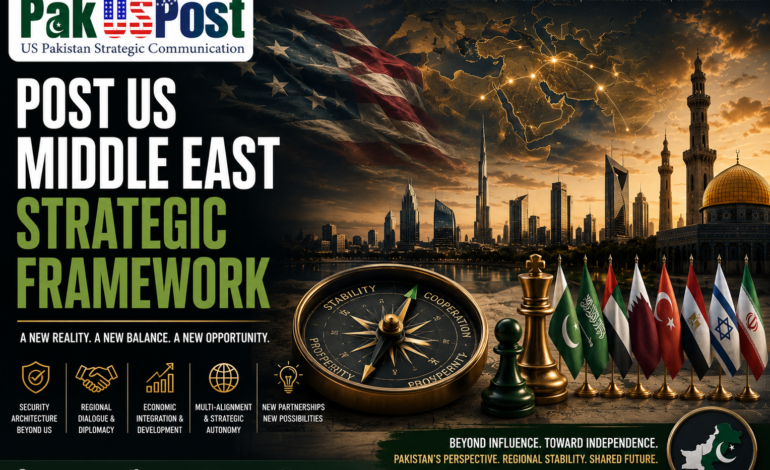
In synthesis, Pakistan’s strategic doctrine for a post US Middle East environment must be defined by adaptability rather than alignment. The state must operate as a calibrated balancer within a fragmented international system where energy security, financial stability, and security depth are interconnected rather than separate policy domains. The emerging order rewards flexibility, redundancy, and multi-vector engagement rather than rigid bloc membership.
Pakistan Doctrine for Post US Middle East can therefore be summarized in five operational principles. Strategic neutrality with functional engagement across all blocs. Energy diversification with reduced chokepoint dependency. Multi-domain deterrence integrating military, economic, and informational security. Financial multi-alignment without systemic decoupling from global capital architecture. And internal cohesion as a prerequisite for external strategic credibility.
A Public Service Message