

Persistent ISR Networks and Strategic Transparency Across Modern Competition

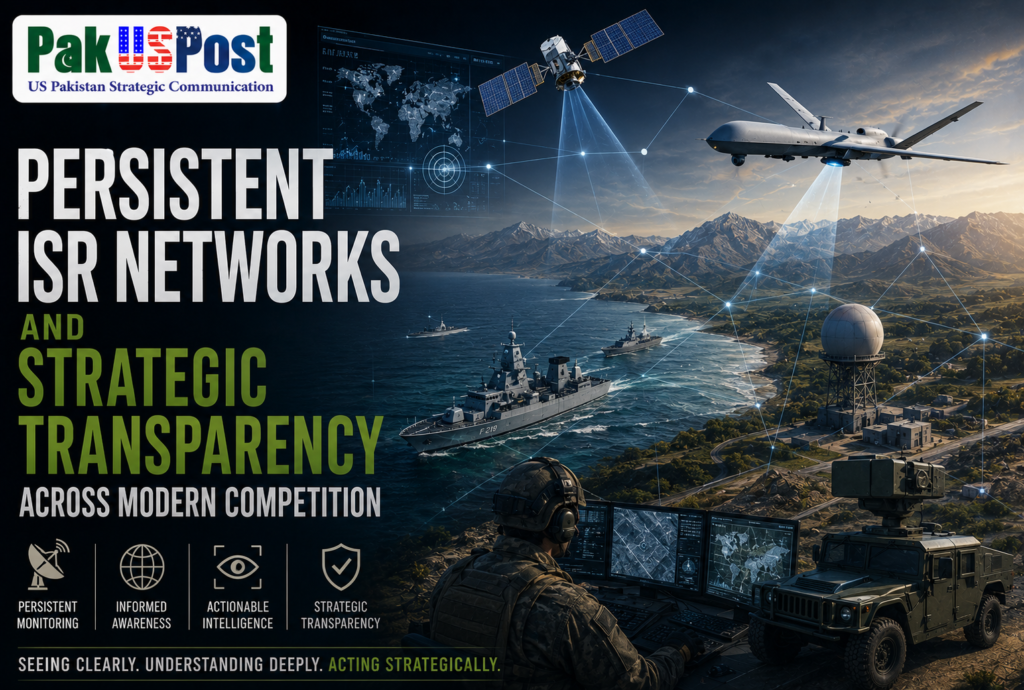
The strategic environment separating Pakistan and the United States is entering a period in which visibility has become as consequential as military capability itself. For decades, national security planning rested upon assumptions that states could conceal deployments, disguise operational intentions, manipulate timelines, and preserve strategic ambiguity through geography, technological asymmetry, or institutional secrecy. Those assumptions are steadily eroding. The convergence of persistent Intelligence, Surveillance and Reconnaissance capabilities, commercial satellite constellations, autonomous maritime systems, unmanned aerial platforms, artificial intelligence driven analytics, hyperspectral imaging, synthetic aperture radar, cyber intelligence integration, and open source intelligence has transformed observation from an episodic activity into a permanent condition. Strategic competition increasingly unfolds under continuous scrutiny, where military movements, infrastructure expansion, logistical preparations, maritime activity, border developments, and even industrial mobilisation become visible to multiple actors simultaneously.
The implications extend far beyond technological modernisation. They represent a structural transformation in international security, forcing governments to reconsider long established assumptions regarding deterrence, escalation, intelligence collection, operational security, and crisis management. Strategic transparency is no longer merely an intelligence objective. It has become a defining feature of the geopolitical landscape itself.
For Pakistan and the United States, whose security relationship has evolved through cooperation, divergence, counterterrorism partnerships, regional instability, and changing geopolitical priorities, persistent ISR ecosystems create both opportunities and vulnerabilities. The future of bilateral military engagement will increasingly depend not simply upon military capability, but upon the institutional capacity to operate effectively in an environment where observation is continuous, information spreads instantly, and operational secrecy becomes progressively more difficult to sustain.
Traditional intelligence operated through cycles. Satellites passed overhead according to predictable orbital schedules. Reconnaissance aircraft entered designated airspace only during selected missions. Maritime patrols were intermittent. Human intelligence required extended preparation and lengthy validation. Military planners therefore calculated windows during which concealment remained possible.
Persistent ISR fundamentally changes those calculations.
Commercial satellite constellations now provide imagery multiple times each day. Synthetic aperture radar penetrates cloud cover and operates regardless of weather conditions or darkness. High resolution optical imagery identifies infrastructure development with remarkable precision. Automatic Identification System tracking monitors commercial shipping across oceans. Aircraft transponders reveal aviation activity. Maritime drones continuously monitor strategic waterways. Underwater autonomous sensors collect acoustic signatures. Artificial intelligence correlates enormous datasets within minutes rather than weeks.
The consequence is straightforward. Observation no longer occurs occasionally. It becomes continuous.
This transition represents one of the most profound shifts in strategic affairs since the emergence of nuclear deterrence. Military planning increasingly assumes that major deployments, logistics concentrations, infrastructure construction, missile transporter movements, naval exercises, or unusual force postures will eventually become visible to numerous governmental and non governmental observers.
Commercial companies have become central participants within this ecosystem. Private satellite operators possess imaging capabilities that rival or complement governmental intelligence agencies. Commercial analytics firms provide geospatial assessments to governments, financial institutions, humanitarian organisations, journalists, and research institutes. Artificial intelligence platforms automatically identify changes in military installations, port activity, railway logistics, and industrial production.
Information therefore diffuses rapidly across multiple audiences.
Governments are no longer the exclusive owners of strategic observation.
This diffusion fundamentally alters diplomatic signalling.
Historically, states deliberately disclosed selected intelligence to shape international perceptions. Today, governments frequently respond to imagery already circulating within public information ecosystems. Strategic communication increasingly involves explaining visible developments rather than selectively revealing hidden information.
Pakistan’s strategic environment illustrates this evolution clearly.
Border monitoring along complex frontiers increasingly combines satellite imagery, unmanned aerial systems, ground sensors, electronic intelligence, artificial intelligence enabled anomaly detection, and integrated command systems. Counterterrorism operations benefit from improved situational awareness while simultaneously facing greater operational exposure. Military infrastructure development, transportation corridors, logistics hubs, and border security projects become progressively more observable.
Continuous ISR improves operational effectiveness but also compresses decision making.
Events that once required days for intelligence confirmation may now circulate globally within hours.
This acceleration influences crisis management.
Pakistan and the United States have repeatedly confronted regional crises involving terrorism, Afghanistan, maritime security, nuclear stability, and broader regional competition. Persistent observation enables earlier warning, improved attribution, and enhanced operational coordination. Shared ISR data may strengthen counterterrorism cooperation, humanitarian operations, disaster response, maritime security, and protection of critical infrastructure.
Yet identical technologies may also generate instability.
Observation without contextual understanding creates opportunities for misinterpretation.
Artificial intelligence excels at identifying unusual activity but remains less capable of accurately interpreting political intent. Increased military logistics may represent routine exercises, humanitarian preparation, equipment maintenance, or mobilisation. Persistent surveillance identifies movement. It cannot always explain motivation.
Strategic stability therefore depends increasingly upon analytical sophistication rather than simply collection capacity.
Pakistan’s military planning must recognise that information superiority no longer emerges solely from expanding surveillance assets. Competitive advantage increasingly derives from integrating observation with disciplined interpretation, institutional coordination, legal oversight, and calibrated decision making.
The United States has invested extensively in networked ISR architectures integrating satellites, airborne platforms, naval systems, cyber capabilities, artificial intelligence, and multinational intelligence sharing. These systems enable persistent monitoring across multiple theatres simultaneously.
However, greater visibility does not automatically produce greater certainty.
Modern conflicts repeatedly demonstrate that abundant information often coexists with analytical disagreement. Competing intelligence assessments, algorithmic biases, fragmented datasets, and political assumptions continue influencing decision making despite unprecedented surveillance capacity.
Strategic transparency therefore generates an apparent paradox.
More observation sometimes produces more uncertainty.
Decision makers confront expanding volumes of information requiring rapid interpretation under political pressure. Artificial intelligence accelerates analysis but simultaneously introduces new risks regarding false positives, algorithmic assumptions, manipulated datasets, and adversarial deception.
Future intelligence competition will revolve not only around collecting information but around validating its reliability.
Pakistan faces important institutional questions in this regard.
ISR modernisation should not become an isolated technological programme driven solely by procurement objectives. Rather, it requires integration across military commands, intelligence agencies, civilian ministries, border management institutions, maritime authorities, aviation regulators, emergency response organisations, and national cyber security structures.
Institutional fragmentation diminishes the value of sophisticated surveillance technologies.
Shared situational awareness requires common operational frameworks, interoperable communications, secure information architecture, unified analytical standards, and clearly defined responsibilities. The expanding commercial space sector introduces another strategic variable.
Commercial imagery increasingly influences diplomatic narratives before governments formulate official responses. International media organisations, policy institutes, financial analysts, and civil society organisations frequently utilise commercially available satellite imagery to evaluate military activity, infrastructure development, disaster response, environmental degradation, and humanitarian crises. Consequently, perception management becomes inseparable from operational planning.
Military activities visible from space generate strategic narratives regardless of official communication. Information discipline therefore acquires unprecedented significance.
Operational security no longer depends exclusively upon preventing observation. It increasingly depends upon anticipating observation and preparing credible explanations consistent with broader national objectives. Pakistan’s engagement with the United States can benefit from recognising this evolving reality.
Bilateral defence dialogue should increasingly incorporate persistent ISR governance alongside traditional military cooperation. Intelligence sharing frameworks require updated protocols reflecting commercial satellite proliferation, artificial intelligence integration, cyber resilience, and multinational information environments.
Joint exercises should include scenarios involving publicly available geospatial intelligence, commercial imagery analysis, disinformation campaigns exploiting authentic surveillance data, and coordinated strategic communication.Future crises will likely unfold across both physical and informational domains simultaneously. Maritime security represents another area requiring strategic adaptation.
The Arabian Sea, Indian Ocean approaches, commercial shipping routes, underwater infrastructure, and energy corridors increasingly fall under persistent observation through autonomous maritime systems, satellite monitoring, unmanned surface vessels, underwater sensors, and artificial intelligence supported maritime analytics. Maritime concealment consequently becomes more difficult. Naval doctrine must therefore balance operational flexibility with realistic assumptions regarding continuous observation.
Persistent maritime awareness may strengthen anti-piracy operations, fisheries protection, counterterrorism cooperation, search and rescue missions, and protection of submarine communication cables. At the same time, increased observation raises escalation risks when routine naval manoeuvres receive exaggerated political interpretation. Strategic signalling must therefore remain deliberate, disciplined, and proportionate.
Border management similarly evolves under persistent ISR. Mountainous terrain previously offered natural concealment limiting surveillance effectiveness. Technological advances increasingly reduce those limitations through integrated satellite coverage, long endurance drones, electronic monitoring, acoustic sensors, thermal imaging, and artificial intelligence assisted terrain analysis.
These developments improve border security while demanding careful governance regarding privacy, legal authority, operational accountability, and civilian oversight. Technology cannot substitute for institutional legitimacy. Effective border management requires balanced integration of surveillance capability with diplomatic engagement, community cooperation, legal transparency, and respect for national sovereignty.
Deterrence theory also requires reassessment.
Classical deterrence emphasised uncertainty regarding adversary capabilities and intentions. Persistent observation reduces certain forms of uncertainty while introducing others. Visible readiness may strengthen deterrence through credible signalling.
Conversely, excessive transparency may reveal operational vulnerabilities, logistical constraints, deployment patterns, maintenance cycles, or command procedures. Future deterrence will therefore depend less upon absolute secrecy than upon adaptive resilience.
States capable of operating effectively despite continuous observation will enjoy greater strategic stability than those relying primarily upon concealment. Institutional adaptability becomes the decisive variable. Artificial intelligence reinforces this transition.
Machine learning systems process immense intelligence datasets beyond human analytical capacity. Pattern recognition identifies anomalies across satellite imagery, communications metadata, logistics movements, maritime traffic, financial activity, and social media simultaneously. These capabilities significantly enhance early warning.
Nevertheless, algorithmic outputs require disciplined human judgment. Military institutions must resist excessive automation in strategic decision making. Artificial intelligence should strengthen human analysis rather than replace it. Professional military education should therefore emphasise critical reasoning, interdisciplinary assessment, cognitive resilience, technological literacy, and structured analytical methodologies capable of identifying both algorithmic strengths and limitations.
Pakistan’s defence planning should similarly prioritise institutional learning’s investments must extend beyond acquiring platforms toward developing analytical organisations capable of integrating diverse information sources into coherent strategic assessments. Human capital remains the foundation of technological effectiveness. Advanced sensors without disciplined analysts merely generate larger volumes of unprocessed information.
Training programmes should therefore integrate geospatial intelligence, cyber analysis, artificial intelligence governance, behavioural assessment, crisis simulation, strategic communication, and legal frameworks governing intelligence operations. Civilian institutions also possess important responsibilities. National resilience increasingly depends upon protecting critical information ecosystems against manipulation, misinformation, cyber intrusion, and psychological influence operations exploiting authentic surveillance data.
Governments must prepare public communication mechanisms capable of responding rapidly to misleading narratives generated from selectively interpreted imagery or fabricated analytical claims.
Strategic transparency requires strategic credibility. Public trust strengthens national resilience during crises. International partnerships similarly require recalibration.
Rather than treating intelligence cooperation exclusively through classified governmental channels, future frameworks should incorporate commercial technology providers, academic research institutions, emergency management organisations, cyber security specialists, and regulatory authorities where appropriate. Whole of government approaches increasingly outperform isolated institutional structures.
Pakistan and the United States possess opportunities to expand cooperation in disaster monitoring, climate observation, maritime safety, humanitarian assistance, counterterrorism intelligence, cyber resilience, and infrastructure protection using persistent ISR technologies while respecting national sovereignty and strategic autonomy.
Such cooperation should remain rules based, mutually beneficial, and institutionally transparent.
Strategic competition need not eliminate selective cooperation where shared interests clearly exist. The broader geopolitical lesson extends beyond bilateral relations.
Persistent observation is reshaping international politics irrespective of ideological differences or regional alignments. Great powers, middle powers, and developing states all confront the same technological reality.
Geography continues influencing security, yet technology increasingly determines how geography is perceived, monitored, interpreted, and governed. Strategic advantage consequently shifts toward institutions capable of rapid adaptation rather than organisations dependent upon information monopolies.
This transformation carries profound implications for establishment planning. National security institutions should adopt integrated ISR governance frameworks linking defence ministries, intelligence organisations, cyber agencies, civilian regulators, maritime authorities, aviation institutions, scientific communities, and strategic communication units within coordinated decision making structures. Information sharing protocols should establish common analytical standards while protecting sensitive operational capabilities. Artificial intelligence applications require rigorous validation procedures, continuous auditing, ethical safeguards, and human oversight to minimise analytical error. Defence planning should emphasise resilient command structures capable of maintaining operational effectiveness despite persistent observation. Military exercises should routinely simulate environments characterised by commercial satellite exposure, open source intelligence dissemination, cyber disruption, and accelerated media reporting. Border security strategies should combine technological monitoring with diplomatic engagement, legal accountability, and community confidence building. Strategic communication capabilities must anticipate publicly available intelligence, ensuring timely, accurate, and credible national messaging during periods of heightened tension. Professional military education should incorporate multidisciplinary instruction integrating technology, geopolitics, behavioural science, data analytics, and crisis leadership. Finally, Pakistan should continue strengthening selective international cooperation on ISR standards, maritime awareness, disaster response, and counterterrorism while preserving strategic autonomy, sovereign decision making, and national security interests.
The defining characteristic of twenty first century security will not be the disappearance of secrecy, because certain intelligence capabilities will always remain classified and operational deception will continue influencing military planning. Rather, the decisive transformation lies in recognising that persistent observation has become the normal operating environment of international politics. Nations capable of adapting institutions, doctrine, governance, and strategic culture to this reality will possess enduring advantages over those seeking to preserve assumptions formed in an era when concealment remained the principal foundation of security. In the emerging geography of strategic transparency, resilience, disciplined governance, institutional adaptability, and credible information management will increasingly determine national influence more than the simple ability to remain unseen.
A Public Service Message


