

Maritime Insurance Shapes Strategic Competition Across the Arabian Sea

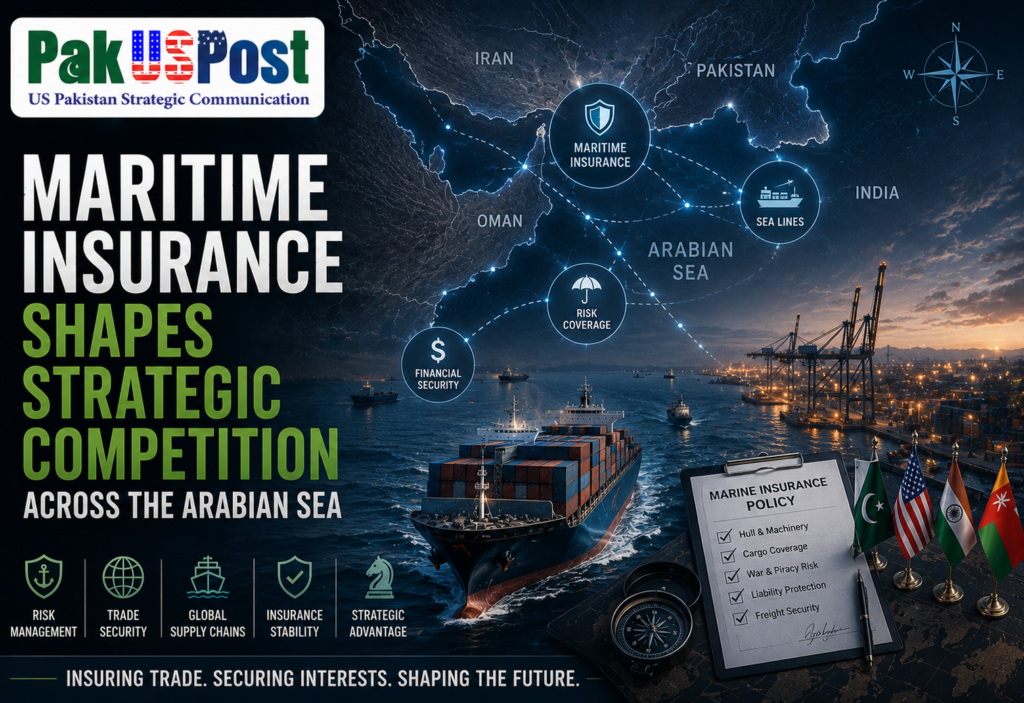
For centuries, maritime power has been measured through fleets, ports, sea lanes, and naval supremacy. In the twenty first century, however, an increasingly influential instrument of maritime competition operates far from the horizon. It exists inside insurance syndicates, risk modelling institutions, commercial advisory firms, financial markets, shipping registries, freight contracts, and legal underwriting frameworks. Modern maritime competition is no longer determined solely by naval deployments or military escalation. It is increasingly shaped by commercial perceptions of risk that influence the movement of capital long before conflict becomes visible. The cost of uncertainty itself has emerged as a strategic variable capable of affecting national resilience without a single missile being launched.
Across the Arabian Sea, maritime insurance architecture is becoming an invisible layer of geopolitical competition. Insurance premiums, war risk assessments, vessel classifications, port advisories, cargo security evaluations, and shipping compliance mechanisms increasingly influence trade flows, investment decisions, and energy security. What once appeared to be technical calculations performed by commercial underwriters now intersect with national security planning, strategic deterrence, and international diplomacy. The distinction between commercial judgement and geopolitical signalling is becoming progressively blurred.
For Pakistan, this transformation carries profound implications. Situated at the junction of the Arabian Sea, the Gulf, the Indian Ocean, and the wider Indo Pacific maritime system, Pakistan occupies a geographical position that offers strategic opportunity while simultaneously exposing the country to commercial vulnerabilities generated outside its immediate control. Karachi Port, Port Qasim, and Gwadar increasingly operate within an international insurance ecosystem whose assessments affect competitiveness irrespective of domestic operational efficiency.
The evolution of maritime insurance demonstrates how economic instruments increasingly precede military instruments in shaping strategic environments. Before a naval blockade is declared, shipping companies may voluntarily alter routes because insurers classify particular waters as elevated risk. Before diplomatic confrontation reaches crisis level, freight costs may increase because underwriters revise probability models. Before commercial sanctions are announced, financial institutions may impose stricter lending conditions on maritime cargo entering designated regions. These adjustments occur quietly, often attracting little public attention, yet their cumulative strategic consequences may exceed those of overt military signalling.
Modern shipping depends upon confidence rather than movement alone. Every commercial voyage requires interconnected participation from insurers, reinsurers, banks, port operators, legal advisers, classification societies, logistics providers, cargo owners, and freight brokers. If confidence weakens within any component of this network, shipping costs rise immediately. Strategic competition therefore increasingly targets confidence rather than infrastructure.
Insurance markets have historically reflected measurable risks including piracy, severe weather, mechanical failures, and armed conflict. Contemporary geopolitical competition has introduced more ambiguous variables. Regional instability, cyber vulnerabilities affecting navigation systems, electronic interference, sanctions exposure, unmanned maritime systems, hybrid threats, terrorism concerns, and political uncertainty now influence premium calculations alongside conventional maritime hazards.
These assessments frequently possess self reinforcing characteristics. Once insurers classify a maritime corridor as presenting elevated risk, shipping companies adjust operations accordingly. Reduced traffic generates perceptions of declining commercial confidence. Investors become cautious regarding port infrastructure. Freight costs increase. Financial institutions modify lending assumptions. The initial perception gradually produces measurable economic consequences irrespective of whether physical threats actually materialise.
The Arabian Sea increasingly illustrates this phenomenon. It connects global energy markets, Gulf hydrocarbon exports, South Asian manufacturing, East African commerce, and emerging regional logistics corridors. Any sustained increase in perceived maritime risk affects not merely shipping companies but entire national economies dependent upon uninterrupted maritime trade.
Pakistan imports substantial volumes of energy through maritime routes. Petroleum products, liquefied natural gas, industrial inputs, fertilisers, machinery, and commercial commodities all depend upon stable shipping conditions. Insurance premiums imposed upon tankers and cargo vessels ultimately become costs absorbed throughout domestic supply chains. Inflationary pressures therefore increasingly reflect international maritime risk assessments alongside traditional market dynamics.
Karachi Port remains Pakistan’s principal commercial gateway. Port Qasim supports industrial activity and energy imports. Gwadar represents long term strategic diversification. Their operational efficiency, however, increasingly depends upon international perceptions extending beyond local port management. Insurance markets evaluate regional maritime conditions collectively rather than individually. A deterioration in broader Arabian Sea security perceptions can therefore affect Pakistani ports despite continued domestic operational stability.
Gwadar occupies an especially significant position within this evolving strategic landscape. Much discussion surrounding Gwadar traditionally emphasises infrastructure development, connectivity, regional trade, and maritime logistics. Equally important, however, is integration into global commercial confidence networks. Infrastructure alone cannot transform a port into an international logistics hub. Shipping companies require predictable insurance costs, transparent legal frameworks, reliable emergency response capabilities, internationally recognised maritime governance standards, and confidence regarding operational continuity.
The economics of shipping frequently demonstrate remarkable sensitivity to marginal increases in uncertainty. A modest adjustment in war risk premiums may alter voyage economics sufficiently to redirect vessels toward alternative ports. Higher insurance costs influence charter agreements, cargo pricing, inventory management, and long term commercial planning. Consequently, maritime insurance functions not merely as financial protection but as strategic market signalling.
American maritime policy occupies an important position within this broader environment. The United States continues to advocate freedom of navigation, protection of international sea lanes, secure maritime commerce, and regional stability. Simultaneously, American naval presence, security partnerships, sanctions frameworks, export controls, and strategic competition influence commercial perceptions across maritime markets.
Freedom of navigation represents more than naval doctrine. It also supports commercial predictability. Shipping companies value environments where legal norms remain enforceable, maritime disputes remain contained, and navigation rights are respected. Consequently, American maritime engagement contributes indirectly to insurance calculations by influencing broader assessments of regional stability.
Yet strategic competition complicates this relationship. Maritime security operations intended to reassure commercial actors may simultaneously reinforce perceptions that regional tensions remain elevated. Expanded naval deployments designed for deterrence can reduce military risks while increasing commercial awareness of geopolitical uncertainty. Insurance markets frequently interpret these signals with considerable caution.
Commercial underwriters increasingly incorporate intelligence derived from naval advisories, satellite monitoring, geopolitical analysis, cyber threat reporting, and regional security assessments. Modern insurance calculations therefore integrate information previously associated primarily with defence institutions. Strategic intelligence and commercial analytics increasingly converge.
This convergence creates new policy challenges for middle powers including Pakistan. Maritime security can no longer remain exclusively within naval institutions. Economic ministries, financial regulators, shipping authorities, insurance specialists, customs administrations, intelligence organisations, foreign policy institutions, energy planners, and commercial stakeholders must increasingly share strategic awareness.
Pakistan’s western seaboard occupies a particularly sensitive position because it simultaneously supports national commerce, regional connectivity, energy imports, fisheries, industrial development, and strategic naval operations. Commercial disruptions affecting maritime confidence therefore possess multidimensional consequences extending beyond transportation economics.
Another emerging dimension involves maritime information competition. Risk advisories influence markets irrespective of whether governments formally endorse them. Commercial intelligence providers, international consultancies, shipping publications, financial analysts, and private security firms increasingly shape perceptions influencing insurance decisions. Their assessments often circulate more rapidly than official governmental communications.
Consequently, information credibility itself becomes a component of maritime resilience. States capable of rapidly communicating verified operational information, demonstrating effective maritime governance, and maintaining transparent incident reporting enjoy greater capacity to preserve commercial confidence during periods of regional uncertainty.
Cybersecurity introduces another significant variable. Modern vessels depend upon integrated navigation systems, digital logistics platforms, satellite communications, automated cargo management, and interconnected financial systems. Insurance providers increasingly evaluate cyber resilience alongside physical security. Successful cyber attacks affecting ports or shipping infrastructure may produce insurance consequences comparable to conventional security incidents.
Artificial intelligence further transforms maritime insurance. Machine learning models increasingly analyse vessel behaviour, cargo movement, geopolitical indicators, weather patterns, port performance, sanctions exposure, and historical incidents. These analytical systems continuously update risk assessments, reducing response times while increasing market sensitivity to emerging developments.
Climate risks further complicate insurance architecture. Rising sea levels, severe storms, coastal flooding, heat related infrastructure stress, and environmental regulations increasingly affect premium calculations. Consequently, maritime resilience now integrates environmental adaptation alongside conventional security planning.
Regional competition surrounding logistics infrastructure also influences insurance markets. Ports increasingly compete not merely through capacity but through governance quality, regulatory predictability, emergency response capabilities, environmental compliance, cybersecurity standards, and commercial transparency. Insurance providers reward operational reliability with more favourable assessments, reinforcing competitive advantages.
Pakistan therefore confronts both challenge and opportunity. Geography provides strategic access connecting multiple regions. Realising this advantage requires institutional sophistication matching contemporary maritime realities. Traditional infrastructure investment remains necessary but insufficient. Strategic competitiveness increasingly depends upon intangible governance capabilities supporting commercial confidence.
Maritime diplomacy should therefore receive greater institutional emphasis. Diplomatic engagement regarding shipping standards, insurance dialogue, regional emergency coordination, environmental cooperation, search and rescue mechanisms, and commercial dispute resolution contributes directly to confidence building. Maritime diplomacy increasingly complements naval diplomacy rather than operating independently.
Commercial intelligence capabilities likewise require institutional strengthening. Governments traditionally monitor military developments extensively while devoting comparatively limited attention to evolving commercial perceptions. Dedicated analytical capacity examining shipping trends, freight pricing, insurance adjustments, cargo diversions, charter markets, and financial risk indicators would significantly enhance strategic awareness.
Pakistan’s naval planning should continue evolving beyond conventional defence responsibilities toward integrated maritime resilience. Naval forces increasingly contribute through domain awareness, humanitarian response, maritime safety, infrastructure protection, cyber cooperation, information sharing, and confidence preservation alongside traditional deterrence missions.
Closer interaction between naval institutions and commercial shipping stakeholders would improve operational coordination. Regular engagement involving port authorities, shipping companies, insurers, customs agencies, logistics operators, energy importers, financial institutions, and maritime regulators would strengthen collective preparedness against emerging disruptions.
Energy security planning similarly requires greater integration with maritime insurance analytics. Import diversification strategies should incorporate assessments regarding insurance volatility, shipping resilience, alternative routing, emergency logistics, strategic petroleum reserves, and contractual flexibility. Economic planning increasingly depends upon understanding commercial maritime risk.
Domestic insurance capability also deserves strategic consideration. While international insurance markets remain indispensable, developing sophisticated national expertise regarding marine insurance analytics, actuarial modelling, legal arbitration, and maritime finance would strengthen institutional resilience. Indigenous analytical capacity reduces dependence upon external interpretations of regional risk.
Legal harmonisation offers another avenue for strengthening commercial confidence. Transparent maritime legislation, efficient dispute resolution mechanisms, internationally recognised arbitration standards, digital customs procedures, and predictable regulatory frameworks encourage favourable commercial assessments extending beyond physical infrastructure.
Public private partnerships should become central components of maritime resilience. Shipping companies frequently possess operational insights unavailable within governmental institutions. Conversely, governments maintain strategic awareness unavailable within commercial organisations. Institutional mechanisms enabling systematic information exchange would improve collective decision making.
Academic institutions likewise possess an important role. Pakistan requires specialised research integrating maritime economics, insurance analytics, naval strategy, international law, cyber security, logistics management, artificial intelligence, and geopolitical forecasting. Contemporary maritime competition increasingly demands interdisciplinary expertise rather than isolated professional specialisation.
Regional cooperation also remains indispensable. Maritime confidence benefits from coordinated search and rescue arrangements, environmental protection initiatives, piracy prevention, information sharing, emergency communications, and technical standardisation. Even amid geopolitical competition, practical maritime cooperation often remains achievable because commercial stability benefits all coastal economies.
The invisible nature of insurance driven strategic competition should not encourage complacency. Economic pressure generated through changing commercial perceptions frequently accumulates gradually before becoming visible through declining investment, increased inflation, disrupted supply chains, or weakened competitiveness. Strategic warning therefore depends upon monitoring subtle commercial indicators rather than awaiting overt crises.
The Arabian Sea will remain central to global commerce throughout the coming decades. Energy transportation, container shipping, digital connectivity infrastructure, undersea communication cables, offshore resources, and emerging maritime technologies will further increase its strategic importance. Competition within this maritime environment will increasingly occur through financial mechanisms, commercial standards, regulatory influence, technological interoperability, and information superiority rather than direct military confrontation alone.
Pakistan possesses significant geographical advantages within this evolving landscape. Geography, however, provides opportunity rather than guarantee. Strategic success increasingly depends upon institutional capacity capable of converting location into sustained commercial confidence. Ports, shipping lanes, naval capabilities, and logistics infrastructure must therefore operate within an integrated national framework recognising that insurance architecture now constitutes an essential dimension of maritime power.
Ultimately, maritime insurance has evolved beyond its traditional commercial function into an instrument influencing strategic behaviour across international waters. Premiums, classifications, advisories, and underwriting decisions increasingly shape national economic resilience before conventional conflict emerges. States capable of understanding this invisible strategic environment will possess greater ability to protect trade, preserve investor confidence, secure energy supplies, and strengthen maritime competitiveness. For Pakistan, the imperative is not merely to defend its coastline but to cultivate a comprehensive maritime governance architecture where diplomacy, intelligence, commercial analytics, naval preparedness, financial resilience, and institutional coordination collectively ensure that commercial confidence becomes a strategic asset rather than a strategic vulnerability.
A Public Service Message


