
Moral Asymmetry and Strategic Coexistence in US Pakistan Relations

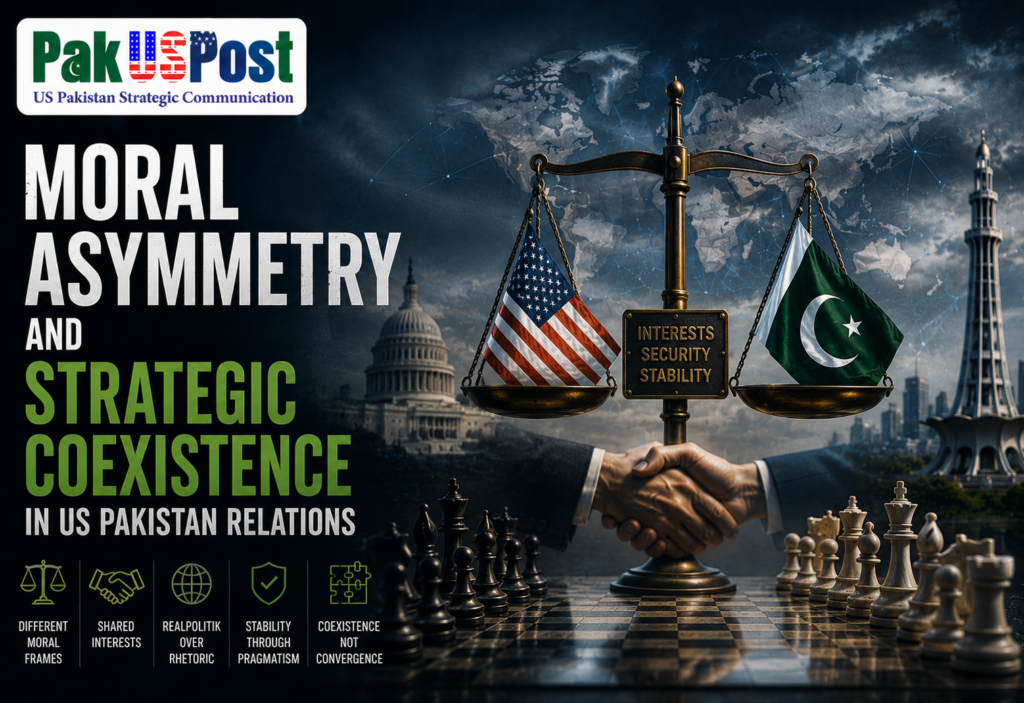
The evolving relationship between Pakistan and the United States is increasingly defined not by convergence but by managed divergence. Where earlier eras of engagement were shaped by episodic alignment under external pressure, the present condition is more structurally ambiguous. It is no longer sufficient to ask whether the two states share interests. The deeper question is whether they can sustain cooperation when they no longer share interpretive frameworks for legitimacy, order, and political meaning.
This condition of moral asymmetry does not produce immediate rupture. On the contrary, it often produces continuity without cohesion. Agreements are signed, cooperation is maintained, and diplomatic channels remain open. Yet beneath this surface stability lies a gradual erosion of interpretive symmetry. Each side increasingly understands the other through its own normative assumptions, producing a relationship that is operationally functional but conceptually misaligned.
The United States approaches international engagement through a historically embedded belief in rule based order, procedural governance, and liberal institutional legitimacy. These are not merely policy preferences but deeply internalised assumptions about how political systems should function. Pakistan, shaped by post colonial state formation, security centric governance imperatives, and recurring cycles of democratic and non democratic transitions, operates with a different hierarchy of legitimacy in which sovereignty, internal stability, and strategic autonomy often take precedence over procedural norms.
These differences are not ideological in the narrow sense. They are structural, rooted in distinct historical trajectories of state formation and external engagement. The United States emerged as a continental power with expanding institutional confidence, while Pakistan emerged from partition under conditions of insecurity, territorial contestation, and institutional consolidation under pressure. These origins continue to shape how each state interprets authority, coercion, and political order.
In practice, this produces a persistent interpretive gap. Policy instruments that are framed in Washington as governance support or institutional strengthening may be perceived in Islamabad as conditionality or external intrusion. Conversely, policy choices in Pakistan that are framed domestically as sovereignty preservation may be interpreted in Washington as institutional fragility or deviation from expected norms. The same action produces different moral readings, and those readings shape subsequent policy expectations.
This divergence becomes more pronounced in periods of crisis. During moments of political instability, electoral contestation, or civil military tension in Pakistan, external observers often apply normative frameworks that emphasise democratic continuity and institutional accountability. Within Pakistan, however, such moments are frequently interpreted through the lens of sovereignty protection and internal political balancing. The resulting dissonance is not merely analytical. It becomes diplomatic, as each side responds not to the other’s actions but to its interpretation of those actions.
Over time, this creates a condition in which misrecognition becomes institutionalised. Each side anticipates the other’s reaction based on its own moral logic, rather than on shared interpretive rules. This is the essence of moral asymmetry: not disagreement over specific policies, but divergence in the very criteria used to evaluate those policies.
The persistence of this asymmetry raises a central theoretical question in contemporary international relations. Can strategic stability exist without moral symmetry? Classical realist frameworks suggest that it can, provided that interests are sufficiently aligned and power distributions are clearly understood. Liberal institutional frameworks suggest that convergence in norms is necessary for durable cooperation. The Pakistan United States relationship sits uneasily between these two models, conforming fully to neither.
In practice, stability has been maintained through what might be described as functional compartmentalisation. Security cooperation has often been insulated from political disagreement. Economic engagement has been mediated through multilateral institutions. Diplomatic communication has relied on carefully calibrated ambiguity. This architecture has allowed the relationship to persist despite underlying normative divergence.
However, compartmentalisation is becoming increasingly difficult to sustain. The integration of digital information systems into political life has collapsed traditional boundaries between policy domains. Economic decisions are instantly interpreted as political signals. Security actions are rapidly reframed as ideological statements. Diplomatic language is subject to immediate public interpretation across multiple audiences simultaneously. As a result, moral asymmetry is no longer confined to elite diplomatic exchanges. It is continuously reproduced in public discourse.
This transformation has significant implications for strategic predictability. Predictability in international relations depends not only on consistent behaviour but also on consistent interpretation. When interpretation becomes unstable, even predictable behaviour can generate unpredictable reactions. This is particularly relevant in crisis situations involving Pakistan, where domestic political dynamics, regional security concerns, and international scrutiny intersect rapidly.
The United States, in turn, faces its own interpretive constraints. Policy decisions regarding Pakistan are not evaluated solely on strategic grounds but are also filtered through domestic political discourse, congressional oversight, and media narratives. This creates a dual interpretive burden. Washington must anticipate not only Pakistani reactions but also domestic interpretations of those reactions. This recursive dynamic increases the complexity of policy calibration.
Within this environment, moral asymmetry becomes not just a philosophical issue but an operational constraint. It affects how signals are sent, how intentions are read, and how credibility is established. A statement intended as technical clarification may be interpreted as political pressure. A policy intended as strategic adjustment may be interpreted as normative judgment. These misalignments accumulate over time, producing friction even in periods of formal cooperation.
One of the most significant consequences of this condition is the gradual erosion of interpretive trust. Trust in international relations is not solely based on repeated interaction. It is also based on shared assumptions about meaning. When those assumptions diverge, repeated interaction may actually reinforce mistrust, because each side interprets consistency differently. What appears as reliability to one actor may appear as rigidity or conditionality to another.
This erosion is particularly visible in the domain of economic engagement. Programs involving the International Monetary Fund, development financing, and structural adjustment are often technically designed, yet they are politically interpreted. In Pakistan, such programs are frequently viewed through the lens of sovereignty and external influence. In Washington, they are often viewed through the lens of institutional discipline and economic reform. These differing interpretations shape not only policy reception but also political sustainability.
The same dynamic applies to security cooperation. Counterterrorism collaboration, intelligence sharing, and regional security coordination are operationally robust, yet they are often surrounded by divergent narratives regarding intent and implication. Actions taken in one domain are frequently reinterpreted in another, producing a continuous loop of reassessment and recalibration.
Despite these tensions, the relationship endures because it continues to serve essential functions for both sides. For Pakistan, engagement with the United States provides access to financial systems, diplomatic leverage, and security coordination in a complex regional environment. For the United States, engagement with Pakistan remains relevant for regional stability, counterterrorism architecture, and broader geopolitical balancing in South Asia.
However, endurance should not be mistaken for equilibrium. A relationship can persist while remaining structurally imbalanced in interpretive terms. The central question is whether such a relationship can be stabilised over the long term without requiring moral convergence. The answer depends on whether alternative stabilising mechanisms can be developed.
One possible mechanism is the institutionalisation of procedural predictability. If moral agreement is absent, then procedural clarity becomes essential. This involves clearly defined communication protocols, consistent diplomatic signalling practices, and transparent articulation of policy objectives. The aim is to reduce interpretive ambiguity even when normative disagreement persists.
Another mechanism is the strategic acceptance of moral pluralism as a permanent condition. Rather than treating normative divergence as a problem to be solved, it can be treated as a structural reality to be managed. This requires both sides to decouple cooperation from moral endorsement. Engagement does not imply approval; disagreement does not imply disengagement.
However, this approach faces significant political constraints. Domestic constituencies in both countries increasingly demand moral clarity in foreign policy. In the United States, foreign engagement is often scrutinised through ethical frameworks that emphasise governance standards. In Pakistan, foreign relations are frequently evaluated through sovereignty narratives and historical experience. These domestic pressures limit the flexibility of elite diplomacy.
A further challenge arises from the accelerating pace of global communication. Digital platforms compress the time between action and interpretation, reducing the space for diplomatic calibration. In such an environment, moral asymmetry becomes more visible and more consequential, because it is continuously expressed in public discourse rather than contained within diplomatic channels.
This raises a deeper question about the future of international order itself. If moral asymmetry is becoming the norm rather than the exception, then the traditional assumption that shared values underpin stable cooperation may need revision. Stability may increasingly depend not on convergence but on the ability to manage divergence without escalation.
For Pakistan and the United States, this implies a shift in strategic imagination. The objective is not to eliminate differences in moral vocabulary, but to prevent those differences from becoming automatic triggers of instability. This requires disciplined communication, institutional resilience, and a willingness to accept ambiguity as a feature of long term engagement.
In this sense, moral asymmetry is not simply a constraint. It is also a test of strategic maturity. It forces both states to distinguish between disagreement and incompatibility, between divergence and hostility, between interpretation and intent. The capacity to make these distinctions consistently may determine whether the relationship remains episodically functional or evolves into a more stable form of coexistence.
Ultimately, the durability of the Pakistan United States relationship will depend less on whether it resolves its moral differences and more on whether it can prevent those differences from defining every interaction. If managed effectively, moral asymmetry can coexist with strategic stability. If mismanaged, it will continue to generate cycles of misunderstanding that undermine even the most carefully constructed areas of cooperation.
The future of this relationship, therefore, lies not in moral convergence but in the architecture of managed divergence, where stability is achieved not through shared belief, but through shared restraint.
A Public Service Message