
Strategic Stability Without Shared Moral Vocabulary

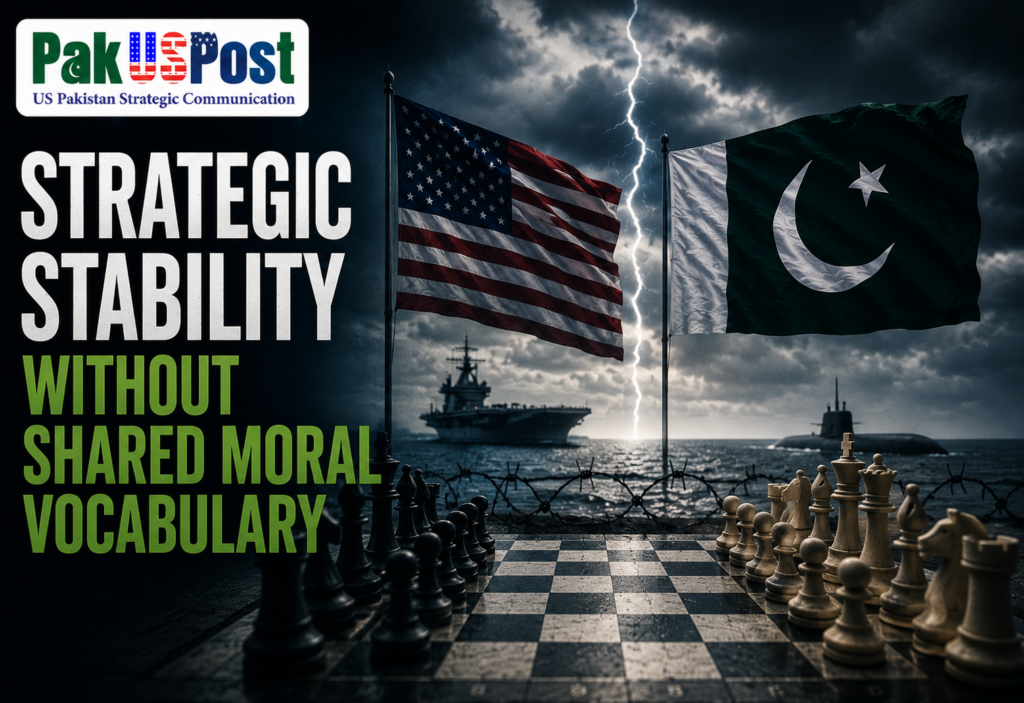
The relationship between Pakistan and the United States has long been interpreted through the familiar vocabulary of interests, alliances, and episodic convergence. Yet beneath this pragmatic surface lies a deeper and less frequently acknowledged tension. It is the absence of a shared moral vocabulary, a common grammar of legitimacy through which both sides can consistently interpret power, sovereignty, order, and political authority. The question is no longer whether the two states can cooperate on specific objectives, but whether durable strategic stability is possible when the philosophical foundations of that cooperation diverge so sharply.
Modern international relations theory often assumes that interests can substitute for shared values. States may disagree on ideology, history, or political systems, yet still cooperate if their material incentives align. This assumption has broadly held for much of the Pakistan United States relationship. During the Cold War, during the Soviet intervention in Afghanistan, and again during the post 9/11 counterterrorism era, transactional convergence repeatedly overcame normative dissonance. However, what appears in hindsight as stability was often contingent rather than structural. It depended on external threats, crisis urgency, and asymmetrical dependencies that temporarily suppressed deeper philosophical differences.
As those external anchors weaken or diversify, the absence of a shared moral language becomes more visible. The United States frequently frames its global engagement in terms of democratic legitimacy, institutional transparency, human rights norms, and rule based order. Pakistan, shaped by a distinct historical experience of partition, post colonial state formation, security centric governance, and civil military complexity, often prioritises sovereignty, internal stability, developmental pragmatism, and strategic autonomy. These are not merely policy preferences. They reflect different civilisational memories of how order is constructed and preserved.
The result is a relationship that is materially functional but conceptually fragmented. Cooperation occurs, but interpretation diverges. Actions are exchanged, but meanings are not always shared. A military cooperation initiative may be understood in Washington as institutional alignment, while in Islamabad it is perceived as conditional engagement. An economic reform program supported by international institutions may be interpreted in one capital as structural modernisation and in the other as externally induced constraint. The same event generates parallel narratives grounded in different moral assumptions.
This divergence becomes more consequential in moments of crisis. When political instability emerges within Pakistan, American policymakers often interpret it through lenses shaped by governance norms, institutional accountability, and democratic continuity. Within Pakistan, however, the same instability may be interpreted through concerns of sovereignty, external influence, or historical patterns of intervention. Neither interpretation is entirely inaccurate, but neither is fully legible to the other. The gap is not informational; it is philosophical.
The absence of a shared moral vocabulary does not prevent cooperation, but it shapes its limits. It constrains the depth of trust that can be achieved, because trust is not only about predicting behaviour but also about interpreting intention. When intention is filtered through incompatible normative frameworks, predictability becomes less meaningful. A predictable actor whose motives are fundamentally misread remains strategically uncertain.
Historically, the Pakistan United States relationship has compensated for this gap through what might be described as calibrated ambiguity. Both sides have often preferred operational cooperation without full conceptual alignment. This ambiguity has allowed flexibility, but it has also produced cycles of disappointment. When expectations diverge too far from underlying realities, periods of intense cooperation are followed by phases of disengagement and recalibration.
The question now is whether this pattern can continue in a more complex global environment. The geopolitical landscape is no longer structured by binary alignments. China’s rise, regional multipolarity, economic fragmentation, and technological competition have expanded the range of strategic options available to both Islamabad and Washington. In this context, the absence of shared moral vocabulary may become less tolerable, because there are fewer external pressures forcing alignment.
At the same time, domestic political evolution in both countries has intensified normative divergence. In the United States, foreign policy debates increasingly incorporate values based assessments, where partnerships are evaluated not only on strategic utility but also on governance standards and political conduct. In Pakistan, domestic discourse is shaped by heightened sensitivity to sovereignty, national dignity, and resistance to perceived external judgment. These internal pressures reinforce external misalignment.
Yet it would be simplistic to assume that shared moral vocabulary is a prerequisite for strategic stability. History offers numerous examples of durable relationships between states with incompatible ideological foundations. During the Cold War, adversarial blocs maintained internal coherence despite profound normative divergence. What sustained those systems was not moral alignment but structured predictability, institutionalised communication channels, and clear red lines that reduced interpretive ambiguity.
The deeper question, therefore, is not whether moral convergence is necessary, but whether functional substitutes can be developed to compensate for its absence. Can procedural trust replace normative trust? Can institutional predictability substitute for shared values? Can disciplined restraint in communication and policy signalling create stability in the absence of philosophical alignment?
One possible answer lies in the distinction between moral vocabulary and operational grammar. Moral vocabulary refers to the language through which states justify their actions. Operational grammar refers to the rules through which they interact. It is conceivable that two states may never agree on moral vocabulary yet still develop a stable operational grammar that governs behaviour. Such a system would prioritise consistency over consensus, restraint over agreement, and predictability over interpretation.
However, the feasibility of this separation is increasingly challenged by the information environment. Digital media ecosystems collapse the boundary between domestic justification and international perception. Every policy action is simultaneously a domestic statement and a global signal. Moral vocabulary therefore becomes operationally relevant because it shapes how actions are received, not just how they are intended.
In this context, the United States and Pakistan face a paradox. On one hand, they do not share a stable moral framework. On the other hand, they cannot avoid operating in a global environment where moral interpretation shapes strategic outcomes. This creates a condition in which normative divergence cannot be ignored, yet normative convergence is difficult to achieve.
The paradox is further complicated by historical memory. Pakistan’s political consciousness is shaped by the experience of colonial governance, partition trauma, and repeated cycles of external engagement followed by disengagement. These experiences have produced a strong emphasis on sovereignty and strategic autonomy as protective mechanisms. The United States, by contrast, carries a self conception as a global stabilising actor, often linking its international engagement to normative commitments about governance and order. These historical narratives are not easily reconciled because they are rooted in different interpretations of legitimacy itself.
Legitimacy is the central unresolved concept in this relationship. For Washington, legitimacy is often derived from procedural governance, electoral continuity, and institutional transparency. For Islamabad, legitimacy is more closely tied to internal coherence, territorial integrity, and the ability of the state to maintain order under conditions of internal and external pressure. These are not mutually exclusive definitions, but they are hierarchically different. They prioritise different elements of political order.
This divergence becomes particularly sensitive in moments of policy conditionality. Economic assistance, security cooperation, and institutional reform programs are often accompanied by expectations that reflect the donor’s normative framework. When these expectations intersect with domestic political sensitivities, they are frequently interpreted not as technical requirements but as moral judgments. This transforms policy disagreements into identity based tensions, increasing friction and reducing flexibility.
At the same time, the United States must contend with the fact that its normative language is not universally received as neutral. In many contexts, it is interpreted through the lens of historical intervention, geopolitical alignment, and selective application. This perception gap further complicates attempts at value based diplomacy, as the same language that signals principle in one context may signal pressure in another.
Despite these tensions, the relationship persists because it continues to serve functional purposes. Security cooperation, counterterrorism coordination, regional stability concerns, and economic interdependence provide recurring incentives for engagement. Yet persistence is not the same as stability. A relationship can endure while remaining structurally fragile.
The key question for policymakers is whether it is possible to move from episodic functionality to sustained strategic equilibrium without requiring full moral convergence. One approach would be to shift emphasis from shared values to shared constraints. Instead of attempting to harmonise moral vocabularies, both sides could focus on establishing constraints that limit misinterpretation and escalation.
These constraints could include predictable diplomatic signalling mechanisms, clearer articulation of red lines, and institutionalised crisis communication channels. They could also involve greater transparency in the framing of conditionality, reducing the gap between technical requirements and perceived moral judgment. Over time, such mechanisms could create a form of procedural trust that compensates for normative divergence.
Another approach involves accepting moral asymmetry as a permanent feature of the relationship while insulating core areas of cooperation from its effects. This would require compartmentalisation, where strategic, economic, and security domains are deliberately separated from ideological interpretation. While difficult in practice, this model has historically underpinned several durable international relationships.
However, compartmentalisation faces increasing pressure from domestic political dynamics and digital communication flows, which tend to integrate rather than separate issues. Economic policy is interpreted through political identity. Security cooperation is interpreted through historical memory. Diplomatic statements are instantly reframed through online discourse. In such an environment, maintaining strict separation between domains becomes increasingly difficult.
Ultimately, the question is not whether Pakistan and the United States can achieve philosophical harmony. That is neither realistic nor necessary. The more relevant question is whether they can construct a stable framework for coexistence that acknowledges moral divergence without allowing it to continuously destabilise operational cooperation.
This requires a shift in strategic imagination. It requires both sides to recognise that modern international relationships are not only about alignment of interests but also about management of interpretive difference. Stability emerges not from shared beliefs but from controlled disagreement, structured communication, and disciplined restraint in translating difference into confrontation.
If such a framework can be developed, then the absence of a shared moral vocabulary need not be an obstacle to strategic stability. It may instead become a manageable condition, one that defines the relationship but does not determine its collapse. If it cannot be developed, then the relationship will likely continue in its current form, functional in moments of necessity, fragile in moments of interpretation, and perpetually vulnerable to the gap between action and meaning.
In this sense, the future of Pakistan United States relations will depend less on whether the two countries agree on what is right, and more on whether they can agree on how to manage the consequences of disagreeing.
A Public Service Message