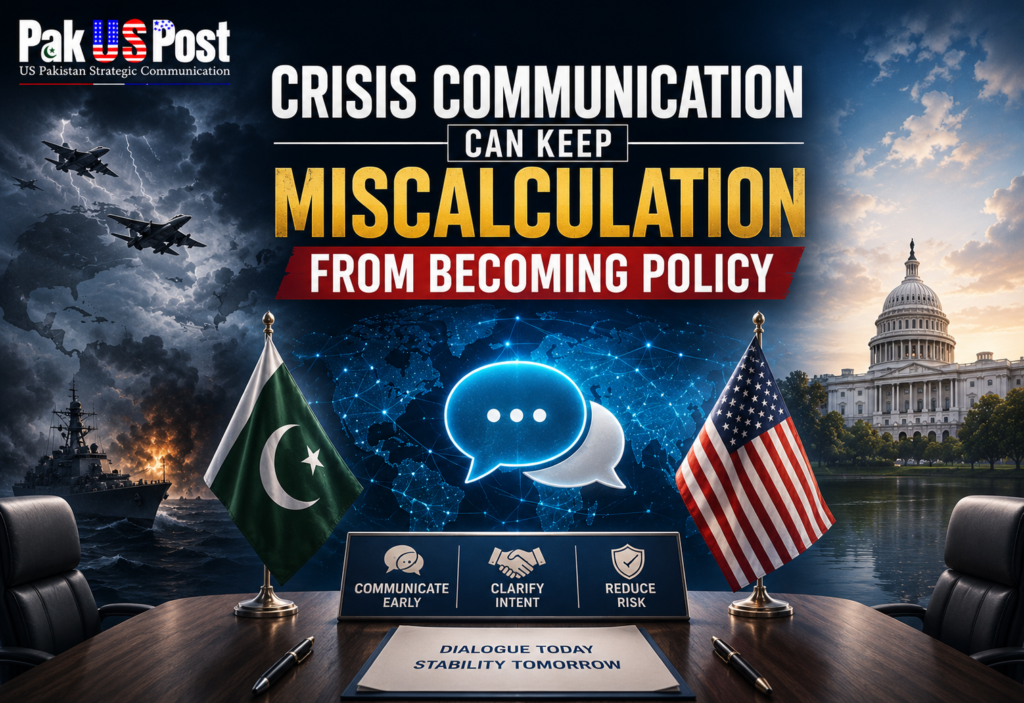
Crisis Communication Can Keep Miscalculation From Becoming Policy

Pak US Post confronts a strategic problem that is increasingly difficult to resolve through conventional diplomacy: governments can now misunderstand one another faster than their institutions can correct the misunderstanding. The 2026 Iran crisis has demonstrated the danger with unusual clarity. Pakistan has maintained simultaneous channels with Washington and Tehran, publicly advocating restraint while privately protecting the confidentiality required for mediation. Islamabad has described sustained exchanges with both sides and has emphasised that proposals transmitted through Pakistani diplomatic channels are communicated faithfully while remaining confidential. Yet the wider information environment has repeatedly moved faster than official diplomacy, creating space in which unverified reports, selective disclosures, political messaging and social media interpretation can acquire the practical significance of policy. That is the central strategic communications problem for Pakistan and the United States. The question is no longer merely whether either government possesses reliable intelligence. It is whether each can rapidly establish what the other government has not done, does not intend to do, and has not authorised before an ambiguous signal is converted into an operational assumption.
The distinction matters because strategic crises rarely begin with a complete picture. They begin with fragments. A military movement is detected. A diplomatic meeting is cancelled. An aircraft changes course. A port introduces new restrictions. An intelligence assessment is selectively leaked. A senior official posts an ambiguous statement. Television commentators interpret silence as preparation. Social media converts interpretation into assertion. Markets respond before ministries have completed verification. Once that sequence begins, correcting the original misunderstanding becomes progressively harder because officials are no longer communicating into an information vacuum. They are communicating against narratives that have already acquired constituencies.
For Pakistan, the 2026 Iran confrontation has imposed an unusually demanding communications test because Islamabad is simultaneously a neighbouring state, a potential economic shock absorber, a diplomatic intermediary and a security actor with direct exposure to developments in the Gulf and Arabian Sea. Pakistan’s engagement with the United States and Iran has included senior political and military contacts and formal mediation efforts, including the Islamabad Memorandum of Understanding and subsequent implementation discussions. The current fragility of the wider arrangement reinforces the lesson. Reuters reported on August 12 that efforts to revive the interim US Iran arrangement had stalled, with Washington and Tehran disputing the fulfilment of reciprocal commitments and indirect contacts continuing through mediators including Pakistan and Qatar. In such an environment, a poorly framed statement by Islamabad can be interpreted in Washington as diplomatic alignment with Tehran, while an American statement concerning military readiness can be interpreted in Islamabad as evidence that mediation has failed.
This is not principally a public relations deficiency. It is an institutional vulnerability. Pakistan’s crisis communication architecture remains dispersed among the Foreign Office, military leadership, intelligence institutions, Prime Minister’s Office, information authorities and diplomatic missions. The United States has its own complex structure involving the White House, State Department, Pentagon, intelligence agencies, combatant commands and embassy system. Their respective hierarchies are sophisticated, but sophistication does not guarantee synchronisation. During a rapidly evolving emergency, an accurate statement issued by one institution can become misleading if another institution releases information before the first has established the relevant operational context.
The remedy should therefore be a standing Pak US Crisis Communications Cell rather than an improvised hotline activated after a crisis has already matured. Its purpose should not be political coordination or intelligence sharing beyond authorised arrangements. It should provide a secure mechanism for validating assumptions about actions that could materially alter the other’s threat perception. The cell should have designated representatives from Pakistan’s Foreign Office, Ministry of Defence, relevant intelligence coordination authorities, armed forces, Ministry of Finance, Ministry of Commerce and diplomatic missions in Washington and Islamabad. The American side should mirror the structure through State, Defense, intelligence liaison and White House national security channels, with clearly nominated alternates to ensure continuity outside normal working hours.
The architecture should operate on three levels. The first should be a secure notification channel for time sensitive information. The second should be an authenticated clarification channel through which either side can challenge an emerging interpretation without creating a public diplomatic incident. The third should be a leader level escalation mechanism reserved for circumstances in which ambiguity itself could trigger military, economic or diplomatic consequences. The objective should be speed with hierarchy, not speed without control.
A notification threshold should be defined in advance. Islamabad should notify Washington when an incident involving Pakistan could reasonably be interpreted as supporting, facilitating or obstructing American military operations in the region. Washington should reciprocate where an American action could materially affect Pakistan’s territorial security, maritime commerce, energy access, diplomatic personnel, airspace, border environment or mediation role. Notification should not imply agreement. Its purpose should be to prevent an adverse inference from silence.
The mechanism should also distinguish between confidential notification and public clarification. Governments often make the mistake of assuming that secrecy and transparency are opposites. They are not. A government can privately disclose enough information to prevent strategic miscalculation while publicly saying only that relevant channels remain active. Pakistan’s experience during the Iran crisis illustrates the value of this distinction. Its Foreign Office has explicitly declined to disclose negotiating proposals because both parties placed trust in Pakistan’s confidentiality, while simultaneously affirming that communications transmitted through its diplomatic channels are faithfully conveyed. That principle should become institutional doctrine rather than remain dependent upon individual diplomatic judgement.
A practical protocol could classify crisis information into four categories. Category one would concern routine developments requiring no immediate notification. Category two would cover potentially consequential military, diplomatic or economic actions requiring notification within two hours. Category three would cover events capable of generating rapid escalation and require authenticated notification within thirty minutes. Category four would include incidents involving Pakistani or American personnel, direct attacks, major maritime disruption, restricted airspace, attacks on diplomatic facilities or actions that could be interpreted as preparation for wider military operations. Such events should trigger immediate notification and, where necessary, leader level contact.
The communications cell should maintain a continuously updated joint chronology during an active crisis. Every significant claim should carry a provenance marker identifying whether it is confirmed, assessed, attributed or unverified. This distinction is crucial. Intelligence agencies routinely work with probability. Public communication tends to flatten probability into certainty. A suspected movement can therefore become a reported mobilisation, which can become a presumed military intention, which can finally be treated as justification for countermeasures. A disciplined crisis chronology would interrupt that escalation.
The same principle should govern misinformation rebuttal. Governments should not attempt to answer every falsehood. That would make official institutions prisoners of the information ecosystem. Instead, rebuttal should be triggered when misinformation could affect military calculations, diplomatic negotiations, financial markets, maritime safety or public order. The rebuttal should identify the specific false claim, state what is verified, identify what remains unknown and explain when the next authoritative update will be issued. Repetition should be avoided. Precision is more credible than rhetorical volume.
Pakistan and the United States should also establish a shared vocabulary for politically sensitive actions. Words such as “support”, “access”, “coordination”, “facilitation”, “intelligence sharing”, “operational cooperation” and “logistical assistance” can carry dramatically different meanings in Washington, Islamabad and Tehran. A government may regard diplomatic facilitation as neutral while another government interprets it as strategic assistance. The crisis mechanism should therefore maintain an agreed terminology register, particularly for statements concerning military facilities, airspace, maritime access, intelligence exchange and sanctions implementation.
This is especially important because Pakistan’s credibility as an intermediary depends upon demonstrating that it can communicate with Washington without becoming an American auxiliary and communicate with Tehran without becoming an Iranian proxy. The diplomatic value of Islamabad’s position is precisely its ability to maintain contact across political divides. Any public communication that unnecessarily converts facilitation into alignment would diminish that asset. Pakistan therefore needs a doctrine of calibrated disclosure: reveal enough to reassure partners about intentions, but not enough to compromise negotiations or create the impression that Islamabad has become a participant in another state’s conflict.
The United States has an equally strong interest in such an arrangement. Washington’s regional policy increasingly intersects with Pakistani interests in energy security, maritime commerce, counterterrorism, Gulf stability and border management. A public American statement that appears to presume Pakistani cooperation can generate domestic political pressure in Islamabad and constrain the government’s room for manoeuvre. Conversely, an ambiguous Pakistani statement can generate suspicion inside Washington that Islamabad is withholding information or quietly assisting an adversary. Neither conclusion necessarily reflects reality. Both can nevertheless become politically consequential.
The Afghanistan experience provides an earlier warning. Pakistan and the United States repeatedly operated through dense security relationships while simultaneously confronting severe disagreements over militant sanctuaries, sovereignty, drone operations, border incidents and intelligence assessments. Strategic communication often became reactive because institutional dialogue was strongest when relations were already deteriorating. That inversion should be corrected. Crisis communication is most valuable before a crisis. The objective is to preserve channels during disagreement rather than construct them after trust has collapsed.
The same lesson applies to nuclear and conventional signalling in South Asia. Research on previous Pakistan India crises has shown that Pakistani messaging was directed simultaneously at domestic audiences, India and Washington, with strategic communication serving deterrence, reassurance and diplomatic positioning at the same time. This multi audience environment complicates every official statement. Washington may interpret a statement primarily through the lens of escalation control, Islamabad’s domestic audience may hear it as a sovereignty signal, and an adversary may read it as deterrence. The answer cannot be silence. It must be message discipline.
Pakistan should consequently create a Crisis Communications Doctrine approved at the national level and tested through quarterly exercises. These exercises should not be ceremonial tabletop discussions. They should simulate contradictory intelligence reports, fabricated official statements, compromised diplomatic accounts, viral misinformation, maritime incidents, sudden sanctions announcements and conflicting television briefings. Participants should be required to produce a verified public statement within fifteen minutes, an authenticated bilateral notification within thirty minutes and a senior leadership assessment within one hour. Performance should be audited after each exercise.
A secure digital platform should support the mechanism, but technology must not become its single point of failure. Communications should employ authenticated government networks, redundant diplomatic channels and pre designated voice verification procedures. Each government should maintain an emergency contact tree with authority levels rather than merely telephone numbers. A crisis message should therefore answer four questions immediately: who sent it, what is confirmed, what action has occurred and what action has not occurred. The fourth question is often the most strategically valuable.
Indeed, the most underused instrument of crisis management is negative clarification. Governments are accustomed to announcing what they are doing. Strategic stability increasingly requires them to explain what they are not doing. Pakistan could tell Washington that it has not authorised military participation, has not granted operational access, has not altered a particular security posture and has not endorsed a specific military action. Washington could similarly clarify that a deployment is defensive, that a particular movement does not constitute preparation for an attack, or that a diplomatic initiative has not been terminated. Such statements can reduce uncertainty without revealing sensitive operational information.
The 2026 Iran crisis has demonstrated why this matters. Pakistan has continued advocating dialogue and maintaining contact despite renewed hostilities, while the diplomatic landscape has remained unstable and contested. In these circumstances, strategic stability cannot depend exclusively upon whether governments possess superior military capabilities or intelligence collection. It depends increasingly upon whether their institutions can prevent uncertainty from becoming intention in the minds of decision makers.
For Pak US Post, the policy conclusion is therefore straightforward but demanding. Islamabad and Washington should institutionalise crisis communication before the next emergency rather than negotiate its rules during one. The mechanism should be secure, interagency, continuously staffed, politically authorised and operationally tested. It should establish notification thresholds, escalation protocols, authenticated clarification procedures, misinformation standards and leader level contact criteria. It should protect diplomatic confidentiality while ensuring that confidentiality is never mistaken for inactivity.
The strategic dividend would extend beyond bilateral relations. A Pakistan able to communicate rapidly and credibly with Washington during a Gulf, Iranian, Afghan or maritime emergency would possess greater diplomatic utility without surrendering strategic autonomy. A United States able to verify Pakistani intentions before acting on intelligence fragments would reduce the probability of unnecessary escalation and preserve a channel to a country whose geography makes it consequential to several theatres simultaneously. In an era when an unverified post can travel across continents before an ambassador receives instructions, the most consequential crisis capability may be neither a missile nor a surveillance platform. It may be the institutional capacity to say, with authority and within minutes, what has happened, what has not happened, what is known, what remains uncertain, and what neither government intends to do.
A Public Service Message