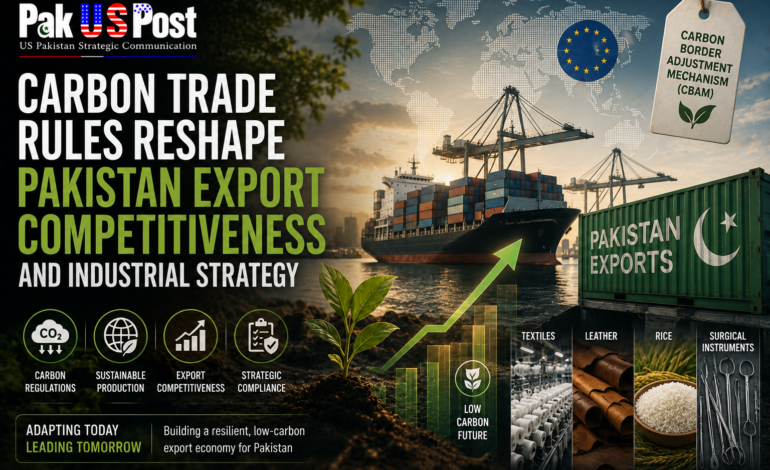
Carbon Trade Rules Reshape Pakistan Export Competitiveness and Industrial Strategy


Climate policy is no longer confined to environmental ministries, international conferences or sustainability declarations. It has entered customs administration, industrial regulation, financial disclosure and international trade policy with unprecedented force. The commercial geography of global exports is increasingly being determined not only by production costs, labour productivity or logistical efficiency but also by carbon intensity, environmental transparency and regulatory compliance. Advanced economies, led by the United States and the European Union, are progressively integrating climate governance into market access requirements, effectively transforming emissions performance into a determinant of commercial competitiveness.
For Pakistan, this transformation arrives at a delicate economic moment. Export diversification remains limited, industrial energy efficiency lags regional competitors, electricity generation continues to rely substantially upon carbon intensive sources and institutional capacity for emissions accounting remains fragmented. Simultaneously, Pakistan seeks expanded preferential access to advanced markets precisely as those markets redefine commercial eligibility through environmental standards rather than traditional tariff structures. The convergence of trade policy and climate regulation therefore represents both an emerging vulnerability and an overlooked strategic opportunity.
The debate surrounding Carbon Border Adjustment Mechanisms frequently focuses upon their environmental justification. Yet from a geopolitical perspective they represent something broader. They establish regulatory influence beyond national borders by extending domestic environmental standards into international supply chains. Exporters operating thousands of kilometres away increasingly find themselves complying with reporting frameworks, emissions verification protocols and sustainability certification systems designed within foreign regulatory jurisdictions. Climate governance thus becomes an instrument shaping international production networks without imposing conventional tariffs.
American policy illustrates this evolution despite pursuing a somewhat different pathway from Europe. Washington has prioritised industrial incentives, clean manufacturing investment, domestic supply chain resilience and strategic decarbonisation through legislation encouraging technological transformation. Simultaneously, environmental disclosure requirements, procurement standards, corporate sustainability reporting and sector specific regulations increasingly influence supplier selection throughout global value chains. American multinational corporations are embedding carbon reporting obligations into supplier contracts regardless of whether federal border carbon tariffs currently exist. Consequently, Pakistani exporters increasingly confront private sector climate requirements alongside evolving public regulation.
The distinction between mandatory regulation and commercial expectation continues narrowing. International retailers, apparel brands, agribusiness corporations, automotive manufacturers and technology firms increasingly require detailed environmental disclosures from suppliers before procurement decisions are finalised. Carbon accounting, renewable electricity utilisation, waste reduction strategies, water stewardship and emissions verification have become commercial credentials rather than voluntary environmental initiatives. Export competitiveness therefore extends beyond product quality and pricing into measurable environmental performance.
Pakistan’s export structure magnifies this challenge. Textiles remain the country’s largest export sector, generating substantial foreign exchange while employing millions across spinning, weaving, dyeing, garment manufacturing and associated industries. Yet textile production is simultaneously energy intensive, water intensive and environmentally scrutinised. International buyers increasingly demand lifecycle emissions calculations, renewable electricity sourcing, wastewater treatment verification, chemical compliance documentation and transparent environmental governance throughout production facilities.
Many Pakistani textile manufacturers have already invested in cleaner technologies, solar installations, wastewater treatment plants and international sustainability certifications. Nevertheless, adoption remains uneven. Large export oriented firms supplying premium international brands generally possess greater financial capacity and managerial expertise to satisfy evolving environmental requirements. Small and medium enterprises integrated within subcontracting networks frequently lack technical knowledge, investment capital and institutional support necessary for comprehensive carbon reporting or emissions reduction initiatives.
This divergence threatens to create a two tier industrial ecosystem. Larger exporters may preserve international market access through environmental modernisation while smaller producers risk exclusion from global supply chains despite competitive manufacturing capabilities. The resulting industrial concentration could reduce employment flexibility, weaken domestic supplier networks and increase economic disparities across manufacturing regions.
Agricultural exports confront equally complex pressures. International markets increasingly require evidence regarding sustainable cultivation practices, water efficiency, fertiliser management, pesticide regulation, biodiversity protection and greenhouse gas emissions associated with agricultural production. Pakistani rice, fruits, vegetables and processed food products increasingly compete within markets where environmental traceability influences purchasing decisions alongside traditional quality standards.
Climate related regulations also intersect with food security considerations. Water scarcity, changing precipitation patterns and rising temperatures already challenge agricultural productivity. Simultaneously, exporters must demonstrate responsible resource utilisation while adapting production systems to increasingly volatile climatic conditions. The combination creates a dual burden requiring environmental resilience domestically while satisfying regulatory expectations internationally.
Manufacturing sectors beyond textiles similarly confront evolving carbon considerations. Cement, steel, chemicals, ceramics and engineering industries exhibit relatively high emissions intensity due to energy consumption and industrial processes. These industries may encounter growing commercial disadvantages if international buyers increasingly favour lower carbon alternatives or if importing jurisdictions introduce emissions based border adjustments.
Energy policy therefore becomes inseparable from export strategy. Pakistan’s industrial competitiveness increasingly depends not merely upon electricity availability but upon electricity composition. Renewable generation, grid modernisation, natural gas utilisation, industrial electrification and distributed solar deployment directly influence export market access because embedded carbon emissions increasingly accompany products into international markets.
Carbon accounting itself presents a significant institutional challenge. Measuring emissions across industrial supply chains requires technical methodologies, internationally recognised standards, independent verification institutions and digital reporting systems capable of generating credible environmental data. Pakistan’s regulatory infrastructure remains underdeveloped in these areas. Multiple governmental agencies possess partial responsibilities regarding environmental regulation, industrial oversight, energy management and export promotion, yet coordination frequently remains limited.
Without credible emissions measurement, exporters may struggle to demonstrate compliance even where genuine environmental improvements have occurred. International markets increasingly demand verified information rather than general sustainability commitments. Data quality consequently becomes a commercial asset.
Institutional readiness extends beyond environmental ministries. Customs authorities require understanding of emerging climate related documentation requirements. Trade negotiators need expertise regarding environmental provisions within commercial agreements. Financial regulators increasingly encounter climate disclosure standards affecting banking, insurance and investment. Universities must develop specialised expertise in carbon accounting, industrial decarbonisation and environmental auditing. Technical education institutions require curricula supporting future sustainability professionals capable of serving domestic industries.
American policy developments deserve particular attention because the United States remains simultaneously a major export destination, technology leader and regulatory innovator. Washington’s industrial strategy increasingly encourages clean manufacturing, strategic mineral security, resilient supply chains and advanced industrial technologies supporting lower emissions production. American investment decisions increasingly incorporate environmental risk assessments alongside commercial analysis.
This creates opportunities for Pakistan if environmental modernisation aligns with broader industrial transformation. International investors seeking geographically diversified production networks increasingly evaluate renewable energy availability, regulatory predictability, environmental governance and sustainability performance before committing capital. Climate resilience therefore contributes directly to investment attractiveness rather than merely regulatory compliance.
Financial markets reinforce these dynamics. International banks, institutional investors and export credit agencies increasingly integrate environmental criteria into lending decisions. Companies demonstrating credible decarbonisation strategies often obtain improved financing conditions compared with firms facing unresolved environmental risks. Pakistani exporters consequently encounter climate considerations within commercial finance alongside trade regulation.
The challenge extends into logistics and transportation. Maritime shipping companies progressively adopt emissions reduction targets while international logistics providers introduce sustainability reporting requirements. Carbon intensity increasingly encompasses transportation networks, warehousing operations and supply chain management rather than factory production alone. Export competitiveness therefore depends upon integrated environmental performance across commercial ecosystems.
Technological innovation offers significant opportunities despite regulatory pressures. Digital monitoring systems enable real time energy management, emissions tracking and production optimisation. Artificial intelligence improves industrial efficiency while reducing resource consumption. Advanced manufacturing technologies minimise waste generation and improve operational precision. Renewable energy integration lowers long term operating costs while enhancing environmental performance.
Pakistan possesses considerable renewable energy potential capable of supporting industrial transformation. Solar irradiation, wind corridors and hydropower resources provide opportunities for cleaner electricity generation. Industrial clusters integrating renewable energy infrastructure may simultaneously improve export competitiveness, reduce energy costs and strengthen resilience against fossil fuel price volatility.
Nevertheless, technological adoption requires supportive policy frameworks. Individual firms frequently cannot finance comprehensive industrial modernisation independently, particularly amid constrained credit markets and macroeconomic uncertainty. Public policy must therefore catalyse private investment through regulatory clarity, financial incentives and institutional coordination.
Carbon accounting standards require national harmonisation. Multiple reporting methodologies risk creating administrative confusion while increasing compliance costs. Pakistan should establish internationally recognised national frameworks aligned with major export destinations without unnecessarily duplicating reporting requirements. Standardisation enhances credibility while reducing administrative burdens upon exporters.
Trade diplomacy assumes heightened strategic significance. Environmental regulations increasingly shape commercial negotiations alongside tariffs, quotas and investment provisions. Pakistani negotiators require sophisticated understanding of climate governance, industrial policy and international environmental law. Diplomatic engagement should emphasise equitable transition pathways recognising developmental realities while supporting legitimate environmental objectives.
International cooperation presents additional opportunities. American universities, research institutions, technology companies and development agencies increasingly support clean manufacturing, emissions monitoring, renewable energy integration and sustainable industrial development globally. Carefully structured partnerships could accelerate Pakistani technological capabilities without generating excessive strategic dependence.
Domestic regulatory credibility remains equally important. Environmental legislation frequently exists but enforcement capacity varies considerably across jurisdictions. Predictable implementation encourages industrial investment whereas inconsistent regulation generates uncertainty without delivering meaningful environmental improvements. Regulatory modernisation should therefore prioritise transparency, technical competence and institutional consistency rather than administrative expansion alone.
Industrial energy efficiency deserves particular emphasis because it simultaneously improves commercial competitiveness and environmental performance. Efficient machinery, process optimisation, waste heat recovery, advanced motors and digital energy management reduce production costs while lowering emissions intensity. Such investments frequently generate financial returns independent of climate regulation through improved operational productivity.
Small and medium enterprises require targeted assistance because they collectively represent substantial employment while possessing limited technical capacity. Shared environmental services, regional testing laboratories, subsidised technical advisory programmes and collaborative certification mechanisms could reduce compliance costs without weakening regulatory integrity.
Export promotion agencies should integrate sustainability advisory functions into commercial support services. Market intelligence increasingly requires analysis of environmental regulations alongside conventional trade statistics. Exporters need timely information regarding evolving reporting requirements, certification expectations and regulatory developments within destination markets.
Universities should establish interdisciplinary research programmes combining engineering, economics, environmental science, international trade and public policy. Carbon accounting, industrial ecology, sustainable manufacturing and climate finance represent emerging professional disciplines essential for future economic competitiveness. Human capital development ultimately determines institutional adaptability.
National security institutions should likewise recognise climate related trade regulations as strategic economic variables rather than purely environmental concerns. Export earnings finance defence modernisation, technological development and macroeconomic stability. Any sustained deterioration in international market access therefore possesses indirect implications for national resilience. Establishment planning increasingly requires integration of economic security, industrial competitiveness and environmental governance within broader strategic assessments.
Climate adaptation and industrial competitiveness should not be treated as separate policy domains. Water security influences agricultural exports. Energy resilience affects manufacturing productivity. Urban infrastructure determines logistics efficiency. Disaster preparedness protects industrial continuity. Integrated planning therefore produces cumulative economic benefits extending beyond environmental objectives alone.
Regional competition further intensifies these dynamics. South Asian and Southeast Asian exporters increasingly invest in renewable manufacturing, green certification and environmental compliance to preserve advanced market access. Countries demonstrating faster institutional adaptation may capture commercial opportunities previously available to slower reformers. Competitive advantage increasingly derives from governance quality as much as production economics.
The strategic question confronting Pakistan is therefore not whether climate related trade regulations will expand but whether domestic institutions can adapt before commercial disadvantages become entrenched. Waiting for universal international consensus risks surrendering market share to more responsive competitors. Conversely, proactive environmental modernisation may strengthen industrial resilience irrespective of external regulatory developments because resource efficiency, technological upgrading and cleaner production generate enduring productivity gains.
Policy should consequently prioritise establishing a National Carbon Accounting Authority integrating emissions measurement, verification and reporting across industrial sectors using internationally recognised methodologies. A Green Export Competitiveness Fund should provide concessional financing supporting renewable energy adoption, energy efficiency improvements, emissions monitoring technologies and environmental certification for export oriented industries. Industrial zones should progressively transition towards integrated renewable electricity infrastructure while digital monitoring systems enable transparent environmental reporting.
Trade diplomacy should incorporate dedicated climate commerce units capable of engaging American and European counterparts regarding emerging environmental regulations, technical assistance opportunities and transitional implementation arrangements. Universities should establish specialised professional programmes producing carbon accountants, environmental auditors, industrial sustainability engineers and climate policy analysts supporting national capacity development. Export promotion institutions should embed environmental advisory services within commercial assistance programmes while financial regulators encourage climate related disclosure standards enhancing international credibility.
Pakistan’s armed forces, strategic planning institutions and economic policymakers increasingly recognise that twenty first century national resilience depends upon technological competitiveness, industrial productivity and secure participation within global value chains. Environmental governance now intersects with each of these priorities. Carbon regulations should therefore be understood neither as temporary commercial irritants nor exclusively ecological concerns but as structural features of an evolving international economic order.
The countries that successfully integrate industrial competitiveness with credible environmental governance will define the next generation of global manufacturing leadership. Pakistan retains substantial advantages through entrepreneurial capacity, established export industries, favourable demographics and growing renewable energy potential. Realising these advantages requires treating climate compliance not as external conditionality but as an instrument for comprehensive industrial modernisation. Within the emerging architecture of international commerce, environmental credibility increasingly determines economic sovereignty, export resilience and strategic influence. The transition has already begun. The remaining question concerns whether Pakistan intends to participate as a rule taker or emerge as a competitive producer capable of thriving within the green economy that advanced markets are rapidly constructing.
A Public Service Message