
Synthetic Media, Diplomatic Stability, And Strategic Crisis Prevention

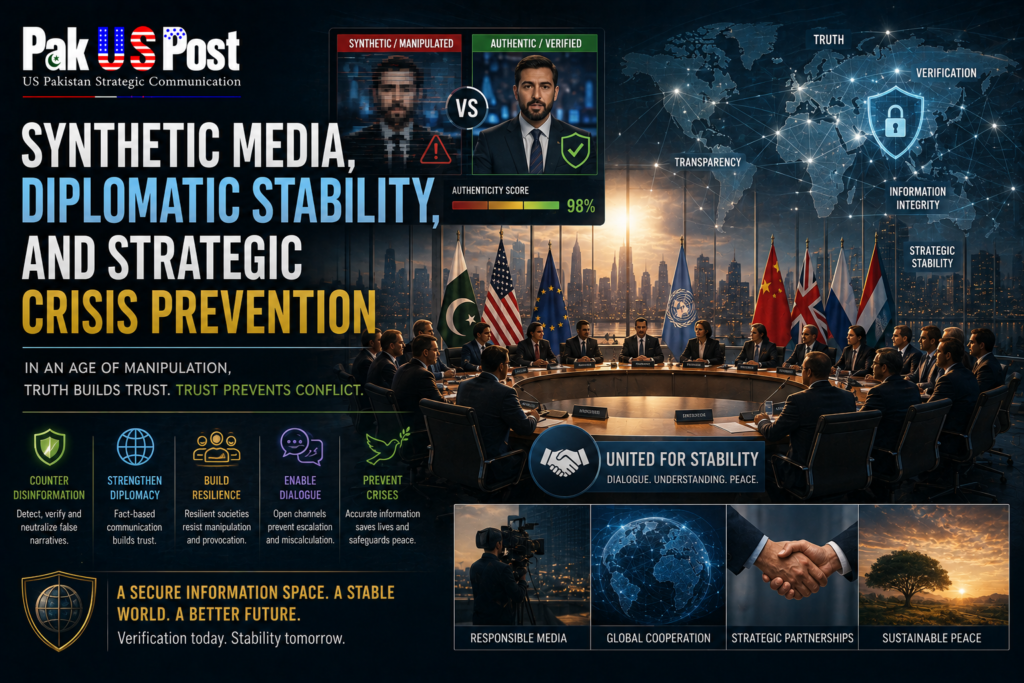
Diplomatic crises have historically emerged from intelligence failures, military miscalculations, political misperceptions and communication breakdowns. During the Cold War, governments invested enormous institutional effort in reducing uncertainty because policymakers recognised that false information could become as dangerous as deliberate aggression. The emergence of generative artificial intelligence has fundamentally altered that equation. Contemporary strategic competition increasingly unfolds inside digital ecosystems where fabricated reality can spread globally within minutes, often reaching political leaders, military personnel, financial institutions and international audiences simultaneously. Synthetic media has therefore evolved beyond a technological novelty into an emerging national security concern capable of reshaping diplomatic decision making.
Generative artificial intelligence has dramatically reduced the cost, complexity and accessibility of producing convincing synthetic video, cloned voices, fabricated documents and manipulated imagery. What previously required sophisticated intelligence capabilities can now be accomplished using commercially available software operated by individuals, criminal organisations, ideological networks or foreign influence actors. This democratisation of deception has expanded the number of potential participants capable of manufacturing diplomatic incidents while simultaneously reducing the time available for governments to distinguish truth from fabrication.
The implications for relations between Pakistan and the United States deserve serious institutional attention. The bilateral relationship already operates within a complex strategic environment influenced by regional security, counterterrorism cooperation, Afghanistan, emerging technologies, nuclear stability, economic engagement and shifting geopolitical alignments. Public narratives frequently evolve faster than official diplomatic exchanges. In such an environment, synthetic media introduces an additional layer of uncertainty capable of magnifying existing political sensitivities before professional verification mechanisms become operational.
Diplomatic signalling depends upon credibility. Governments communicate intentions through official statements, military deployments, intelligence disclosures, ambassadorial engagement and carefully calibrated public messaging. Deepfakes threaten every component of this signalling architecture. A fabricated video showing a senior political leader announcing military mobilisation, an artificial audio recording falsely declaring suspension of diplomatic relations or manipulated satellite imagery depicting fictional military deployments could generate immediate international reactions before authenticity is established.
The acceleration of information flows compounds this vulnerability. Traditional crisis management allowed hours or even days for intelligence validation. Contemporary digital platforms reward speed rather than accuracy. News organisations compete for immediacy, social media algorithms amplify emotionally charged content and automated recommendation systems distribute sensational material at unprecedented scale. Strategic adversaries increasingly recognise that manipulating information velocity may achieve greater operational impact than manipulating information quality.
Military establishments face particularly acute challenges. Modern command structures increasingly integrate open source intelligence alongside classified assessments. Artificial intelligence driven monitoring systems collect enormous volumes of publicly available information to support situational awareness. Synthetic media can contaminate these information streams, increasing analytical uncertainty precisely when commanders require clarity. False battlefield imagery, fabricated troop movements or manipulated communications could complicate operational assessments during periods of heightened regional tension.
Pakistan and the United States both maintain sophisticated military institutions, yet both remain exposed to cognitive manipulation conducted outside traditional intelligence channels. An artificial recording purporting to originate from senior military leadership could circulate widely before technical verification becomes available. Financial markets, diplomatic missions, foreign governments and domestic populations might react immediately, producing real world consequences despite the information being entirely fabricated.
The psychological dimension deserves equal consideration. Human cognition naturally prioritises emotionally compelling visual evidence over technical explanations. Deepfakes exploit this behavioural tendency by presenting fabricated events with apparent authenticity. Even after exposure, false narratives frequently retain influence because initial impressions shape subsequent interpretation. Crisis communication therefore becomes increasingly difficult once manipulated material achieves widespread circulation.
International misinformation campaigns have simultaneously become more coordinated. Rather than relying upon isolated pieces of fabricated content, hostile actors increasingly construct integrated influence operations combining artificial intelligence generated articles, synthetic interviews, cloned official statements, manipulated videos, coordinated social media activity and automated amplification networks. The objective extends beyond persuading audiences to believe specific falsehoods. Instead, campaigns seek to undermine confidence in every source of information, creating strategic ambiguity that weakens institutional authority.
This erosion of informational trust carries significant diplomatic implications. Governments rely upon public confidence during periods of crisis. Citizens must believe official statements sufficiently to avoid panic, financial instability or social disorder. When synthetic media systematically undermines institutional credibility, even accurate government communications may encounter widespread scepticism. Strategic competitors recognise that weakening confidence can become as valuable as spreading disinformation itself.
Pakistan confronts distinctive vulnerabilities arising from its evolving digital landscape. Internet penetration has expanded rapidly while social media increasingly influences political discourse, public opinion and media consumption. Digital literacy remains uneven across demographic groups, creating varying capacities to distinguish manipulated material from authentic reporting. Information spreads rapidly through encrypted messaging platforms where verification becomes considerably more difficult than within conventional media environments.
The American information ecosystem faces parallel challenges despite possessing greater technological resources. Political polarisation, fragmented media consumption and algorithmically personalised information environments have reduced consensus regarding trusted sources. Deepfakes therefore enter an already contested informational landscape where audiences often evaluate evidence through ideological rather than empirical frameworks. This environment complicates bilateral communication because fabricated narratives may acquire domestic political significance before diplomatic verification occurs.
Traditional journalism occupies a critical position within this evolving security environment. Professional verification standards remain indispensable, yet news organisations increasingly confront commercial pressures favouring rapid publication. Artificial intelligence generated material complicates editorial verification because manipulation frequently surpasses ordinary visual inspection. Journalists therefore require advanced forensic capabilities alongside traditional investigative methodologies.
Media verification systems must evolve accordingly. Digital watermarking, cryptographic authentication, provenance tracking, metadata preservation, blockchain supported content verification and artificial intelligence assisted forensic analysis collectively represent essential components of future information integrity infrastructure. None individually offers complete protection, yet integrated deployment substantially improves resilience against synthetic manipulation.
Legal preparedness remains uneven across jurisdictions. Existing legislation generally addresses defamation, cybercrime, fraud and electoral interference rather than sophisticated synthetic media targeting international diplomacy. Jurisdictional fragmentation further complicates enforcement because manipulated content often originates across multiple legal systems before circulating globally through decentralised digital platforms. International law has yet to establish comprehensive standards governing state responsibility for artificial intelligence enabled information warfare.
Pakistan’s legislative framework requires continued adaptation to address synthetic media without compromising constitutional protections concerning freedom of expression and legitimate political discourse. Overly broad regulatory measures risk suppressing authentic journalism while insufficient regulation permits hostile influence operations to expand unchecked. Policymakers therefore face the delicate challenge of balancing democratic openness with national security imperatives.
American regulatory debates reveal comparable complexity. Constitutional protections surrounding speech limit governmental intervention while technological innovation continues advancing faster than legislative processes. Consequently, institutional resilience increasingly depends upon collaborative partnerships involving government agencies, technology companies, research institutions, media organisations and civil society rather than purely regulatory approaches.
Strategic communication has consequently become an essential element of national defence. Governments must communicate rapidly, consistently and transparently during emerging crises. Delayed official responses create informational vacuums readily exploited by synthetic media campaigns. Conversely, premature statements lacking adequate verification risk undermining long term institutional credibility. Effective crisis communication therefore requires carefully rehearsed protocols balancing speed with evidentiary confidence.
Pakistan and the United States possess substantial opportunities for bilateral cooperation in this domain despite broader geopolitical differences. Technical collaboration concerning digital forensics, artificial intelligence governance, cyber resilience, crisis communication and information authentication directly supports mutual strategic stability. Such cooperation need not depend upon complete convergence across wider foreign policy priorities. Shared interest in preventing accidental escalation provides sufficient strategic rationale.
Military to military communication channels warrant particular strengthening. Existing deconfliction mechanisms primarily address physical military activities rather than digitally fabricated incidents. Future protocols should incorporate rapid authentication procedures enabling immediate verification of suspicious communications, videos, imagery or purported official statements. Dedicated technical liaison teams could significantly reduce uncertainty during periods of elevated tension.
Intelligence cooperation similarly requires modernisation. Intelligence agencies increasingly analyse synthetic media alongside conventional information operations. Shared technical methodologies for identifying manipulation, exchanging forensic indicators and assessing coordinated influence campaigns would improve collective situational awareness. Such cooperation remains sensitive but strategically valuable because fabricated crises rarely respect national boundaries.
Artificial intelligence itself offers defensive capabilities alongside offensive risks. Advanced machine learning systems increasingly detect inconsistencies within manipulated audio, visual artefacts, behavioural anomalies, facial biomechanics and digital provenance. Continuous investment in detection technologies therefore represents an essential national capability. Nevertheless, policymakers should avoid assuming technological solutions alone will permanently outpace manipulation techniques. Offensive and defensive artificial intelligence will likely continue evolving simultaneously.
Educational resilience deserves greater strategic emphasis. Public awareness concerning synthetic media substantially reduces manipulation effectiveness. Citizens familiar with artificial intelligence generated deception become less likely to disseminate unverified material during politically sensitive periods. Educational initiatives should therefore extend beyond technical specialists toward journalists, civil servants, military personnel, educators, financial institutions and ordinary citizens.
Universities can contribute significantly through interdisciplinary research integrating computer science, behavioural psychology, media studies, international relations, cybersecurity and law. Pakistan possesses expanding academic expertise capable of supporting national resilience provided sustained investment encourages collaborative research rather than isolated disciplinary approaches. American universities similarly continue pioneering synthetic media detection methodologies offering opportunities for academic partnership.
Technology companies occupy an equally consequential position. Platform governance increasingly influences international stability because algorithmic recommendation systems determine information visibility during rapidly evolving events. Transparent moderation standards, authenticated governmental communication channels, rapid forensic collaboration and coordinated response mechanisms should become integral components of responsible platform governance without undermining legitimate public debate.
Financial markets represent another overlooked vulnerability. Fabricated diplomatic announcements, manipulated sanctions declarations or artificial military escalation narratives can trigger significant capital market volatility before corrections emerge. Central banks, financial regulators and commercial institutions therefore require integrated verification mechanisms protecting economic stability against synthetic information shocks.
Critical infrastructure operators should likewise incorporate information authentication into broader resilience planning. Energy networks, telecommunications providers, transportation systems and emergency services increasingly depend upon reliable information flows during crises. Artificial intelligence generated misinformation targeting operational decision makers could disrupt essential services even without direct cyber intrusion.
Pakistan’s National Cyber Security architecture has traditionally prioritised technical network protection. Future institutional evolution should treat information integrity as an equally important security objective. Cybersecurity can no longer focus exclusively upon protecting hardware and software. Protecting cognitive decision environments has become an equally essential component of national resilience.
The establishment community faces distinctive responsibilities because military preparedness increasingly intersects with digital information security. Strategic planning should incorporate synthetic media scenarios into command exercises, crisis simulations and national contingency planning. Decision makers should regularly rehearse responses involving fabricated military announcements, manipulated diplomatic communications, artificial intelligence enabled influence operations and coordinated disinformation campaigns targeting civil military coordination.
Foreign ministries similarly require institutional adaptation. Diplomatic services traditionally concentrated upon state communications transmitted through recognised official channels. Contemporary diplomacy increasingly unfolds within contested digital environments where unofficial narratives frequently influence international perceptions before formal diplomatic engagement begins. Digital verification units equipped with advanced forensic capabilities should therefore become permanent components of diplomatic institutions.
International organisations also possess important roles. The United Nations, regional security organisations and multilateral technology forums increasingly recognise artificial intelligence governance as an international security priority. Norm development concerning synthetic media targeting diplomatic communications should become part of broader discussions regarding responsible state behaviour in cyberspace and artificial intelligence governance.
Strategic deterrence itself may gradually evolve. Just as nuclear powers developed communication mechanisms reducing accidental escalation, future digital deterrence may require internationally recognised verification standards, authenticated governmental communication infrastructure and cooperative forensic mechanisms capable of rapidly exposing fabricated diplomatic incidents. Preventing miscalculation increasingly depends upon preserving informational certainty alongside military stability.
The private sector constitutes another indispensable partner. Artificial intelligence developers, cybersecurity firms, telecommunications providers and digital authentication companies collectively possess technical expertise unavailable within government alone. Structured public private partnerships should therefore become permanent rather than crisis driven arrangements, enabling continuous technological adaptation as synthetic capabilities evolve.
Pakistan’s broader digital transformation agenda provides an opportunity to integrate information authenticity into emerging technological infrastructure from the outset rather than retrofitting protective measures after vulnerabilities become entrenched. Secure digital identity systems, authenticated governmental communications, trusted public broadcasting standards and advanced forensic laboratories collectively strengthen long term resilience while supporting broader digital modernisation objectives.
Relations between Pakistan and the United States increasingly extend beyond traditional security cooperation toward technology governance, digital commerce, cybersecurity and innovation partnerships. Synthetic media therefore represents not merely an emerging threat but a shared governance challenge requiring sustained institutional dialogue. Constructive engagement in this domain can generate practical cooperation even amid broader geopolitical disagreements because both governments possess a direct interest in preventing fabricated crises from destabilising bilateral relations.
The defining strategic challenge of the artificial intelligence era may ultimately concern trust rather than technology. Diplomatic stability depends upon confidence that official communications genuinely originate from recognised authorities, military signals accurately reflect operational intentions and public information retains verifiable authenticity. Preserving that confidence requires institutional innovation matching the pace of technological transformation. For Pakistan, the imperative extends beyond defending against misinformation. It requires constructing a comprehensive national information assurance architecture integrating intelligence, diplomacy, cybersecurity, journalism, legal reform, technological innovation, military preparedness and public communication into a coherent strategic capability capable of preventing synthetic deception from becoming the catalyst for genuine international confrontation.
A Public Service Message