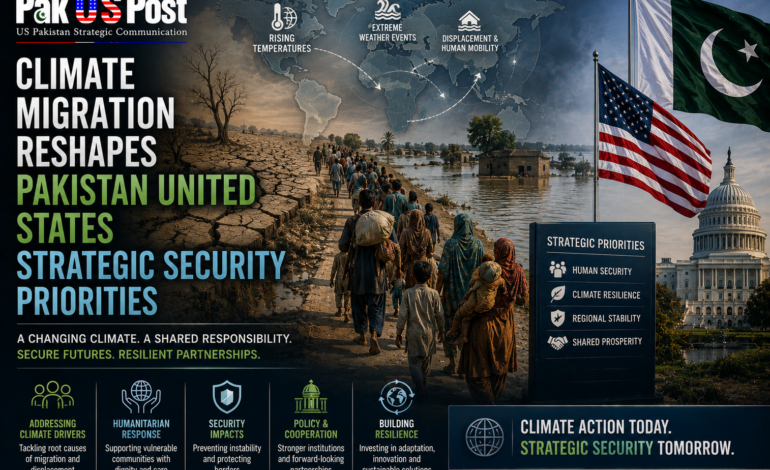
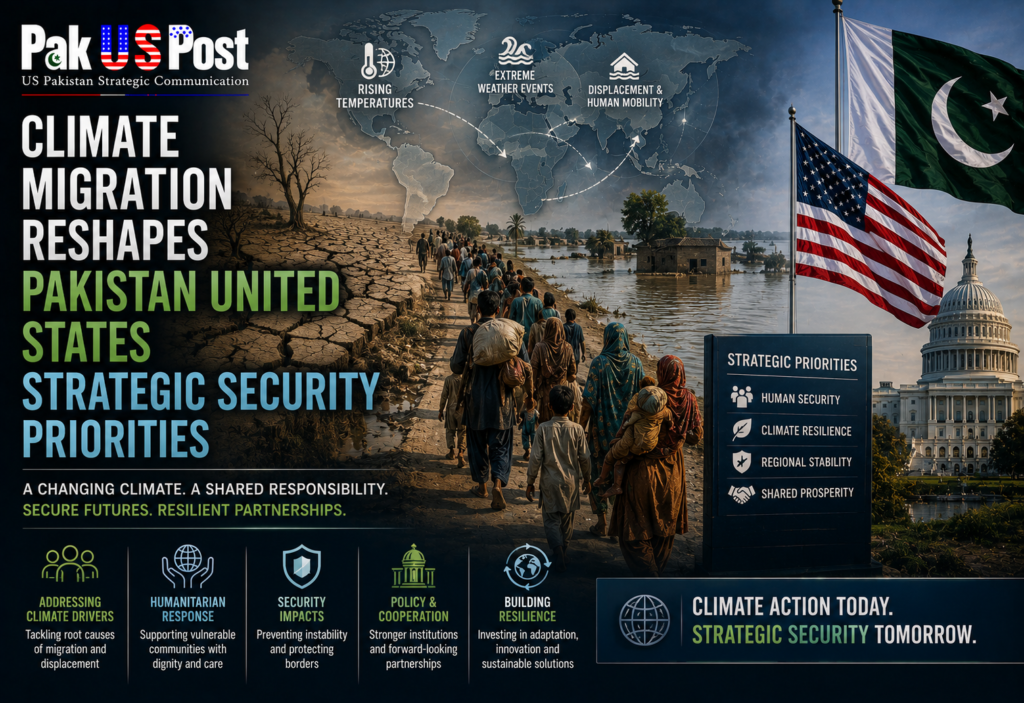
Climate Migration Reshapes Pakistan United States Strategic Security Priorities

Climate change has progressively moved beyond the traditional boundaries of environmental governance into the core architecture of national security, strategic planning and geopolitical stability. The distinction once separating humanitarian emergencies from defence calculations has narrowed considerably as prolonged droughts, catastrophic floods, glacial instability, agricultural disruption and accelerating urbanisation increasingly reshape demographic patterns across vulnerable states. Environmental displacement is no longer viewed merely as a developmental challenge. It is emerging as a strategic variable capable of influencing internal stability, border governance, economic resilience, public health, food security and regional diplomacy. For Pakistan and the United States, whose bilateral engagement has historically centred upon counterterrorism, regional security and economic cooperation, climate induced migration presents an opportunity to redefine strategic collaboration around resilience rather than crisis response.
Pakistan occupies one of the world’s most climate exposed geographies despite contributing only a marginal share of global greenhouse gas emissions. The interaction between Himalayan glacier retreat, erratic monsoon behaviour, declining groundwater reserves, heat stress, desertification and recurrent flooding has intensified pressures upon already constrained governance systems. The cumulative impact extends far beyond environmental degradation. It directly affects agricultural productivity, employment generation, provincial resource allocation, urban planning, energy reliability and national cohesion. Every climate shock generates secondary consequences that progressively alter security calculations across multiple institutions.
The devastating floods of recent years illustrated that environmental disasters no longer remain isolated humanitarian events. Millions of internally displaced citizens required emergency shelter, healthcare, livelihood assistance and infrastructure reconstruction. Transportation corridors suffered prolonged disruption while agricultural production experienced extensive losses. Educational institutions suspended operations, local administrations became overstretched and disease outbreaks complicated recovery efforts. Such crises demonstrated that environmental disasters rapidly evolve into governance emergencies requiring coordinated responses extending well beyond conventional disaster management authorities.
Climate migration introduces particularly complex security dynamics because population movement unfolds gradually before reaching visible crisis thresholds. Families facing repeated crop failures, declining irrigation reliability or livestock losses frequently migrate toward expanding urban centres rather than remaining within increasingly unproductive rural communities. These movements accumulate over years, altering demographic balances, labour markets, housing demand and municipal service delivery. Informal settlements expand without adequate infrastructure while competition over employment, water access and public services intensifies social pressures.
Karachi, Lahore, Faisalabad, Rawalpindi and other metropolitan centres increasingly absorb environmental migrants whose displacement stems less from armed conflict than from deteriorating ecological conditions. Municipal institutions frequently lack the financial resources, demographic forecasting tools and administrative flexibility necessary to accommodate sustained population inflows. Consequently, urban congestion, sanitation deficiencies, public health vulnerabilities and unemployment reinforce one another, creating conditions capable of generating broader political dissatisfaction and security concerns.
International strategic communities increasingly recognise that climate migration should not be analysed solely through humanitarian frameworks. Defence institutions across multiple countries have incorporated environmental risk assessments into long term strategic planning because climate shocks influence military readiness, infrastructure resilience, logistics planning, border management and civil emergency operations. Strategic planning now increasingly acknowledges that future crises may originate from cascading environmental failures rather than traditional interstate confrontation alone.
For Pakistan, integrating climate displacement into national security planning requires conceptual transformation. Environmental intelligence should become an institutional component of strategic assessments alongside conventional defence indicators. Hydrological monitoring, agricultural productivity forecasting, demographic mobility analysis and climate modelling should inform national security deliberations because ecological instability frequently precedes governance stress.
Water insecurity represents perhaps the most strategically consequential dimension of environmental migration. Pakistan’s dependence upon glacier fed river systems exposes national agriculture, energy production and food security to changing climatic conditions. Irregular precipitation patterns complicate irrigation planning while groundwater depletion reduces adaptive capacity across rural communities. Water scarcity simultaneously affects industrial productivity, household consumption and agricultural employment, increasing incentives for migration.
Climate related migration also possesses significant implications for provincial governance. Population redistribution alters fiscal requirements, electoral representation, public infrastructure demand and resource allocation mechanisms. Provinces experiencing substantial inward migration require expanded investments in healthcare, education, housing, policing, transport infrastructure and employment creation. Without integrated planning, demographic pressures risk widening governance disparities between regions.
Agricultural transformation further intensifies migration dynamics. Pakistan’s rural economy remains deeply dependent upon climate sensitive sectors including wheat, cotton, rice and livestock production. Rising temperatures, unpredictable rainfall and expanding pest prevalence reduce productivity while increasing production costs. Smaller farmers frequently possess limited financial resilience, compelling migration toward urban labour markets where employment opportunities often remain uncertain. The resulting rural depopulation simultaneously reduces agricultural sustainability and expands urban vulnerability.
Food security consequently becomes intertwined with strategic stability. Declining domestic agricultural productivity increases dependence upon international commodity markets already experiencing climate related volatility. Rising food prices disproportionately affect lower income households, contributing to inflationary pressures, fiscal burdens and social dissatisfaction. Food insecurity therefore evolves into a multidimensional governance challenge rather than simply an agricultural concern.
The Pakistan United States relationship offers considerable opportunities for expanding cooperation around climate resilience. Historically, bilateral engagement has prioritised defence cooperation, development assistance, counterterrorism and economic reform. Climate resilience increasingly provides a complementary strategic agenda capable of strengthening long term institutional partnerships while addressing shared concerns regarding regional stability, humanitarian preparedness and sustainable development.
The United States possesses advanced capabilities in climate science, satellite observation, disaster forecasting, hydrological modelling, agricultural innovation and environmental risk analytics. These technological strengths could substantially enhance Pakistan’s institutional capacity for anticipatory governance. Bilateral cooperation should increasingly emphasise predictive resilience rather than reactive emergency assistance.
Satellite based environmental monitoring provides one particularly promising avenue. Advanced remote sensing technologies enable continuous observation of water availability, glacier movement, vegetation health, land degradation and population mobility. Integrating such information into Pakistan’s planning institutions would improve early warning systems supporting agriculture, disaster management and national security decision making simultaneously.
Climate finance constitutes another essential dimension of bilateral cooperation. Pakistan requires extensive investment to strengthen water infrastructure, climate resilient agriculture, renewable energy systems, flood protection, urban resilience and ecological restoration. Accessing international financing increasingly depends upon transparent governance frameworks, credible project management and institutional accountability. Cooperation with American development institutions and international financial organisations could strengthen implementation capacity while expanding investment confidence.
Institutions including the International Monetary Fund increasingly recognise climate vulnerability as a macroeconomic stability issue rather than solely an environmental concern. Climate disasters weaken fiscal sustainability through reconstruction expenditures, declining tax revenues, infrastructure losses and reduced agricultural output. Consequently, macroeconomic reform, fiscal resilience and climate adaptation increasingly converge within broader development planning. Pakistan’s engagement with international financial institutions should therefore integrate climate resilience into economic stabilisation strategies rather than treating environmental investment as a peripheral expenditure.
Urban governance represents another strategic priority requiring bilateral knowledge exchange. American experience in metropolitan planning, digital infrastructure management, geographic information systems, emergency communication and resilient public utilities offers practical lessons adaptable to Pakistani conditions. Urban resilience planning should incorporate demographic forecasting, climate exposure mapping, infrastructure redundancy and public health preparedness into comprehensive municipal governance frameworks.
Environmental displacement additionally intersects with public health security. Climate migration frequently accelerates disease transmission through overcrowded settlements, inadequate sanitation, contaminated water supplies and constrained healthcare access. Heatwaves, vector borne diseases and malnutrition further compound vulnerabilities. Public health institutions therefore require integration into broader national resilience planning rather than operating independently from disaster management and security agencies.
Military institutions increasingly perform humanitarian support functions during major environmental emergencies. Pakistan’s armed forces possess substantial logistical capabilities, engineering expertise and rapid deployment capacity demonstrated during previous disaster responses. However, expanding climate emergencies necessitate institutional adaptation emphasising prepositioned resources, resilient infrastructure, interoperable communications and specialised environmental contingency planning.
Defence planning should therefore incorporate environmental scenario simulations examining infrastructure disruption, internal displacement, logistics constraints and critical supply chain continuity. Such exercises would improve preparedness without redefining military institutions as primary humanitarian actors. Civilian leadership should remain central while defence capabilities provide strategic support under clearly established coordination mechanisms.
Border governance also requires reconsideration within climate security frameworks. Environmental pressures affecting neighbouring regions may gradually influence migration patterns, cross border resource competition and humanitarian coordination requirements. Effective border management increasingly depends upon integrated intelligence, humanitarian preparedness and regional diplomatic engagement rather than exclusively physical security measures.
Climate resilience likewise influences economic competitiveness. Investors increasingly evaluate environmental governance, infrastructure resilience and sustainability standards when assessing long term investment destinations. Countries demonstrating effective climate adaptation strengthen confidence among international financial institutions, multinational corporations and development partners. Environmental resilience therefore contributes directly to economic diplomacy.
Educational institutions possess equally significant responsibilities. Universities should expand interdisciplinary research connecting climate science, economics, security studies, engineering, public administration and urban planning. Evidence based policymaking requires sustained domestic research capacity capable of informing strategic decisions with locally generated data rather than excessive dependence upon external assessments.
Data governance represents another institutional priority. Pakistan currently maintains valuable information across meteorological agencies, agricultural departments, provincial authorities, disaster management institutions and census organisations. However, fragmented databases frequently limit integrated analysis. Establishing a national environmental intelligence platform capable of consolidating hydrological, demographic, agricultural, infrastructure and climate information would substantially improve strategic planning.
Artificial intelligence and advanced analytics increasingly enable predictive governance. Machine learning applications can identify migration trends, forecast agricultural stress, optimise water allocation and improve disaster preparedness. Pakistan should expand digital partnerships supporting responsible adoption of these technologies while strengthening domestic analytical capabilities.
Public communication remains fundamental to resilience. Climate misinformation, inaccurate disaster reporting and inconsistent institutional messaging undermine public confidence during emergencies. Strategic communication frameworks should emphasise transparency, scientific credibility and timely dissemination of verified information. Public trust significantly enhances compliance with evacuation orders, resource conservation measures and recovery initiatives.
The private sector similarly constitutes an indispensable stakeholder. Insurance markets, financial institutions, agricultural enterprises, telecommunications companies and infrastructure operators collectively influence national resilience. Public private partnerships should encourage climate resilient investment through regulatory incentives, blended financing mechanisms and technological innovation.
Provincial coordination requires equal attention. Environmental challenges disregard administrative boundaries while governance responsibilities frequently remain fragmented across federal, provincial and local institutions. Establishing permanent intergovernmental coordination mechanisms focused upon environmental security would improve policy coherence and resource allocation.
Pakistan should additionally institutionalise climate risk assessments within national development planning. Every major infrastructure investment, industrial project and urban expansion initiative should undergo environmental resilience evaluation incorporating future climatic projections rather than historical conditions alone. Strategic planning must anticipate evolving risks instead of merely responding to previous disasters.
The bilateral Pakistan United States agenda could further expand through joint professional exchanges linking defence colleges, emergency management agencies, agricultural research institutions, hydrological authorities, universities and urban planning organisations. Such cooperation would deepen institutional familiarity while generating practical policy innovations grounded in operational experience.
Regional diplomacy should likewise integrate environmental cooperation despite broader geopolitical complexities. Shared river systems, glacier monitoring, disaster forecasting and scientific collaboration offer confidence building opportunities capable of complementing traditional diplomatic engagement. Environmental security frequently creates space for technical cooperation even where broader political disagreements persist.
National resilience ultimately depends less upon responding effectively after disasters than upon anticipating systemic risks before they mature into crises. Environmental displacement exemplifies a slow moving strategic challenge whose consequences accumulate gradually before becoming politically visible. Institutions designed primarily for immediate emergency response require transformation toward predictive governance supported by integrated intelligence, scientific expertise and coordinated policymaking.
Pakistan stands at an important strategic juncture. Climate migration is no longer a hypothetical future concern but an evolving structural reality influencing governance, economic performance, demographic distribution and national security simultaneously. Integrating environmental risk into strategic planning would strengthen institutional resilience while improving policy coherence across defence, development, finance, agriculture and urban governance. For the Pakistan United States partnership, climate resilience offers a forward looking strategic agenda aligned with shared interests in regional stability, sustainable development and institutional capacity. The most effective security architecture of the coming decades will not be measured solely by conventional military preparedness but by the ability of states to anticipate environmental disruption, protect vulnerable populations, preserve economic continuity and sustain public confidence under increasingly complex climatic conditions. Such preparedness will determine strategic resilience as decisively as traditional defence capabilities in an era where ecological instability increasingly shapes geopolitical realities.
A Public Service Message