Domestic Political Ramifications of Pakistan–United States Policy Moves

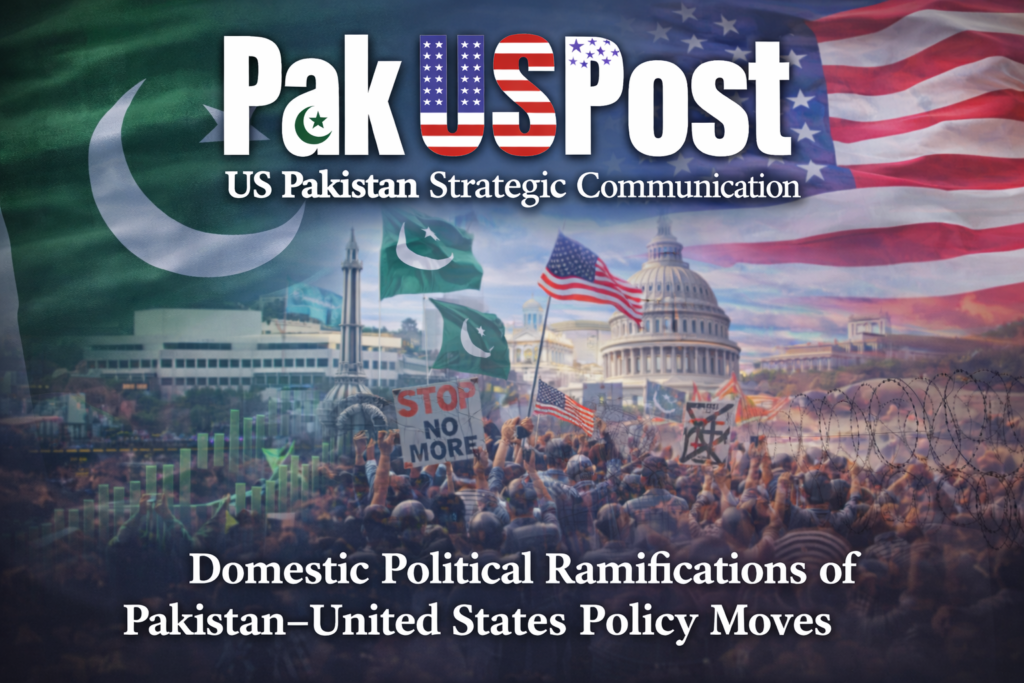
In the past year, the evolving engagement between Pakistan and the United States has begun to produce discernible political reverberations within both countries, shaping internal debates, recalibrating elite consensus, and influencing the broader contours of governance and institutional interaction. The latest phase of Pakistan–United States policy interaction is no longer confined to foreign policy circles or strategic communities; instead, it is increasingly embedded in domestic political discourse where competing narratives, institutional interests, and electoral considerations intersect. This transformation reflects a deeper reality of contemporary international relations, where external alignments and diplomatic engagements are inseparable from internal political legitimacy, governance structures, and public perception. As both Islamabad and Washington navigate this recalibrated relationship, domestic political dynamics in each capital are becoming both a driver and a constraint in shaping the trajectory of bilateral engagement.
In Pakistan, the renewed interaction with the United States has entered a politically sensitive environment characterized by shifting civil military relations, evolving party competition, and a heightened awareness of sovereignty narratives. Political parties across the spectrum have responded to recent policy moves with varying degrees of support, caution, and critique, reflecting their ideological positioning as well as their strategic calculations. For some segments of the political elite, engagement with Washington is viewed through a pragmatic lens as an opportunity to stabilize the economy, enhance diplomatic leverage, and secure access to global markets and institutions. This perspective emphasizes the instrumental value of the relationship, focusing on tangible outcomes such as investment inflows, financial support, and strategic relevance. At the same time, other political actors frame the engagement within a more critical discourse that highlights concerns about external influence, policy conditionality, and the historical asymmetry of the relationship. These competing narratives are not merely rhetorical; they shape parliamentary debates, media discussions, and the broader political climate in which foreign policy decisions are evaluated.
The role of Pakistan’s military establishment remains central in mediating the domestic political implications of engagement with the United States. Historically, security cooperation with Washington has been closely linked to military institutions, and the current phase of recalibration continues to reflect this dynamic, albeit in a more nuanced form. The military’s support for selective engagement, particularly in areas of counterterrorism and strategic stability, influences the extent to which civilian leadership can pursue broader policy initiatives with Washington. At the same time, the military is increasingly attentive to public sentiment and political narratives, recognizing that overt alignment with external powers can generate domestic backlash if not carefully managed. This has resulted in a calibrated approach where engagement is pursued with a degree of discretion, emphasizing national interest and strategic autonomy while maintaining functional cooperation.
Civilian institutions in Pakistan, including parliament and the executive, play an important role in shaping the policy discourse surrounding Pakistan–United States relations. Legislative oversight mechanisms, though evolving, provide a forum for debate on the implications of bilateral agreements, particularly in areas such as trade, security cooperation, and development assistance. Parliamentary committees and policy forums have increasingly engaged with questions related to transparency, accountability, and the long term impact of external partnerships. This reflects a gradual institutionalization of foreign policy oversight, where decisions are subject to scrutiny not only from within the executive but also from broader political stakeholders. However, the effectiveness of these mechanisms varies, influenced by political polarization, capacity constraints, and the complex interplay between civilian and military authority.
Electoral considerations further complicate the domestic political landscape in Pakistan. Political parties often calibrate their positions on foreign policy issues, including relations with the United States, based on their electoral constituencies and strategic messaging. In periods of political contestation, narratives around sovereignty, national dignity, and external influence can become central themes in campaign rhetoric. Engagement with Washington, therefore, is not merely a policy choice but also a political signal that carries implications for public perception and voter alignment. Parties may adopt differentiated positions, with some emphasizing the economic and strategic benefits of cooperation while others highlight risks associated with dependency or external pressure. This dynamic creates a fluid political environment in which foreign policy decisions are closely intertwined with domestic political strategy.
In the United States, the domestic political ramifications of engagement with Pakistan are shaped by a different but equally complex set of factors. The recalibrated relationship is situated within a broader foreign policy framework that prioritizes strategic competition, economic resilience, and selective engagement with regional partners. Within this context, Pakistan is not at the forefront of U.S. domestic political debate, yet it occupies a relevant space in discussions related to counterterrorism, regional stability, and the management of post Afghanistan security challenges. Policymakers in Washington approach engagement with Pakistan through a pragmatic lens, balancing the need for cooperation with concerns related to governance, accountability, and long term strategic alignment.
Congressional oversight plays a critical role in shaping the parameters of Pakistan–United States engagement. Legislative bodies in the United States exercise authority over foreign assistance, security cooperation, and trade policy, thereby influencing the scope and sustainability of bilateral initiatives. Debates within Congress often reflect a combination of strategic considerations and normative concerns, including issues related to human rights, democratic governance, and the use of external assistance. These debates can shape the conditions under which engagement is pursued, affecting funding allocations, program design, and policy priorities. While there is recognition of Pakistan’s strategic relevance, there is also an emphasis on ensuring that engagement aligns with broader U.S. values and interests.
The executive branch in Washington, including the State Department and the Department of Defense, plays a central role in operationalizing the recalibrated engagement with Pakistan. Policy decisions are influenced by assessments of regional dynamics, threat perceptions, and the broader strategic environment. Engagement with Pakistan is often framed within the context of managing risks associated with instability in Afghanistan, maintaining situational awareness in South Asia, and preserving channels of communication with key regional actors. This approach reflects a pragmatic understanding of Pakistan’s role as a geographically and strategically significant state, even as the United States prioritizes other regions and partnerships within its global strategy.
Think tanks and policy communities in the United States contribute to shaping the discourse حول Pakistan–United States relations by providing analysis, recommendations, and critiques of policy approaches. These institutions play an important role in informing policymakers, framing public debate, and generating intellectual frameworks that guide engagement. Discussions within these circles often emphasize the need for a balanced approach that recognizes Pakistan’s strategic importance while addressing concerns related to governance, economic stability, and regional behavior. The diversity of perspectives within the policy community reflects the complexity of the relationship and underscores the importance of nuanced analysis in shaping effective policy.
Media narratives in the United States also influence the domestic political context of engagement with Pakistan. Coverage of Pakistan tends to focus on issues related to security, regional stability, and political developments within the country. While not a dominant topic in mainstream media, Pakistan appears in discussions related to broader geopolitical themes, including counterterrorism, relations with China, and developments in Afghanistan. Media framing can shape public perception and influence the political environment in which policy decisions are made, particularly when issues gain prominence due to specific events or developments.
The interaction between domestic political dynamics in Pakistan and the United States creates a complex environment for bilateral engagement. Policy moves that are perceived positively in one country may generate skepticism or critique in the other, reflecting differences in political culture, strategic priorities, and public expectations. Managing this interaction requires a careful balancing of communication, transparency, and policy design to ensure that initiatives are understood and supported within both domestic contexts. This is particularly important in areas such as economic cooperation, security engagement, and development assistance, where public perception can influence the sustainability and effectiveness of policy initiatives.
The civil military equilibrium in Pakistan represents a critical factor in shaping the domestic political ramifications of engagement with the United States. The distribution of authority between civilian leadership and military institutions influences decision making processes, policy priorities, and the implementation of bilateral initiatives. While civilian governments are responsible for articulating foreign policy, the military’s role in security matters and its historical engagement with the United States give it significant influence in shaping outcomes. The current phase of recalibration reflects an effort to balance these dynamics, with both civilian and military actors contributing to a coordinated approach that aligns with national interests.
Inter institutional debates within Pakistan further shape the domestic political landscape. Government ministries, regulatory bodies, and policy institutions engage in discussions حول the implications of engagement with the United States, particularly in areas such as trade, technology, and governance. These debates reflect the complexity of integrating external partnerships into domestic policy frameworks, where competing priorities and institutional mandates must be reconciled. Effective coordination among these institutions is essential for ensuring that policy initiatives are implemented efficiently and produce intended outcomes.
Public opinion in Pakistan plays a significant role in shaping the political environment surrounding Pakistan–United States relations. Historical experiences, media narratives, and contemporary developments influence how the public perceives engagement with Washington. While there is recognition of the potential benefits of cooperation, including economic opportunities and strategic relevance, there is also a degree of skepticism rooted in concerns about sovereignty and external influence. Political leaders must navigate these perceptions carefully, balancing the need for engagement with the imperative of maintaining public trust and legitimacy.
In the United States, public opinion regarding Pakistan is less pronounced but still relevant in shaping the broader political context. Perceptions are influenced by media coverage, policy debates, and historical narratives related to security cooperation and regional dynamics. While Pakistan does not occupy a central place in U.S. public discourse, shifts in perception can influence political support for engagement, particularly in areas involving security cooperation or financial assistance. Policymakers must therefore consider domestic sensitivities when designing and implementing policy initiatives.
The evolving political dynamics in both countries highlight the importance of institutional resilience and policy continuity in sustaining bilateral engagement. Changes in political leadership, electoral cycles, and shifts in public sentiment can influence the trajectory of the relationship, creating uncertainties that must be managed through consistent communication and long term planning. Building institutional frameworks that transcend individual administrations can help ensure that engagement remains stable and effective, even in the face of political change.
At a broader level, the domestic political ramifications of Pakistan–United States policy moves reflect the interconnected nature of modern governance, where external and internal factors are deeply intertwined. The recalibrated relationship offers opportunities for both countries to advance their strategic interests, but it also requires careful management of domestic dynamics to ensure that these opportunities are realized. This involves balancing competing narratives, addressing concerns related to sovereignty and governance, and fostering a political environment that supports constructive engagement.
Looking ahead, the future of Pakistan–United States relations will depend not only on strategic alignment at the international level but also on the ability of both countries to manage domestic political considerations effectively. This requires a nuanced understanding of the interplay between foreign policy and domestic politics, as well as a commitment to transparency, accountability, and inclusive decision making. By addressing these challenges, both Islamabad and Washington can build a more sustainable and mutually beneficial partnership that reflects the realities of a changing global landscape.
In conclusion, the domestic political ramifications of recent Pakistan–United States policy moves underscore the complexity of modern bilateral relations, where strategic engagement is inseparable from internal political dynamics. The interplay of political narratives, institutional roles, electoral considerations, and public perception shapes the environment in which policy decisions are made and implemented. As both countries navigate this evolving relationship, the ability to manage domestic dynamics will be critical in determining the success and sustainability of their engagement.
A Public Service Message