
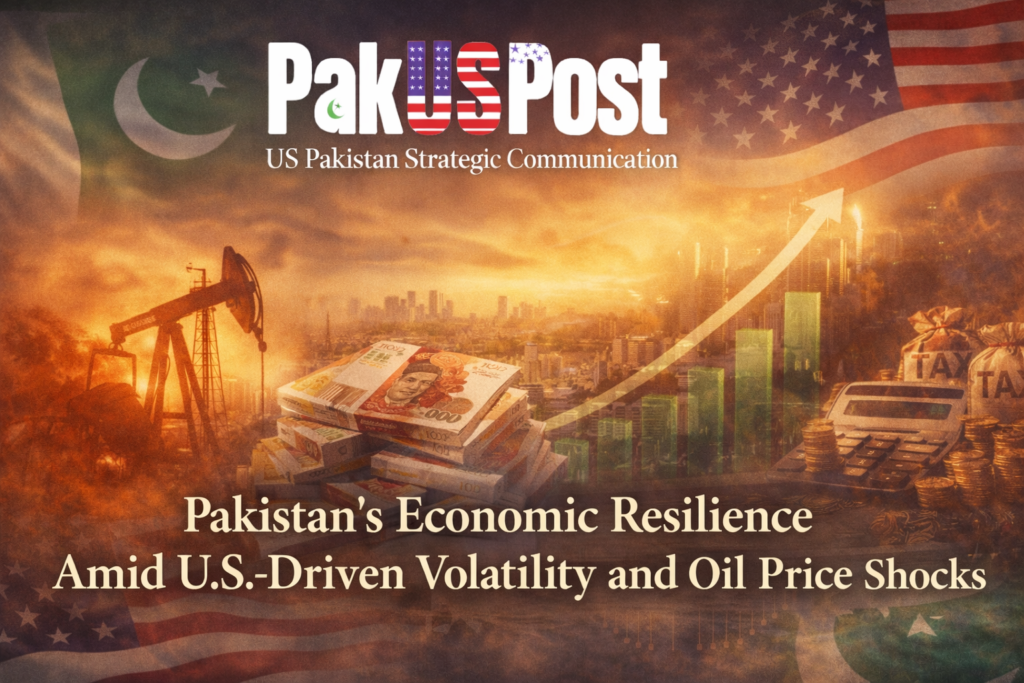
Pakistan’s Economic Resilience Amid U.S.-Driven Volatility and Oil Price Shocks

The global economic environment is undergoing unprecedented turbulence, shaped by fluctuating energy prices, shifting U.S. policy postures, and cascading effects on financial markets worldwide. For Pakistan, a nation with deep economic interlinkages to the Gulf and significant reliance on imported energy, the consequences of these disruptions are immediate, profound, and multifaceted. Rising oil prices, inflationary pressures, and the potential recalibration of U.S.-led international economic frameworks, including conditionalities tied to IMF programs, necessitate a strategic, forward-looking, and multidimensional response to safeguard national economic stability and seize emerging opportunities. The challenge is not merely reactive fiscal management but the formulation of an integrated policy framework that converts global volatility into avenues for strategic advantage.
Energy dependence constitutes the most visible and pressing vulnerability. Pakistan imports the majority of its oil and gas from external suppliers, including Gulf states, and disruptions in global supply chains or price spikes directly translate into domestic inflation, increased fiscal deficits, and external account pressures. The doubling of oil prices or sudden price volatility, often triggered by geopolitical shocks or U.S. policy shifts, disproportionately affects Pakistan’s macroeconomic equilibrium. Industrial production, transportation, and electricity generation face higher input costs, while households bear the brunt of energy-related inflation, which erodes disposable income and constrains consumption. Strategic energy planning, diversification of supply sources, and the negotiation of long-term preferential contracts are therefore central to shielding Pakistan from destabilizing shocks.
Beyond energy, Pakistan’s engagement with international financial institutions, particularly the IMF, is acutely affected by global economic volatility. IMF programs, which often provide lifelines for balance of payments stability, are conditioned on structural reforms and fiscal discipline. Rising oil prices increase import bills, necessitate larger subsidies or fiscal transfers, and complicate adherence to IMF targets. Pakistan’s ability to negotiate program modifications, secure flexible disbursement schedules, and integrate contingency planning into fiscal policy is critical. Strategic engagement with multilateral institutions must be proactive, leveraging Pakistan’s role as a key regional actor and its position at the nexus of energy flows, trade corridors, and strategic partnerships to achieve favorable terms that safeguard domestic economic priorities.
Remittances and labor exports constitute a parallel economic vector vulnerable to U.S.-driven economic instability. Pakistani workers in the Gulf contribute significantly to foreign exchange inflows, but fluctuations in regional employment conditions, currency volatility, or geopolitical tensions can reduce remittance flows, compounding fiscal pressures. Ensuring continuity in labor exports requires proactive labor diplomacy, legal protections, and financial mechanisms that facilitate stable transfers, thereby insulating Pakistan’s economy from external shocks. These measures must be integrated into broader economic planning to maintain consumption, social stability, and capital inflows.
Trade dynamics are similarly exposed to U.S.-influenced global volatility. Pakistan’s export sectors, including textiles, agriculture, and emerging industries, depend on predictable access to international markets, favorable financing, and trade facilitation. Disruptions caused by oil price shocks, economic sanctions, or shifts in U.S. policy frameworks can affect both demand and competitiveness. Pakistan must adopt adaptive trade strategies, including diversification of export destinations, negotiation of preferential trade agreements, and alignment with emerging regional markets, to mitigate risks while maximizing revenue generation. Integration of trade policy with energy security and fiscal planning amplifies national resilience.
Fiscal and monetary policy form the backbone of economic stability in this context. Central banking authorities must employ tools such as interest rate management, hedging against oil price volatility, strategic reserve allocation, and targeted subsidies to buffer the economy from shocks. Simultaneously, government fiscal policy must prioritize efficient expenditure allocation, revenue mobilization, and the reduction of structural deficits that are exacerbated by rising import bills. Coordination between monetary and fiscal authorities ensures that interventions are timely, calibrated, and effective in maintaining macroeconomic equilibrium.
The challenge of inflation is compounded by imported price shocks and domestic supply constraints. Rising energy costs directly feed into consumer prices, while disruptions in global supply chains create cascading effects across food, transportation, and industrial sectors. Pakistan must implement a combination of short-term stabilization measures, such as targeted subsidies or price smoothing mechanisms, alongside medium-term structural reforms to improve energy efficiency, domestic production capacity, and market competitiveness. A coherent strategy integrates inflation control with broader economic resilience, ensuring that social stability and growth are not compromised.
Debt sustainability is a critical consideration. External borrowing, whether from multilateral institutions, bilateral partners, or capital markets, is sensitive to global interest rate shifts, currency volatility, and investor confidence influenced by U.S. policy. Pakistan must adopt a disciplined approach to debt management, combining strategic refinancing, hedging, and proactive engagement with creditors to reduce vulnerability to exogenous shocks. A robust debt strategy ensures that fiscal capacity is preserved even in periods of high oil prices, economic volatility, or external uncertainty.
The strategic dimension of economic resilience extends beyond domestic stabilization to regional and international leverage. Pakistan can position itself as an indispensable intermediary in energy transit, trade facilitation, and economic coordination, leveraging its geographic location, port infrastructure, and connectivity through initiatives such as the China-Pakistan Economic Corridor. By offering stability in trade routes, energy flows, and investment channels, Pakistan can attract capital, diversify partnerships, and enhance bargaining power in negotiations with both Gulf states and global financial actors. This approach transforms exposure to external shocks into an avenue for influence and revenue generation.
Institutional capacity and governance are central to implementing these measures effectively. Economic resilience requires coordinated policy-making across ministries, financial institutions, and regulatory bodies. Scenario planning, real-time monitoring of global developments, and agile response mechanisms enable Pakistan to anticipate disruptions, respond decisively, and communicate policy effectively to domestic and international stakeholders. A culture of strategic foresight and operational discipline strengthens both economic and diplomatic credibility.
Finally, Pakistan’s approach must integrate energy diversification, fiscal prudence, and international diplomacy into a cohesive framework. Investment in renewable energy, indigenous production, and alternative energy sources reduces vulnerability to imported oil shocks, while engagement with IMF and other multilateral partners ensures access to financial buffers. Strategic diplomacy secures favorable terms for trade, investment, and energy cooperation, reinforcing domestic policy initiatives. By linking economic policy with strategic foreign engagement, Pakistan can navigate external volatility while safeguarding growth, stability, and long-term national interests.
In conclusion, rising global oil prices and U.S.-driven economic volatility present both immediate challenges and long-term strategic opportunities for Pakistan. By adopting an integrated economic strategy that combines energy security, fiscal discipline, trade diversification, institutional resilience, and proactive diplomacy, Pakistan can convert global uncertainty into a platform for strengthened national stability and enhanced regional influence. Success in this endeavor requires vision, agility, and coordination across policy, finance, and diplomacy. Pakistan’s ability to act decisively today will determine whether it remains vulnerable to external shocks or emerges as a resilient and strategically empowered actor in a volatile global economy.
A Public Service Message