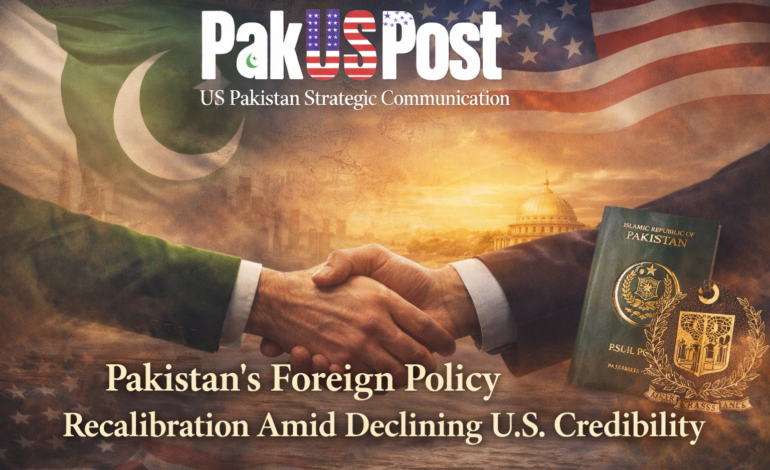
Pakistan’s Foreign Policy Recalibration Amid Declining U.S. Credibility


The international order in the twenty-first century is increasingly characterized by uncertainty, fluidity, and the erosion of long-standing guarantees once assumed to be durable. The United States, historically the anchor of global security, economic stability, and geopolitical influence in the Middle East and South Asia, faces both internal political volatility and strategic overstretch. In the context of prolonged instability across the Middle East, rising regional tensions, and shifting domestic political dynamics in Washington, Pakistan is confronted with the urgent need to recalibrate its foreign policy. The challenge is not merely one of reactive diplomacy but of strategic foresight: how to safeguard national interests, maintain regional credibility, and leverage emerging opportunities while navigating a landscape in which U.S. reliability is increasingly questioned.
Pakistan’s foreign policy has long been shaped by a combination of ideological alignment, strategic necessity, and economic pragmatism. The relationship with the United States, central to its security architecture and international positioning, has provided access to military assistance, economic support, and diplomatic backing on multiple fronts. However, the erosion of U.S. credibility, whether due to domestic political turbulence, policy reversals, or a retrenchment from the Middle East, necessitates a reassessment of assumptions underpinning Pakistan’s traditional foreign policy approach. Reliance on a singular external guarantor has historically created vulnerabilities, and the present juncture underscores the imperative for diversification, agility, and strategic autonomy.
The declining credibility of the United States in the eyes of regional actors and global observers introduces a dual challenge for Pakistan. On one hand, over-reliance on Washington risks entanglement in conflicts or diplomatic disputes that may not align with national priorities. On the other, abrupt disengagement from established U.S. partnerships without a coherent strategy could compromise economic, security, and geopolitical objectives. The solution lies in a calibrated foreign policy that balances continuity with adaptability, ensuring that Pakistan remains a trusted interlocutor for both traditional allies and emerging regional powers.
Geopolitically, Pakistan must enhance its role as a mediator and stabilizer, particularly in the context of Middle Eastern tensions and Gulf security. Washington’s retrenchment provides an opening for Islamabad to assert influence as a neutral actor capable of facilitating dialogue between Gulf monarchies, Iran, and other regional stakeholders. By leveraging historical ties, cultural affinities, and operational credibility, Pakistan can establish itself as a conduit for conflict de-escalation, confidence-building, and multilateral engagement. This approach reinforces national relevance while avoiding the perception of alignment with any single external power.
Diversification of partnerships is essential. Pakistan’s foreign policy recalibration should prioritize strengthening bilateral and multilateral relations beyond traditional reliance on the United States. Engagement with China, the European Union, regional powers such as Saudi Arabia and the United Arab Emirates, and emerging actors in Central and South Asia offers opportunities to broaden strategic options. These relationships can provide alternative sources of investment, security cooperation, and diplomatic support, enhancing Pakistan’s capacity to maneuver in a volatile international environment while preserving strategic autonomy.
Domestic economic imperatives are closely intertwined with foreign policy recalibration. U.S.-driven instability, sanctions regimes, and policy unpredictability have direct repercussions for Pakistan’s financial stability, trade access, and investment flows. A forward-looking foreign policy must integrate economic diplomacy, ensuring that bilateral and multilateral engagements support trade continuity, attract investment, and provide resilience against external shocks. This includes leveraging Pakistan’s role in energy corridors, trade facilitation, and infrastructure projects to secure tangible economic returns that reinforce strategic independence.
Strategic communication is a critical component of recalibrated foreign policy. Pakistan must articulate a coherent narrative that emphasizes neutrality, reliability, and constructive engagement. This narrative should be consistent across diplomatic channels, international forums, and domestic discourse, reinforcing Pakistan’s credibility as a principled actor capable of balancing competing regional and global interests. Clear messaging reduces the risk of misperception, builds trust among partners, and enhances Pakistan’s leverage in negotiations.
Security considerations remain central to foreign policy recalibration. The reliability of external partners has implications for defense planning, threat assessment, and crisis management. In the event of diminished U.S. presence or influence, Pakistan must reassess its security commitments, operational doctrines, and contingency plans. This includes enhancing indigenous capabilities, strengthening regional partnerships, and investing in intelligence-sharing mechanisms that provide situational awareness and rapid response capacity. The objective is to ensure that Pakistan’s security posture remains robust even amid uncertainty regarding external guarantees.
Multilateral engagement is a strategic lever that can amplify Pakistan’s influence and reduce dependence on any single power. Participation in regional organizations, international forums, and diplomatic initiatives allows Pakistan to shape discourse, build coalitions, and advocate for positions aligned with national interests. This approach enhances credibility, facilitates conflict prevention, and positions Pakistan as a proactive actor capable of shaping regional outcomes rather than merely reacting to them.
The recalibration also requires nuanced risk assessment. Aligning too closely with any emerging power bloc risks compromising neutrality, while overemphasizing disengagement from traditional partners may limit access to critical resources and diplomatic support. Pakistan’s strategy must therefore balance risk and opportunity, employing a diversified portfolio of partnerships, proactive engagement, and selective alignment that preserves maneuverability while maximizing influence.
Energy and economic interdependence remain central to foreign policy strategy. Rising global oil prices, volatility in financial markets, and potential disruptions in Gulf energy supply chains necessitate diplomatic initiatives that secure continuity of supply, favorable pricing, and alternative arrangements. Pakistan can leverage relationships with Gulf states, regional powers, and multilateral institutions to negotiate energy agreements that provide stability, support fiscal resilience, and underpin broader strategic objectives. This integration of economic and geopolitical considerations strengthens Pakistan’s position as a credible, reliable, and indispensable partner.
Ultimately, Pakistan’s foreign policy recalibration is about strategic foresight, proactive engagement, and principled neutrality. By enhancing its role as a mediator, diversifying partnerships, securing economic resilience, and maintaining a credible security posture, Pakistan can navigate the erosion of U.S. influence without compromising national interests. The ability to act decisively, communicate consistently, and integrate domestic priorities with regional and global strategy will determine whether Pakistan emerges as a stabilizing actor in an uncertain international order.
In conclusion, the decline of U.S. credibility in the Middle East is not merely a challenge but an opportunity for Pakistan to assert agency, enhance regional influence, and safeguard national interests. By adopting a multifaceted foreign policy that balances neutrality with proactive engagement, integrates security with economic imperatives, and diversifies partnerships while preserving strategic autonomy, Pakistan can transform a period of uncertainty into a platform for enhanced relevance, credibility, and long-term strategic advantage. The decisions made today will shape Pakistan’s geopolitical trajectory for decades, determining whether it remains a peripheral actor or becomes an indispensable architect of regional stability and resilience.The international order in the twenty-first century is increasingly characterized by uncertainty, fluidity, and the erosion of long-standing guarantees once assumed to be durable. The United States, historically the anchor of global security, economic stability, and geopolitical influence in the Middle East and South Asia, faces both internal political volatility and strategic overstretch. In the context of prolonged instability across the Middle East, rising regional tensions, and shifting domestic political dynamics in Washington, Pakistan is confronted with the urgent need to recalibrate its foreign policy. The challenge is not merely one of reactive diplomacy but of strategic foresight: how to safeguard national interests, maintain regional credibility, and leverage emerging opportunities while navigating a landscape in which U.S. reliability is increasingly questioned.
Pakistan’s foreign policy has long been shaped by a combination of ideological alignment, strategic necessity, and economic pragmatism. The relationship with the United States, central to its security architecture and international positioning, has provided access to military assistance, economic support, and diplomatic backing on multiple fronts. However, the erosion of U.S. credibility, whether due to domestic political turbulence, policy reversals, or a retrenchment from the Middle East, necessitates a reassessment of assumptions underpinning Pakistan’s traditional foreign policy approach. Reliance on a singular external guarantor has historically created vulnerabilities, and the present juncture underscores the imperative for diversification, agility, and strategic autonomy.
The declining credibility of the United States in the eyes of regional actors and global observers introduces a dual challenge for Pakistan. On one hand, over-reliance on Washington risks entanglement in conflicts or diplomatic disputes that may not align with national priorities. On the other, abrupt disengagement from established U.S. partnerships without a coherent strategy could compromise economic, security, and geopolitical objectives. The solution lies in a calibrated foreign policy that balances continuity with adaptability, ensuring that Pakistan remains a trusted interlocutor for both traditional allies and emerging regional powers.
Geopolitically, Pakistan must enhance its role as a mediator and stabilizer, particularly in the context of Middle Eastern tensions and Gulf security. Washington’s retrenchment provides an opening for Islamabad to assert influence as a neutral actor capable of facilitating dialogue between Gulf monarchies, Iran, and other regional stakeholders. By leveraging historical ties, cultural affinities, and operational credibility, Pakistan can establish itself as a conduit for conflict de-escalation, confidence-building, and multilateral engagement. This approach reinforces national relevance while avoiding the perception of alignment with any single external power.
Diversification of partnerships is essential. Pakistan’s foreign policy recalibration should prioritize strengthening bilateral and multilateral relations beyond traditional reliance on the United States. Engagement with China, the European Union, regional powers such as Saudi Arabia and the United Arab Emirates, and emerging actors in Central and South Asia offers opportunities to broaden strategic options. These relationships can provide alternative sources of investment, security cooperation, and diplomatic support, enhancing Pakistan’s capacity to maneuver in a volatile international environment while preserving strategic autonomy.
Domestic economic imperatives are closely intertwined with foreign policy recalibration. U.S.-driven instability, sanctions regimes, and policy unpredictability have direct repercussions for Pakistan’s financial stability, trade access, and investment flows. A forward-looking foreign policy must integrate economic diplomacy, ensuring that bilateral and multilateral engagements support trade continuity, attract investment, and provide resilience against external shocks. This includes leveraging Pakistan’s role in energy corridors, trade facilitation, and infrastructure projects to secure tangible economic returns that reinforce strategic independence.
Strategic communication is a critical component of recalibrated foreign policy. Pakistan must articulate a coherent narrative that emphasizes neutrality, reliability, and constructive engagement. This narrative should be consistent across diplomatic channels, international forums, and domestic discourse, reinforcing Pakistan’s credibility as a principled actor capable of balancing competing regional and global interests. Clear messaging reduces the risk of misperception, builds trust among partners, and enhances Pakistan’s leverage in negotiations.
Security considerations remain central to foreign policy recalibration. The reliability of external partners has implications for defense planning, threat assessment, and crisis management. In the event of diminished U.S. presence or influence, Pakistan must reassess its security commitments, operational doctrines, and contingency plans. This includes enhancing indigenous capabilities, strengthening regional partnerships, and investing in intelligence-sharing mechanisms that provide situational awareness and rapid response capacity. The objective is to ensure that Pakistan’s security posture remains robust even amid uncertainty regarding external guarantees.
Multilateral engagement is a strategic lever that can amplify Pakistan’s influence and reduce dependence on any single power. Participation in regional organizations, international forums, and diplomatic initiatives allows Pakistan to shape discourse, build coalitions, and advocate for positions aligned with national interests. This approach enhances credibility, facilitates conflict prevention, and positions Pakistan as a proactive actor capable of shaping regional outcomes rather than merely reacting to them.
The recalibration also requires nuanced risk assessment. Aligning too closely with any emerging power bloc risks compromising neutrality, while overemphasizing disengagement from traditional partners may limit access to critical resources and diplomatic support. Pakistan’s strategy must therefore balance risk and opportunity, employing a diversified portfolio of partnerships, proactive engagement, and selective alignment that preserves maneuverability while maximizing influence.
Energy and economic interdependence remain central to foreign policy strategy. Rising global oil prices, volatility in financial markets, and potential disruptions in Gulf energy supply chains necessitate diplomatic initiatives that secure continuity of supply, favorable pricing, and alternative arrangements. Pakistan can leverage relationships with Gulf states, regional powers, and multilateral institutions to negotiate energy agreements that provide stability, support fiscal resilience, and underpin broader strategic objectives. This integration of economic and geopolitical considerations strengthens Pakistan’s position as a credible, reliable, and indispensable partner.
Ultimately, Pakistan’s foreign policy recalibration is about strategic foresight, proactive engagement, and principled neutrality. By enhancing its role as a mediator, diversifying partnerships, securing economic resilience, and maintaining a credible security posture, Pakistan can navigate the erosion of U.S. influence without compromising national interests. The ability to act decisively, communicate consistently, and integrate domestic priorities with regional and global strategy will determine whether Pakistan emerges as a stabilizing actor in an uncertain international order.
In conclusion, the decline of U.S. credibility in the Middle East is not merely a challenge but an opportunity for Pakistan to assert agency, enhance regional influence, and safeguard national interests. By adopting a multifaceted foreign policy that balances neutrality with proactive engagement, integrates security with economic imperatives, and diversifies partnerships while preserving strategic autonomy, Pakistan can transform a period of uncertainty into a platform for enhanced relevance, credibility, and long-term strategic advantage. The decisions made today will shape Pakistan’s geopolitical trajectory for decades, determining whether it remains a peripheral actor or becomes an indispensable architect of regional stability and resilience.
A Public Service Message