
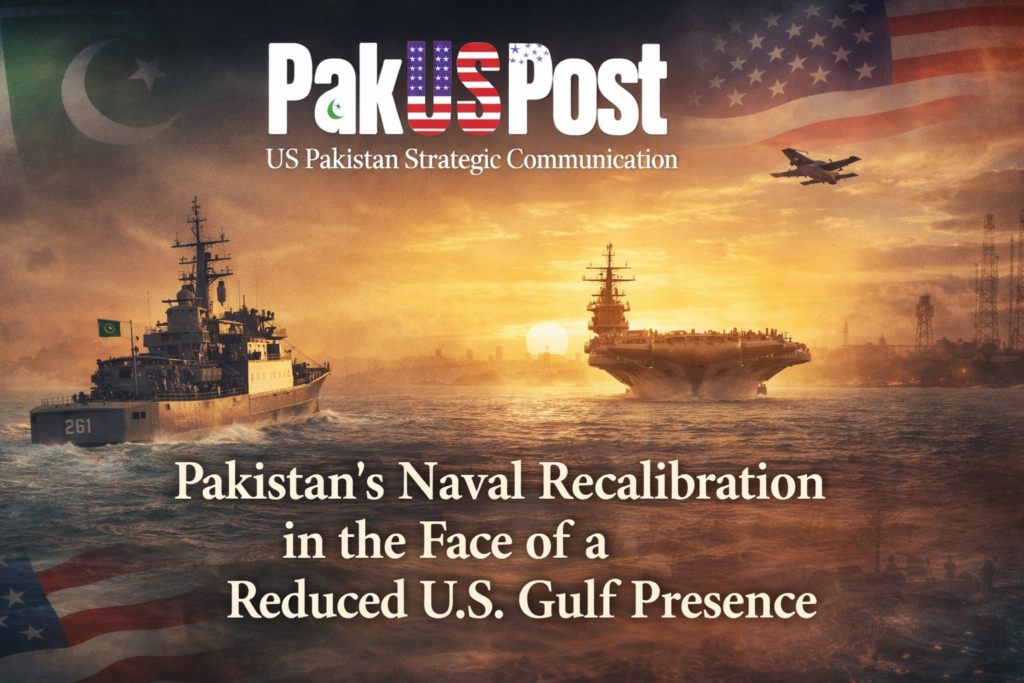
Pakistan’s Naval Recalibration in the Face of a Reduced U.S. Gulf Presence

The security architecture of the Persian Gulf and the broader Middle East has long depended on the presence of external actors, most prominently the United States Navy, whose operational footprint has provided a measure of deterrence and stability. Recent indications of a potential drawdown or reduction in the U.S. naval presence introduce both challenges and opportunities for Pakistan, whose strategic calculus must now adapt to a regional environment in which traditional external guarantees are diminishing. The shift compels Islamabad to reassess its naval doctrine, regional security strategy, and the role it can play in ensuring the stability of energy flows, maritime chokepoints, and regional trade corridors, all while safeguarding national interests and maintaining strategic flexibility.
Pakistan’s geographic positioning affords it a unique vantage point. The Arabian Sea, the approaches to the Strait of Hormuz, and proximity to the Gulf littoral confer both strategic responsibility and operational opportunity. A reduction in U.S. naval presence amplifies the relevance of regional actors capable of providing stabilization, and Pakistan, through its growing naval capabilities and strategic location, is well-placed to assume a more active role. This is not merely a matter of force projection but of operational relevance, situational awareness, and the capacity to coordinate multilaterally with both regional and extra-regional stakeholders in order to mitigate disruptions to maritime security.
The immediate implication of a U.S. drawdown is the potential erosion of conventional deterrence. The deterrent effect previously derived from U.S. naval dominance—ensuring the uninterrupted flow of energy and trade—may be partially replaced by regional actors whose capabilities, mandates, and alignments are less predictable. Pakistan’s naval doctrine must, therefore, evolve to account for a spectrum of contingencies, from asymmetric threats targeting shipping lanes to conventional regional naval confrontations. This evolution requires investment in maritime surveillance, rapid response capabilities, and command and control structures that can operate independently yet remain interoperable with friendly external forces when necessary.
Pakistan’s approach should prioritize the protection of critical maritime infrastructure. Ports, shipping lanes, and energy transit routes are vulnerable to disruption, and their security is directly tied to both national and regional economic stability. By expanding its naval patrols, establishing intelligence-sharing networks, and integrating real-time monitoring with Gulf and regional partners, Pakistan can offer a credible stabilizing presence. This capability enhances deterrence not only through visible force but through the demonstration of situational awareness, rapid responsiveness, and operational competence.
Multilateral coordination becomes a critical dimension of strategic recalibration. A reduced U.S. presence does not signify an absence of international interest but rather a reallocation of responsibilities among regional stakeholders. Pakistan must cultivate operational partnerships with Gulf navies, regional maritime organizations, and multilateral security frameworks, ensuring that its contributions are both effective and aligned with broader regional objectives. Participation in joint exercises, contingency planning, and threat modeling strengthens Pakistan’s position as a responsible and capable actor, capable of filling gaps created by external retrenchment without overextending national resources or compromising neutrality.
The operational doctrine must also integrate asymmetric and hybrid threat management. Modern maritime threats are increasingly characterized by non-state actors, cyber-enabled disruptions, and proxy engagements. Pakistan’s naval strategy must therefore incorporate intelligence-driven operations, cyber resilience measures, and rapid mobilization protocols capable of responding to unconventional threats. Such a posture reinforces regional confidence in Pakistan’s capabilities while ensuring that engagement does not escalate into entanglement in conflicts that fall outside its strategic interests.
Geopolitical prudence is essential in navigating this recalibration. A more assertive naval role in the Gulf and Arabian Sea carries the potential for perception risks. Iran, Gulf states, and other regional powers will interpret Pakistan’s posture through the lens of balance and intent. Islamabad must communicate clearly that its expanded operational footprint is defensive, aimed at maintaining maritime stability, safeguarding energy flows, and ensuring regional security, rather than projecting influence or taking sides in conflicts between external or regional powers.
Energy and trade considerations reinforce the strategic imperative. Disruptions in the Persian Gulf directly affect Pakistan’s energy imports, industrial output, and economic stability. By investing in capabilities that protect energy transit, Pakistan not only secures its national interests but positions itself as an indispensable partner for Gulf states and other stakeholders reliant on secure maritime routes. The integration of energy security into naval strategy represents a force multiplier, enhancing the strategic significance of Pakistan’s contributions relative to the resources invested.
Internal institutional coherence is another essential factor. Effective implementation of an expanded naval doctrine requires coordination between the navy, strategic planning agencies, intelligence institutions, and civilian policymakers. Contingency planning, risk assessment, and scenario modeling must be conducted with precision, ensuring that operational initiatives are synchronized with broader diplomatic and economic strategies. This integration strengthens Pakistan’s ability to act decisively, enhances the credibility of its commitments, and ensures that contributions to regional security are sustainable over the long term.
Technological investment complements strategic recalibration. Surveillance systems, unmanned maritime platforms, intelligence-sharing networks, and cyber defense capabilities are central to a doctrine capable of operating in the absence of a dominant U.S. presence. By leveraging indigenous capabilities, acquiring relevant platforms, and integrating technological solutions into operational planning, Pakistan can expand the reach, responsiveness, and effectiveness of its naval operations without disproportionately increasing costs or exposure to risk.
The recalibration also provides opportunities for Pakistan to enhance its influence within multilateral maritime frameworks. By positioning itself as a credible stabilizer, capable of bridging the operational gaps created by external retrenchment, Pakistan can secure a voice in regional decision-making forums, participate in the formulation of shared security norms, and contribute to the establishment of mechanisms for dispute resolution. This expanded role strengthens both diplomatic standing and operational authority, embedding Pakistan in the evolving architecture of Gulf and regional security.
Ultimately, Pakistan’s repositioning in response to a reduced U.S. naval footprint represents a convergence of opportunity and responsibility. By combining strategic foresight, operational competence, multilateral engagement, and technological sophistication, Pakistan can transform a potential vulnerability into a platform for enhanced influence, credibility, and regional relevance. Success in this endeavor requires disciplined execution, institutional coherence, and a clear articulation of intent to both regional partners and adversaries. Failure to act decisively risks marginalization, misperception, and exposure to security shocks emanating from instability in the Gulf.
The imperative is clear. Pakistan’s naval recalibration is not an optional adjustment but a strategic necessity in a world where traditional external guarantees are diminishing. By assuming a proactive, flexible, and credible role in maritime security, Pakistan can safeguard national interests, stabilize critical regional infrastructure, and enhance its strategic standing. The ability to navigate these dynamics with intelligence, prudence, and operational effectiveness will determine whether Pakistan remains a peripheral actor or emerges as a pivotal contributor to the security and stability of the Gulf and its own national security architecture.
A Public Service Message