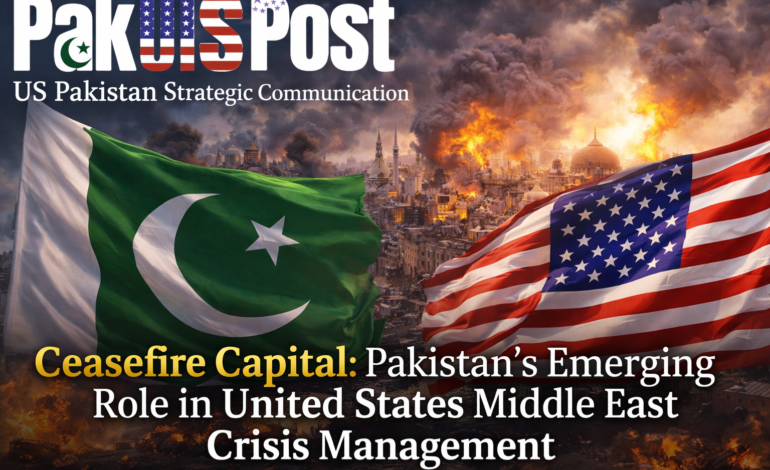
Ceasefire Capital: Pakistan’s Emerging Role in United States Middle East Crisis Management


The architecture of contemporary international relations is undergoing a subtle yet consequential transformation, wherein the rigid hierarchies of the past are being recalibrated by the functional necessity of mediation, access, and trust. In this evolving system, the ability to communicate across adversarial divides has become a strategic asset often more valuable than conventional military or economic strength. Pakistan’s recent diplomatic engagement in facilitating de-escalation between Washington and Tehran, under the leadership of Shehbaz Sharif, illustrates a nascent but significant shift in its geopolitical utility. It positions Pakistan not merely as a regional actor but as an intermediary with the capacity to influence crisis trajectories in one of the most volatile theaters of global politics.
The notion of Pakistan as a conduit between the United States and Iran is not entirely unprecedented, yet it has rarely been as consequential as it appears in the present moment. The structural antagonism between United States and Iran has long created a vacuum in diplomatic communication, often filled by European intermediaries or informal backchannels. However, shifting geopolitical realities, including the recalibration of American foreign policy priorities and Iran’s complex regional engagements, have created space for alternative actors to emerge. Pakistan, by virtue of its historical ties, geographic proximity, and multifaceted relationships, finds itself uniquely positioned to occupy this space.
This positioning is not accidental but the result of a gradual accumulation of strategic capital. Pakistan’s longstanding engagement with Washington, characterized by periods of cooperation and contention, has endowed it with a nuanced understanding of American strategic thinking. Simultaneously, its relationship with Tehran, shaped by shared borders, cultural linkages, and pragmatic cooperation, provides it with access that few American allies possess. The convergence of these relationships creates a rare diplomatic advantage, enabling Pakistan to function as a credible interlocutor.
From the perspective of American foreign policy, the utility of such an intermediary cannot be overstated. Direct engagement with Iran remains politically and strategically fraught for Washington, constrained by domestic considerations and regional alliances. In this context, the availability of a trusted channel that can convey intentions, clarify misunderstandings, and facilitate de escalation is invaluable. Pakistan’s role in this regard aligns with a broader trend in U.S. diplomacy, which increasingly relies on partners to manage complex regional dynamics.
However, the significance of Pakistan’s role extends beyond its immediate functional utility. It reflects a deeper shift toward a more networked model of global governance, where influence is distributed across a range of actors rather than concentrated in a few dominant powers. In such a system, middle powers that can navigate diverse relationships and act as bridges between conflicting parties acquire disproportionate importance. Pakistan’s engagement in the recent ceasefire scenario exemplifies this dynamic, suggesting that its strategic relevance is being redefined in real time.
Yet, the transition from situational relevance to sustained strategic role is fraught with challenges. One of the primary questions is whether Pakistan’s involvement represents a durable shift toward a trilateral engagement framework or merely a contingent alignment driven by specific circumstances. The answer depends on multiple variables, including the evolution of U.S. Iran relations, regional dynamics, and Pakistan’s own policy choices.
For Pakistan to consolidate its position, it must move beyond ad hoc interventions and develop a coherent framework for engagement. This involves institutionalizing diplomatic channels, enhancing analytical capabilities, and ensuring consistency in its messaging. The credibility of an intermediary is contingent upon its perceived neutrality and reliability. Any perception of bias or inconsistency can undermine its effectiveness and erode trust.
Moreover, Pakistan must carefully manage the delicate balance inherent in its relationships. Its engagement with the United States is multifaceted, encompassing security cooperation, economic ties, and political dialogue. At the same time, its relationship with Iran is shaped by regional considerations, including border security, energy cooperation, and cultural affinities. Navigating these relationships requires strategic finesse, ensuring that engagement with one does not alienate the other.
The broader regional context further complicates this equation. The Middle East is characterized by a complex web of alliances and rivalries, where actions are often interpreted through the lens of broader strategic competition. Pakistan’s involvement in U.S. Iran dynamics may be viewed with skepticism by other regional actors, particularly those with adversarial relationships with Tehran. Managing these perceptions is critical to maintaining the legitimacy of its role.
In this regard, transparency and communication are essential. Pakistan must articulate the principles guiding its engagement, emphasizing its commitment to stability, dialogue, and peaceful resolution. By framing its actions within a normative framework, it can mitigate concerns and enhance its credibility. Engagement with regional stakeholders, including key allies of the United States, can further reinforce this approach.
Another critical dimension is the integration of economic considerations into diplomatic strategy. The concept of ceasefire capital, as evidenced by the positive response of global markets to de-escalation, underscores the economic stakes of geopolitical stability. Pakistan can leverage its role in facilitating stability to attract investment, enhance trade relationships, and strengthen its economic position. This requires a deliberate effort to link diplomatic achievements with economic initiatives, creating a virtuous cycle of stability and growth.
The role of intellectual and analytical capacity in this process cannot be overlooked. Effective mediation requires a deep understanding of the interests, motivations, and constraints of all parties involved. Pakistan must invest in research institutions, policy analysis, and scenario planning to enhance the quality of its engagement. Collaboration with international think tanks and academic institutions can provide valuable insights and strengthen its diplomatic toolkit.
Furthermore, the domestic dimension plays a crucial role in sustaining external engagement. Political stability, institutional coherence, and policy continuity are essential for maintaining credibility. Frequent shifts in policy or internal discord can undermine confidence and limit the effectiveness of diplomatic initiatives. Therefore, Pakistan’s pivot toward a mediation role must be supported by efforts to strengthen governance and ensure consistency in its foreign policy.
The question of sustainability also extends to the broader international system. The emergence of middle powers as key intermediaries reflects a structural shift, but it is not without limitations. The capacity of such states to influence outcomes is often contingent upon the willingness of major powers to engage and the alignment of interests. Pakistan must therefore calibrate its ambitions, recognizing both the opportunities and constraints of its position.
In evaluating the potential for a trilateral engagement framework involving Pakistan, the United States, and Iran, it is important to consider the evolving nature of their relationships. While structural tensions between Washington and Tehran are unlikely to dissipate in the near term, there may be opportunities for limited engagement on specific issues. Pakistan can play a role in facilitating such engagement, provided it maintains credibility and neutrality.
However, the institutionalization of such a framework would require a level of trust and commitment that may not yet be present. It is more realistic to view Pakistan’s role as part of a flexible and adaptive network of intermediaries, rather than as a fixed component of a formal trilateral arrangement. This does not diminish its significance but rather reflects the fluid nature of contemporary diplomacy.
The strategic implications of Pakistan’s engagement are profound. By positioning itself as a facilitator of dialogue between adversarial powers, it enhances its relevance and expands its diplomatic horizons. This, in turn, can influence its relationships with other major actors, including China and regional organizations. The ability to contribute to global stability can serve as a foundation for broader engagement and cooperation.
In conclusion, Pakistan’s emerging role in United States Middle East crisis management represents both an opportunity and a challenge. It highlights the potential of middle power diplomacy in shaping outcomes in a complex and interconnected world. At the same time, it underscores the need for strategic clarity, institutional capacity, and careful management of relationships. The concept of ceasefire capital captures the tangible benefits of such engagement, linking geopolitical actions to economic outcomes.
For Pakistan, the path forward lies in consolidating this role, embedding it within a coherent strategic framework, and leveraging it to enhance its global standing. By doing so, it can transform episodic successes into a sustained trajectory, positioning itself as an indispensable actor in the management of international crises. The stakes are high, but so are the potential rewards, not only for Pakistan but for a global system in need of effective and credible intermediaries.
A Public Service Message


