Arabian Waters Define Pakistan’s Next Great Strategic Gamble

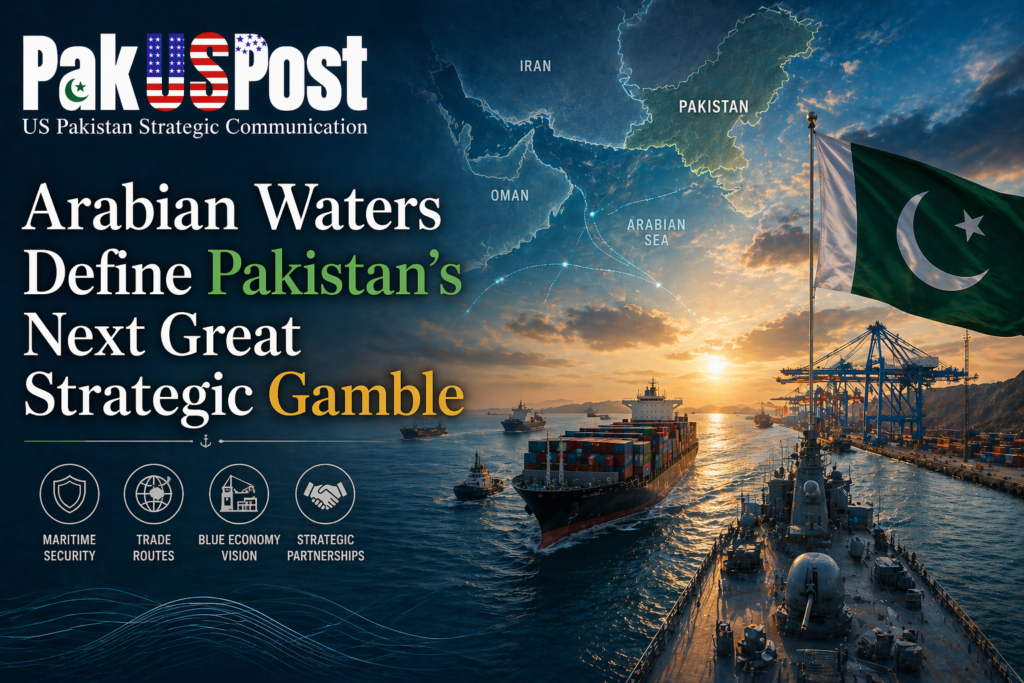
For much of Pakistan’s modern history, strategic thought has been dominated by land. Borders, mountain passes, river plains and conventional force balances shaped planning, budgets and political imagination. The sea existed largely as a supporting space, important for trade but secondary in doctrine. That hierarchy is now becoming obsolete. The northern Indian Ocean, stretching through the Arabian Sea and connected to the Gulf, East Africa and wider Indo Pacific routes, is emerging as one of the decisive theatres of twenty first century power politics. Energy shipments pass through it. Digital cables run beneath it. Naval patrols shadow one another across it. Ports compete for cargo and influence around it. Insurance premiums, shipping schedules and supply chains respond instantly to disruptions within it. For Pakistan, whose coastline opens directly onto these waters, the strategic question is no longer whether maritime affairs matter. It is whether the state can act quickly enough to benefit from their growing importance.
The Arabian Sea has become more contested because multiple transformations are occurring at once. First, Asia’s economic weight has expanded, increasing the volume and strategic value of sea borne commerce. Second, China’s rise has generated a demand for more secure maritime access to energy and trade routes. Third, India seeks blue water naval reach commensurate with its ambitions as a major power. Fourth, Gulf states are converting wealth into logistics influence through global port networks and shipping investments. Fifth, the United States remains committed to preserving freedom of navigation and strategic presence, even as it recalibrates burdens across regions. When several powers simultaneously view the same waters as essential, competition becomes structural rather than episodic.
Pakistan often discusses these developments defensively, through the language of encirclement or exclusion. Yet maritime change also creates openings. Geography has placed Pakistan near the Strait of Hormuz approaches, close to Gulf energy arteries and adjacent to routes linking the Middle East with South Asia. Karachi already serves as a commercial anchor. Gwadar offers a second node with different strategic possibilities. A state with two significant maritime gateways, proximity to energy lanes and relations with China, Gulf countries and the West possesses options many others would envy. The challenge lies in converting options into capability.
Gwadar occupies the centre of this debate, though often in distorted ways. It is alternately marketed as a future Dubai, dismissed as an underperforming symbol or securitised as a covert military outpost. Reality is more prosaic and more consequential. Ports succeed through throughput, governance, connectivity and trust. They fail through neglect, inefficiency and overstatement. Gwadar’s true significance is not that it can magically transform Pakistan overnight, nor that it must compete in zero sum fashion with every nearby port. Its importance lies in diversification. It gives Pakistan an additional deep water asset, a western coastal platform and a potential logistics option tied to broader regional networks.
That potential remains unrealised because infrastructure alone does not generate commerce. Ships require predictable turnaround times, customs systems, warehousing, hinterland roads, rail links, utilities and legal clarity. Investors need confidence that contracts will be honoured and policy will not reverse with each political cycle. Local populations need visible benefits, jobs and inclusion. Security personnel can protect a port, but they cannot create an economy around one. Pakistan’s central task is therefore institutional rather than symbolic. Gwadar must become a functioning commercial ecosystem before it can become strategic leverage.
India’s maritime rise sharpens the urgency. New Delhi has steadily expanded naval capacity, surveillance reach and strategic partnerships across the Indian Ocean. It participates in exercises with major powers, invests in island relationships and seeks stronger presence from the Arabian Sea to the Pacific. Its logic is straightforward. If India wants influence beyond South Asia, it must matter at sea. Pakistan need not mirror India ship for ship. Such competition would be costly and unnecessary. But Islamabad must recognise that maritime imbalance can create diplomatic and economic pressure even absent war. A state unable to secure trade lanes or monitor nearby waters becomes strategically reactive.
The answer lies in selective capability. Pakistan Navy doctrine should emphasise sea denial, coastal defence, anti submarine awareness, unmanned maritime systems and protection of merchant traffic. Smart sensors, integrated command networks and resilient maintenance often yield more value than prestige platforms. Partnerships with friendly navies for training and exercises can multiply competence. Maritime power today is as much about information and persistence as about hull numbers.
China’s presence complicates and benefits Pakistan simultaneously. Beijing seeks more reliable access across the Indian Ocean for commerce, energy and strategic flexibility. Pakistan offers geography, partnership and Gwadar’s location. Yet Chinese involvement also invites scrutiny from rivals who fear dual use infrastructure or future military access. Islamabad should manage this carefully. Sovereign transparency matters. Pakistan gains most when Chinese investment enhances commercial viability, industrial development and connectivity, not when narratives reduce its ports to chessboard squares in great power rivalry.
The Gulf dimension is equally important and often underappreciated. The United Arab Emirates, Saudi Arabia and Qatar increasingly view ports, logistics chains, food security corridors and industrial relocation as tools of national strategy. They invest globally in terminals, shipping assets and supply hubs. For Pakistan, Gulf partnerships can provide capital, cargo flows and commercial discipline. A Gwadar or Karachi linked to Gulf logistics ecosystems may prove more transformative than a purely geopolitical conception of port development. Money moves where efficiency lives.
The United States remains a maritime fact in the region regardless of shifting headlines. American naval capabilities, alliances and dollar based financial influence continue to shape shipping security, sanctions enforcement and crisis responses. Pakistan should therefore avoid framing maritime policy as anti American balancing. A more intelligent approach is plural alignment. Work with China commercially, with Gulf states financially, with Western partners on standards and with multiple navies on sea safety. Middle powers prosper when they diversify relationships.
The digital layer of maritime strategy is now impossible to ignore. Undersea cables carry data that underpins finance, communications and commerce. Ports rely on software systems vulnerable to cyber disruption. Satellite tracking shapes logistics efficiency. Insurance pricing depends on real time risk analysis. This means maritime security can be undermined without a single missile fired. Pakistan’s doctrine must integrate cyber resilience, data governance and digital infrastructure protection into naval planning. Ports that cannot secure data will struggle to secure cargo.
Climate risk also enters the equation. Rising sea levels, coastal erosion, extreme heat and storm volatility threaten infrastructure across the Arabian Sea littoral. Insurance costs may rise. Fisheries may shift. Urban coastal pressure may intensify. Pakistan’s maritime planning must therefore include resilience engineering, environmental monitoring and sustainable fisheries management. Strategic relevance in coming decades will belong partly to states that protect their coasts while using them productively.
Domestic politics remains the hidden variable. Investors and shipping firms are highly sensitive to governance noise. Regulatory confusion, tax unpredictability, bureaucratic delays and internal instability quietly redirect commerce elsewhere. Pakistan sometimes imagines strategic location can compensate for administrative disorder. Maritime trade punishes that illusion quickly. Cargo chooses reliability.
Media narratives within Pakistan often swing between hype and despair. One season Gwadar is portrayed as the gateway to a new century. The next it is labelled a failure because miracles did not arrive on schedule. Serious statecraft requires a steadier register. Ports are long term assets. Singapore, Dubai and Rotterdam were built through decades of institutional consistency, not television excitement. Public communication should focus on milestones, transparency and measurable progress rather than fantasy timelines.
For readers in the United States, Pakistan’s maritime future deserves more attention than its traditional security stereotypes. A stable and commercially integrated Pakistan can support diversified supply chains, energy transit resilience and regional balance. An underdeveloped maritime Pakistan leaves more space for insecurity, smuggling and zero sum rivalry. Supporting customs modernisation, climate resilient infrastructure and lawful commerce would advance broader interests more effectively than episodic crisis engagement.
What practical agenda should Islamabad adopt now. First, treat maritime policy as national economic strategy, not a niche naval file. Second, accelerate Gwadar’s utility through power reliability, municipal services and investor facilitation. Third, modernise Karachi simultaneously rather than presenting ports as rivals. Fourth, expand coast guard and maritime domain awareness against smuggling and sabotage. Fifth, invite multiple commercial partners so no single actor defines Pakistan’s maritime identity. Sixth, build coastal human capital through technical institutes, ship repair training and logistics education.
Pakistan should also think regionally. East Africa, Oman, the Gulf and Central Asia all connect naturally to an Arabian Sea strategy. Shipping routes can anchor export plans. Fisheries can support food industries. Repair yards can service regional fleets. Warehousing can support transshipment. Data cables can support digital trade. Maritime leverage is broader than naval presence.
The concept of leverage itself needs updating. In previous eras, leverage often meant threatening denial. Today it also means being too useful to ignore. A port that moves goods efficiently creates influence. A coastline hosting reliable energy storage creates influence. A navy trusted in rescue operations creates influence. A state facilitating cables, commerce and compliance creates influence. Pakistan should seek indispensability more than intimidation.
None of this denies hard security realities. Rivalries will persist. Crises may erupt in the Gulf or wider Indian Ocean. Sea lanes can be disrupted by war, piracy or coercion. Pakistan therefore needs credible defence capabilities. But defensive strength is maximised when embedded in prosperous systems. A struggling economy cannot sustain maritime ambition for long.
The Arabian Sea is no longer a peripheral space beside Pakistan. It is becoming a front door to the century’s major contests over trade, technology and power. Nations that understand this early will shape the rules. Those that delay will rent access from others.
Pakistan still possesses time, coastline and strategic relationships enough to matter greatly. Yet windows narrow when neighbours reform faster and shipping habits harden. The next great Pakistani strategic gamble is not whether to look seaward. It is whether the country can build the institutions that make the sea pay. If it can, Arabian waters may become the source of renewed relevance. If it cannot, geography will remain impressive but underused, and opportunity will sail elsewhere.
A Public Service Message